
Stop scrolling if you’re worried about being “stuck in limbo.”
In British Columbia, failing your competency assessment doesn’t just mean a “try again” sticker—it means your name stays off the BC Care Aide & Community Health Worker Registry, and your ability to earn a living in a health authority Care Centre is on ice. You’ve done the hard work; don’t let a confusingly worded exam keep you from your first shift.
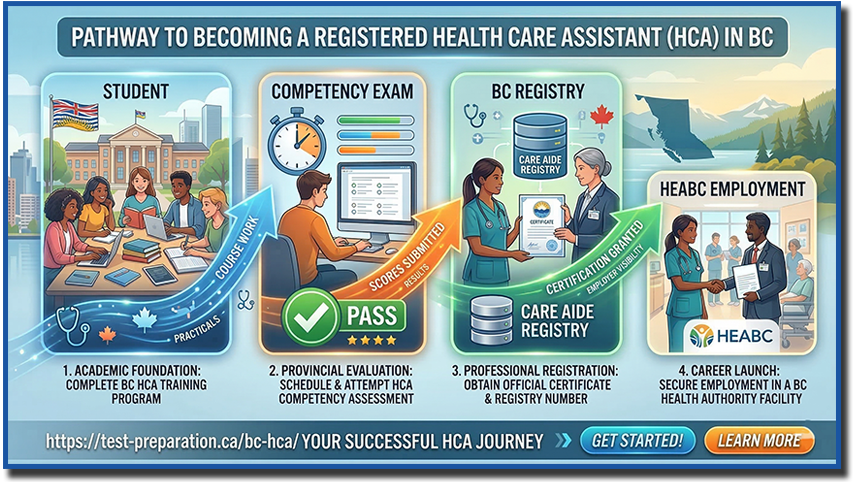
Getting your foot in the door as a care worker in British Columbia involves navigating a unique provincial framework. Whether you entered the field through HCAP employer sponsorship or completed your formal training independently, your journey ultimately leads to the provincial care registry. Passing the hurdle to get your name on that list isn’t just about memorizing textbook definitions—it requires understanding real-world clinical realities.
Whether you need a BC HCA Practice Test PDF or a full BC HCA Registry Exam Prep Course, we’ve stripped away the corporate jargon to give you exactly what you need to pass the first time. No mazes, no “Big Prep” fluff—just the straight path to your registration number.
Quick Facts: The BC Health Care Assistant (HCA) Registry Exam
What is it? The mandatory evaluation required to join the BC Care Aide & Community Health Worker Registry. The BC Health Care Assistant (HCA) registry exam evaluates a candidate’s readiness based on provincial standards, specifically testing knowledge of the Adult Guardianship Act, resident rights, and delegated nursing tasks.
Who must take it? Graduates of recognized BC post-secondary programs or international applicants undergoing competency assessment.
What does it cover? Core clinical skills, personal care, cognitive support, and provincial legal standards (e.g., Adult Guardianship Act, Patient’s Bill of Rights).
Primary Risk: Failing the registry assessment keeps your name off the active registry list, delaying employment in health authority care facilities.
The BC HCA Landscape: Key Organizations & Acts You Need to Know
If you’re studying for your registry exam or navigating your way through the system, you’re going to run into a handful of acronyms and provincial laws over and over. Here is the plain-English breakdown of who’s who and what matters:
- Health Career Access Program (HCAP): A paid pathway funded by the Ministry of Health (BC) that lets you get hired as an unregulated care worker while your employer pays for your HCA education.
- BC Care Providers Association (BCCPA): The leading voice for continuing care sector employers across the province, shaping how care standards are rolled out.
- HEABC (Health Employers Association of BC): Manages labor relations and bargaining for public health sector employers, influencing hiring guidelines and career mobility.
- Community Care and Assisted Living Act: The provincial legislation that sets out licensing, health, and safety standards for assisted living and residential care facilities in BC.
- Adult Guardianship Act: A critical piece of provincial legislation protecting vulnerable adults. Expect exam questions on your legal duty to report abuse, neglect, or self-neglect.
- Scope of Practice & Delegated Tasks: The legal boundaries of what an HCA can do independently versus tasks (like certain minor wound care or medication administration) that must be specifically delegated and supervised by a regulated nurse.
| If you want to get started right now...BC Care Aide registry exam practice questions PDF or online course | Direct Access |
|---|---|
|
PDF Download Guide Get the workbook in minutes. Perfect for printing at home. |
Download PDF |
|
Full Suite Online Course The complete BC HCA roadmap with interactive lessons. |
View Course |
Decoding the Jargon: What the Examiners Actually Mean
Explicit Definitions for Your Registry Exam
Examiners love using formal bureaucratic terms that can trip you up if you haven’t seen them in context. Here is what they actually mean for your daily work and your exam score:
- What is the BC Care Aide & Community Health Worker Registry?
- It is the central registry that tracks qualified Health Care Assistants in British Columbia. Passing your competency evaluation and getting your name on this registry is mandatory if you want to work in publicly funded health authority facilities.
- What are Delegated Tasks?
- Clinical procedures outside your normal routine HCA training that a regulated healthcare professional (like an RN or LPN) teaches, assesses, and formally delegates to you for a specific client.
- What is Competency-Based Assessment?
- The testing method used to prove you possess the practical, cognitive, and interpersonal skills required to safely practice under the BC provincial framework—the exact focus of our kitchen-table practice materials.
Navigating the BC HCA Competency Assessment and Mock Exams
Before facing the real evaluation, candidates often benefit from running through a timed mock exam to spot knowledge gaps. The provincial evaluation tests whether you truly understand your professional scope of practice—knowing exactly where your independent care duties end and where a nurse’s delegated tasks begin.
Avoiding Common Safety Traps on the Exam
Exam writers love to throw tricky scenarios your way that test your judgment under pressure. To protect your score and your future career, keep these core principles top of mind during your review:
- Resident Autonomy: When a care choice conflicts with facility convenience, provincial patient rights always prioritize the resident’s personal choice as long as they are capable and not an immediate danger to themselves or others.
- Clinical Placement Realities: Bridge the gap between textbook theory and what you actually experience on the floor during your clinical placement rotations.
- Legal Reporting Mandates: Never assume someone else will report suspected abuse or safety hazards; the legal duty to act falls squarely on the individual care provider.
Ready for the 2-Minute BC HCA Challenge?
Before you dive into the deep end of your studies, let’s see where you stand right now. This isn’t a “Big Prep” high-pressure exam; think of it more like a quick check-in over a cup of coffee.
How it works:
5 Questions: Carefully selected from the core BC Provincial Curriculum.
120 Seconds: That’s all it takes. No fluff, just the essentials.
The Goal: To help you spot the “blind spots” in your knowledge before they become hurdles on exam day.
Instructions:
Read each question carefully—in caregiving, the details matter.
Pick the best answer based on BC standards and safety protocols.
Check your score at the end to see which areas of the roadmap need a bit more attention.
Ready? Take a deep breath. Your timer starts now!
1. The “Section 7” Legal Check
Under the Adult Guardianship Act, if you suspect a resident is being financially abused by a family member but the resident is capable and asks you to stay out of it, what is your primary responsibility?
A) Call the police immediately.
B) Respect the resident’s wish as they are a capable adult.
C) Report the “Designated Agency” (Health Authority) for investigation.
2. The Patients’ Bill of Rights
A resident at a Nanaimo care home insists on wearing their favorite sweater, even though it is soiled and has a strong odour. According to the BC Patients’ Bill of Rights, you should:
A) Remove the sweater while they are sleeping for laundry.
B) Respect their choice but document the odour.
C) Insist they change it for the health and safety of the communal dining room.
3. The Violence Prevention Protocol
You are entering a room and a resident is pacing and muttering. According to the HEABC Provincial Violence Prevention curriculum, what is your first action?
A) Use a “Point of Care” Risk Assessment (PCRA).
B) Call for a Code White.
C) Approach the resident and ask them to sit down.
4. The Delegation of Task
A Registered Nurse asks you to perform a task that was not covered in your HCA training. Under BC Registry competencies, you can perform this task IF:
A) The RN stays in the room and watches you.
B) It is a “Delegated Task” with clear instructions and ongoing supervision.
C) The resident gives verbal consent.
5. The Registry Rule
How many hours of “eligible practice” must a BC HCA complete over a three-year period to maintain an active status on the BC Care Aide & Community Health Worker Registry?
A) 450 hours.
B) 600 hours.
C) There is no hour requirement, only annual fee payment.
1. Correct Answer: C.
The Trap: Most people pick B because they value "privacy." But in BC, the Adult Guardianship Act mandates reporting to a Designated Agency if there is a suspicion of abuse. You don't call the police (A) first, and you don't ignore it (B).
2. Correct Answer: B.
The Trap: "Big Prep" loves to pick C (Health and Safety). But BC law is very firm on the Right to Choice. As long as they aren't an immediate danger to themselves, they can wear that smelly sweater.
3. Correct Answer: A.
The Trap: Many students want to "help" (C) or "overreact" (B). BC protocol requires a PCRA before you even step into that resident's personal space.
4. Correct Answer: B.
The Trap: Having an RN watch you (A) isn't enough. It must be a formal Delegated Task following the specific health authority's policy.
5. Correct Answer: B.
The Trap: This is a pure "Registry Knowledge" question. If you chose A or C, you’re using outdated info or guessing. 600 hours is the magic number.
The “Anatomy of a Wrong Answer”
The Question: According to the BC Patients’ Bill of Rights, if a resident refuses a bath, the HCA should:
A) Document the refusal and report to the supervisor immediately.
B) Explain the health risks and proceed with the bath for the resident’s safety.
The Trap Answer: B. Why? “Big Prep” guides often focus on “safety first.” But in BC, Informed Consent and the Community Care and Assisted Living Act prioritize the resident’s right to refuse.
If you choose B, you’ve just failed a core competency on resident autonomy. Our prep teaches you to spot “Safety Traps” that violate BC law.
Test Prep vs. Real Job Prep: Why Real-World Scenarios Matter
Big test prep companies give you generic, memorization-style questions that teach you how to pass a test but leave you flat-footed on day one of your shift. At Complete Test Preparation, our materials combine rigorous exam prep with practical workplace judgment so you are ready for both the registry and the resident’s room. Unlike generic national nursing aids tests, the BC registry framework requires precise adherence to provincial health authority policies, making localized practice materials essential for first-time passes.
Generic Test Prep
Focuses only on rote memorization without clinical context.
Sample Question: What is the normal fasting blood glucose range for an adult?
- A) 2.0 to 4.0 mmol/L
- B) 4.0 to 6.0 mmol/L
- C) 7.0 to 10.0 mmol/L
- D) 11.0 to 14.0 mmol/L
Result: You memorize a number, but you don’t know what to do when your patient’s hands start shaking.
Complete Test Preparation (Kitchen-Table Style)
Integrates clinical realities, safety protocols, and multi-condition care.
Sample Scenario: John is 78, has dementia, stroke weakness, and diabetes. You are preparing to shave him. What is your first action?
- A) Place a warm damp towel around his face
- B) Check the chart for safety and razor type
- C) Gather your towels and shaving cream
- D) Make certain John has privacy
Result: Correct Answer is (B). Because John is on diabetes management, checking for anticoagulant therapy or skin integrity via the chart prevents a dangerous bleeding mishap.
Don’t just pass the exam—build the critical thinking skills required to protect your patients and excel in your career.
Choose Your Training Ground
From our Victoria kitchen table to your study space.
PDF Download Version
Perfect for the student who needed to start studying ten minutes ago.
- ✔Instant Gratification: No waiting for the mailman. Buy, download, and practice in seconds.
- ✔Searchable & Portable: Use Ctrl+F to find formulas or rules instantly on your phone or laptop.
- ✔Print What You Need: Save ink by printing only the sections that trip you up.
- ✔Budget-Friendly: We pass the savings on printing and shipping directly to you.
Complete Online Course
Our most comprehensive tool—like having a teacher at your kitchen table.
- ★The AI Tutor: A helping hand that nudges you in the right direction without giving away answers.
- ★Realistic Simulation: “Timed Test” mode mimics the pressure of the big day so you don’t freeze up.
- ★Dynamic Tracking: Tells you exactly where you’re “green” (ready) or “red” (needs work).
- ★Study Anywhere: As long as there’s Wi-Fi, your classroom is open 24/7.
BC HCA Exam FAQs: Key Legal Scenarios & Registry Rules
Q: Under the Adult Guardianship Act, if you suspect a resident is being financially abused by a family member but the resident is capable and asks you to stay out of it, what is your primary responsibility?
Answer: Report to the “Designated Agency” (Health Authority) for investigation. The Adult Guardianship Act mandates reporting to a Designated Agency if there is a suspicion of abuse.
Q: A resident at a Nanaimo care home insists on wearing their favorite sweater, even though it is soiled and has a strong odour. According to the BC Patients’ Bill of Rights, what should you do?
Answer: Respect their choice but document the odour. BC law is very firm on the Right to Choice as long as they aren’t an immediate danger to themselves.
Q: You are entering a room and a resident is pacing and muttering. According to the HEABC Provincial Violence Prevention curriculum, what is your first action?
Answer: Use a “Point of Care” Risk Assessment (PCRA). BC protocol requires a PCRA before you even step into that resident’s personal space.
Q: A Registered Nurse asks you to perform a task that was not covered in your HCA training. Under BC Registry competencies, you can perform this task IF:
Answer: It is a “Delegated Task” with clear instructions and ongoing supervision. It must be a formal Delegated Task following the specific health authority’s policy.
Q: What is the Health Career Access Program (HCAP) in BC?
Answer: The Health Career Access Program (HCAP) is a provincially funded initiative by the Ministry of Health (BC) that provides paid employment and education pathways for individuals wanting to become Health Care Assistants in British Columbia.
Q: What laws govern BC Health Care Assistants?
Answer: HCAs in British Columbia must practice within the guidelines of provincial legislation, notably the Community Care and Assisted Living Act and the Adult Guardianship Act, which dictate safety standards and the legal duty to report abuse.
Q: How hard is the BC HCA competency test?
Answer: The exam can be challenging because it tests much more than basic caregiving—it requires a firm grasp of provincial legislation, safety protocols, and the HCA Jurisprudence exam BC standards. Candidates who rely only on general nursing guides often stumble on localized legal scenarios like elder rights and reporting mandates.
Q: How do I prepare for the BC Care Aide Registry exam?
Answer: Preparation involves reviewing core clinical skills, provincial legal frameworks, and practicing with localized exam questions designed specifically for BC competencies, provided by independent publishers like Complete Test Preparation Inc.
Published by, Complete Test Preparation Inc.
Updated: Monday, September 7th, 2026
Published: Monday, March 9th, 2026
Our Independent Publishing Standards
Every practice question, diagnostic drill, and study guide on this page is researched and rigorously checked against official provincial standards. Since 2005, we have combined extensive research into exam patterns with real-world classroom insights to provide practical academic readiness with test prep. Rather than serving up generic multiple-choice drills, our materials focus directly on the actual core skills required by the BC Ministry of Health and the BC Care Aide & Community Health Worker Registry—designed specifically for the Canadian educational market to get everyday folks into rewarding careers without the corporate runaround.
Written by, Brian Stocker MA.,
Credentials: Master of Arts (M.A.), expert in Canadian educational publishing, test-taking strategy, and adult academic upgrading since 2005.
Since 2005, we’ve sat at the kitchen table helping Canadian learners. As independent publishers, our practice materials are shaped by years of real-world classroom experience and extensive research into the exact pain points where students stumble—and how to fix them. All practice modules on this site are built directly around official regulatory frameworks, including the BC Care Aide & Community Health Worker Registry competencies and provincial health authority guidelines. We transparently test our materials to ensure they mirror the standard pass mark and question difficulty of the official provincial standards, where candidates must master core competencies in resident rights, safety protocols, and professional practice. We are fiercely committed to giving everyday folks the straight goods they need to step into rewarding careers without the corporate runaround.
Authoritative References & Regulatory Links:
BC Care Aide & Community Health Worker Registry
• Adult Guardianship Act [RSBC 1996] Chapter 6, Province of British Columbia
• HEABC Provincial Violence Prevention Curriculum Standards for British Columbia Health Care Assistants