




Back

Stop Guessing: Master Logic Questions for Your RCMP, CFAT, GAT, or CBSA Exam

If you’re staring at a screen trying to make sense of abstract patterns, you aren’t alone. Most candidates fail the logic section not because they lack intelligence, but because they’re trying to use “common sense” in a test built on strict, objective deduction. At Complete Test Preparation Inc., we’ve spent years in the classroom helping students break through this “IQ Trap.”

We don’t believe in gatekeeping success behind expensive, corporate-style courses. Whether you’re looking for a CFAT logic questions download or a CBSA entrance exam study guide PDF, we provide the tools to help you stop the panic. Our Study Hall AI Tutor is designed to act as your 24/7 partner, helping you master the “Language of Logic” so you can pass the first time—and skip the agonizing year-long wait that comes with a failed attempt.

3-Minute Power Drill

1. Verbal (RCMP)
All recruits must pass the fitness test. Brian is a recruit. Therefore:

A) Brian has passed the fitness test.
B) Brian must pass the fitness test.
C) Brian is a police officer.
D) Brian failed the fitness test.

2. Spatial (CFAT)
Which 3D shape is created by folding a flat cross-shaped net with a square in the centre and four squares attached to each side?

A) Pyramid.
B) Cube.
C) Prism.
D) Cylinder.

3. Abstract (GAT)
Look at this sequence: Circle, Square, Triangle, Circle, Square, ____. What is next?

A) Square.
B) Circle.
C) Triangle.
D) Rectangle.”

4. Word Problem (CBSA)
A courier must process 40 packages per hour. If they have processed 25 packages in 30 minutes, how many more must they process to meet the quota?

A) 10.
B) 15.
C) 20.
D) 25.

5. Analogy (CFAT)
Engine : Fuel :: Battery : ____

A) Electricity.
B) Wire.
C) Power.
D) Car.

Logical reasoning questions are designed to assess your ability to analyze, evaluate, and draw conclusions based on given information. There are many types of questions, each focusing on different aspects of critical thinking. Here are some common types of logical reasoning questions:

Verbal Reasoning      Problem Solving or Word Problems   Folding    Analogies

Image Analogies (Matching)   Analytical Reasoning  Verbal Classification

Sentence Logic    Abstract reasoning and Pattern Recognition


Verbal Reasoning

Verbal reasoning questions test your ability to understand and analyze written information.

Example :

Tom and Tim are brothers. They look exactly the same. They also have the same birthdays.

a. Tom is older than Tim
b. Tim is more handsome than Tom
c. Tom and Tim are twins
d. Tom and Tim are best friends

1. C
The only certain thing is they are twins.

Verbal Reasoning Practice

Tests with Verbal Reasoning Questions

Deputy Sheriff  Corrections Canada BC Police  RCMP

Abstract Reasoning & Pattern Recognition Questions

Abstract reasoning and Pattern Recognition

Abstract reasoning and Pattern Recognition questions test your ability to identify patterns and relationships. Abstract reasoning and pattern recognition are cognitive skills that enable you to identify relationships, make connections, and solve problems that involve complex or abstract information. These skills are crucial for tasks that require higher-order thinking and adaptability to novel situations.

Abstract Reasoning and Pattern Recognition Practice

Tests with Abstract Reasoning and Pattern Recognition 

RCMP   TACHS

Problem Solving Questions

Problem solving or word problems.

Word problems give background information, in plain English, on a real-world problem, with one or more variables missing.   You are required to translate into mathematical notation and solve for the missing information.

Problem-solving is the process of identifying, analyzing, and resolving problems in a systematic and logical manner. Word problems, are mathematical problems that in everyday language and use real-world scenarios. Some information is given, and one or more pieces of information, or variables, are missing.  You must understand the given information, and the relationship to the missing variables, identify the mathematical operations necessary to solve the problem, and then carry out those operations to arrive at the correct answer.

Example:

1. Employees of a discount appliance store receive an additional 20% off the lowest price on any item. If an employee purchases a dishwasher during a 15% off sale, how much will he pay if the dishwasher originally cost $450?

a. $280.90
b. $287.00
c. $292.50
d. $306.00

1. D
The cost of the dishwasher = $450
15% discount amount = 450•15/100 = $67.5
The discounted price = 450 – 67.5 = $382.5
20% additional discount amount on lowest price = 382.5•20/100 = $76.5
So, the final discounted price = 382.5 – 76.5 = $306.0049

Problem Solving Practice

How to Solve Word Problems

Types of Word Problems

Most Common Word Problem Mistakes on a Test

Spatial Reasoning Visual Acuity Questions

Spatial reasoning questions

test your ability to visualize and manipulate objects in two or three dimensions.  These questions require you to mentally visualize objects and their relationships in space, as well as to understand how they move and interact with each other.

Visual acuity is the accurately perception of different visual elements, such as shapes, colors, and patterns.

Example question:

1.  When put together, what 3-dimensional shape will you get?
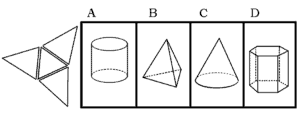
1. B

Spatial Ability Practice

Spatial Relations Practice (BOOK)

Spatial Relations II – Folding

Folding

Spatial Relations II – Folding questions are a type of visual-spatial reasoning question used in cognitive and intelligence tests, and pre-employment test such as the Canada Post GAT, CFAT, CBSA and the CCAT tests. These questions require individuals to mentally manipulate a two-dimensional object by folding it along specified lines to create a three-dimensional object, and then to identify the resulting object or how it would appear if unfolded.

Folding Example:

When the two longest sides touch what will the shape be?
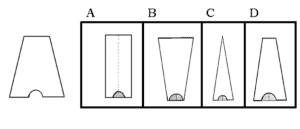
1. D

Folding Practice and Tutorial

Spatial Relations Practice (Book)

Analogies

Analogies

Analogies on a standardized test, such as IQ tests or aptitude tests, assess a test-taker’s verbal reasoning ability. An analogy question consists of two pairs of related words. The test-taker is then asked to identify a third pair of words that has the same or a similar relationship.

Example:

1.  Nest : Bird 

a. Cave : bear
b. flower : petal
c. window : house
d. dog : basket

1. A

This is a Functional relationship.   A Bird lives in a nest, the way way a bear lives in a cave.

Analogy Practice Questions

Analogy Tutorial

Analogy Quiz

Analogies – I Images

Matching

An analogy is a comparison between 2 things.   You are presented with an object and asked to choose an object that is similar or is not similar.  Also called Matching.

Example:

In the following questions, select the choice that does not belong with the other three.

1.
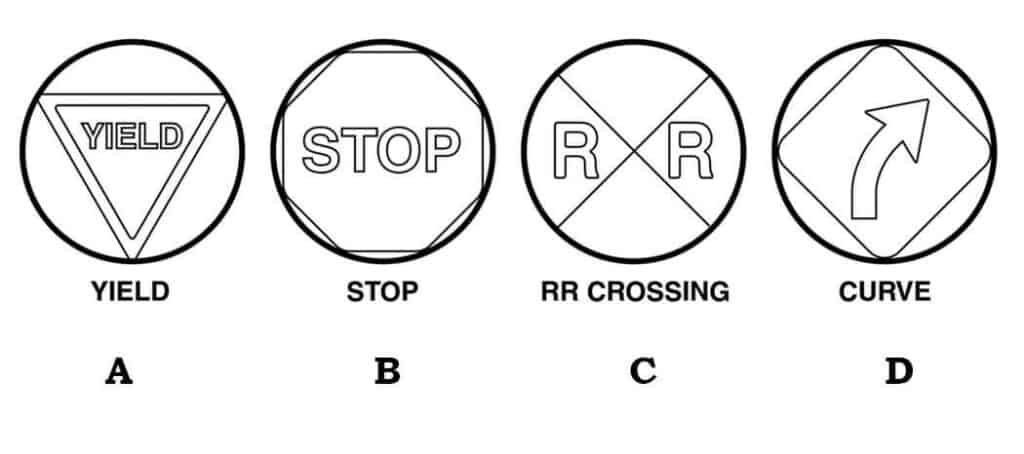
1. C
All signs are directional road signs except choice C.


Image Analogy (Matching) Practice

Analytical Reasoning

Analytical Reasoning

Analytical reasoning questions are included in standardized tests, such as IQ, aptitude, and entrance exams for graduate or professional programs. Analytical reasoning questions test a person’s ability to think logically and analyze complex information.

Analytical reasoning questions typically present a scenario, such as a a group of facts and rules, a diagram, chart, or passage of text. The test-taker is asked to use this information to answer a series of questions that requires drawing logical conclusions, or deductions.  The test-taker must determine, give a set of facts and rules what could or must be true.

Example:

1. Use your knowledge of the real relations between the existing nouns to determine the best response.

A CRUX resembles LILO but is closer to the Sun

A TIGO resembles Jupiter but is farther from the Sun

A LILO resembles Earth but is closer to the Sun

Which of the following is the best response?

a. LILO is farther from the Sun than Jupiter

b. CRUX is closer to the Sun than Jupiter

c. Jupiter is closer to the Sun than LILO

d. LILO is farther from the Sun than TIGO

1. B
Based on the relations outlined in the first & third statements, we know that a CRUX is closer to the Sun than a LILO, which is closer than Earth. We also know that Earth is closer than Jupiter from the knowledge we have of these existing nouns, and, from the second statement, we know that Jupiter is closer than a TIGO. From closest to farthest, the order of the words is: CRUX, LILO, Earth, Jupiter, TIGO. Therefore, t choice 2 is the correct answer.

[CRUX<LILO<Earth<Jupiter<TIGO in terms of distance from the Sun] 

Analytical Reasoning Practice

Verbal Classification

Verbal classification

Verbal classification are common on IQ or aptitude tests, that assess a person’s ability to identify relationships between words and concepts.

The test-taker is given a list of words and asked to identify the word does not belong, based on the relationships or patterns of the given words.

Example:

1. Which word does not belong?

a. Jet
b. Float plane
c. Kite
d. Biplane

1. C
A kite is not a type of plane.

Verbal Classification Practice

Sentence Logic

Sentence logic

Sentence logic questions are found in standardized tests, such as aptitude or entrance tests for graduate or professional programs, that assess a person’s ability to understand and apply logical reasoning.

The test-taker is presented with a set of sentences or paragraphs in the form of syllogisms:  2 sentences, or premises are given, and students are asked if the third sentence is true or false.

1. The Silver fish can swim faster than the black fish. The gold fish can swim faster than the black fish. The gold fish can swim faster than the silver fish. If the first 2 statements are true, then the third statement is:

True False Uncertain

1. Uncertain

We don’t have enough information here to make a decision. Perhaps the gold fish can swim faster than the black fish AND the silver fish – we don’t know.

Sentence Logic Practice

Logic Tutorial

{ "@context": "https://schema.org", "@type": "Course", "name": "Canadian Public Service Logic Prep", "description": "Master logic questions for RCMP, CFAT, GAT, and CBSA exams with interactive drills.", "provider": { "@type": "Organization", "name": "Complete Test Preparation Inc.", "url": "https://www.test-preparation.ca", "logo": "https://test-preparation.ca/images/LogoL2.jpg" }, "offers": { "@type": "Offer", "price": "29.99", "priceCurrency": "CAD" }, "instructor": { "@type": "Person", "name": "Brian Stocker" }, "about": [ {"@type": "Thing", "name": "Logical Reasoning", "sameAs": "https://en.wikipedia.org/wiki/Logical_reasoning"}, {"@type": "Thing", "name": "Treasury Board of Canada", "sameAs": "https://www.canada.ca/en/treasury-board-secretariat.html"} ] }

Written by,

Updated: Thursday, July 16th, 2026
Published: Tuesday, March 5th, 2019