Waiting for high school admissions results can feel like pressing pause on your teenager’s future. When a student walks into the TACHS test cold—unprepared for the weird logic puzzles in the Ability section or fumbling with digital screens—they risk missing out on their local Catholic high school of choice. That means watching classmates secure their placements while your family is left stressed out by what-ifs.
Here at Complete Test Preparation Inc., we do things differently. We write right from the kitchen table, and we know that corporate, massive-box test publishers treat students like numbers on a spreadsheet. We don’t do that. Whether you are looking for a TACHS practice test PDF download or paperback study guide, we are here to clear away the bureaucratic fog of the Archdiocese and give you straightforward, honest preparation that actually makes sense.
If you are searching for a TACHS practice test PDF download or need New York Catholic high school entrance exam questions that reflect what is actually on the test, you are in the right place. Our materials are built specifically to get you ready without the corporate fluff.
The “Day in the Life” Application Roadmap
Navigating the New York Catholic high school admissions process can feel like wandering through a maze of registration windows, score percentiles, and unfamiliar testing software without a map. Here is how the journey usually unfolds for families:
- The Fall Rush (October): Students juggle regular middle school coursework while trying to prep for exams, often spending all their energy on SHSAT prep and completely forgetting that the TACHS is right around the corner.
- Registration & Proctoring Setup: Families navigate online forms or mail-in packets to the TACHS Examination Office, followed by setting up at-home testing environments with unfamiliar proctoring software.
- Test Day (November): Students sit down in front of a computer screen, facing extended digital reading passages and tricky spatial reasoning questions without physical page-flipping to help them navigate.
- The Waiting Game: Scores are sent directly to the student’s chosen Catholic high schools, leading to weeks of anxious waiting for admissions decisions.
We have already laid out the tracks so you do not have to guess what the diocese is looking for.
About the TACHS
The 2-Minute TACHS Ability Challenge
Welcome to the Kitchen-Table Speed Drill
If there is one part of the Catholic high school admissions exam that catches smart students completely off guard, it is the Ability Section. Almost every eighth grader walks into this test having spent weeks drilling regular math and reading, only to get ambushed by figure matrices, paper folding, and spatial reasoning puzzles—topics no teacher has ever assigned for homework.
Big-box test prep companies want you to think spatial reasoning is a mysterious, fixed talent you are either born with or not. We know better around here. Spatial reasoning is a trainable muscle.
The catch? On test day, you only have about 35 seconds per question.
This 2-minute challenge is built to help you practice under pressure, spot the traps, and train your brain to break down visual patterns without panicking. Grab a scrap piece of paper, set a timer for two minutes, and let’s see how you do.
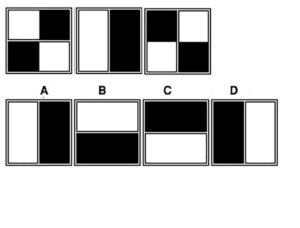
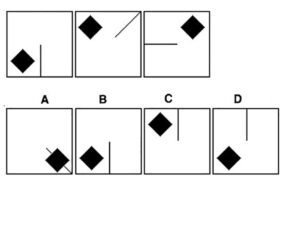
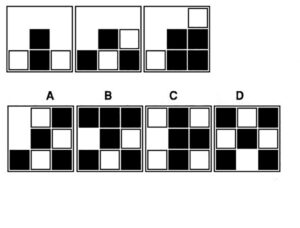
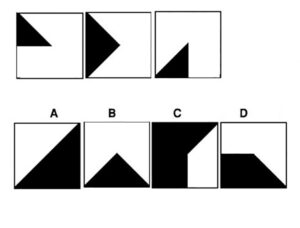
1. B
Each figure is created by adding the mirror image of the previous figure.
2. B
Each square has 2 blank squares.
3. A
The inner square is rotated clockwise on the corner of the outside square.
4. C
The bottom box is rotated counter-clockwise.
PDF Download
Amazon Paperback
Exam Content
Reading (vocabulary and reading comprehension)
- Vocabulary: (20 questions, 10 minutes) students’ knowledge on definitions are tested by the TACHS
- Reading Comprehension: (30 questions, 25 questions) Demonstration of a student’s ability to analyze text by identifying details and coming up with inferences.
Language (four short tests on capitalization, spelling, usage and punctuation and expression)
- Spelling, Punctuation, Capitalization: Students must answer questions about sentences and paragraphs to show their grammar knowledge
- Paragraphs: (10 questions, 7 minutes) Organization and clarity of paragraphs.
Mathematics Includes number sense, algebra, operations, data analysis and measurement two sections estimation, concepts and problem solving data interpretation
-
- Concepts, Data Interpretation, Problem Solving. Tables, analyses of graphs, basic operations and world problems (32 questions, 33minutes)
- Estimation: Estimate answers (18 questions, 7 minutes)
Abilities
- Changes and similarities: where by students ability to analyze sequence and patterns.(40 questions, 25 minutes)
- Abstract Reasoning: Predictions and inferences are made by the students about patterns.
Gaps in Understanding & Preparation
Gap 1: Neglecting the Ability Section
Reality Check: Students focus exclusively on Reading, Math, and Writing, but completely neglect the Ability section, which comprises 25% of the test and is scored separately by Catholic high schools.
Expert Quote: “Students who prepare only academic content, without strengthening analytical thinking, often struggle.”
Expert Quote: “Students who spend October entirely on SHSAT prep arrive at the November TACHS having done zero Ability practice.”
Gap 2: Digital Format & Screen Stamina Unfamiliarity
Reality Check: Students are completely unprepared for the physical and mental strain of reading extended passages on a screen without physical page flipping.
Expert Quote: “Screen stamina is a real factor. Students who are not accustomed to sustained on-screen reading may experience fatigue more quickly. Practicing in a digital format that mirrors the actual TACHS experience helps reduce anxiety and improve performance on test day.”
Gap 3: At-Home Proctoring and Environment Stress
Reality Check: Families are left wondering how to handle webcam requirements, room scans, and home distractions without institutional support.
Expert Quote: “Because the TACHS is administered digitally and taken at home, preparation must go beyond academic content. Students should be comfortable with reading extended passages on a screen, managing time without physical page flipping, navigating between questions within a section, and maintaining focus in a home environment.”
Recommended Tips From Other Students
Spatial Reasoning is Trainable: Students often think spatial puzzles are an innate talent, but research and peer advice prove otherwise. As experts note, “Spatial reasoning and pattern recognition are trainable skills, not fixed talents. Research in cognitive psychology shows that repeated exposure to visual-spatial problem sets produces measurable gains, often within 4 to 8 weeks of deliberate practice.”
Grammar and Mechanics Matter More Than You Think: Public school curricula do not always emphasize old-school grammar rules, which hurts students on test day. As one advisor puts it, “By studying capitalization rules, punctuation placement, and verb conjugation, you’ll be able to answer over half of the questions correctly. Since these topics aren’t always covered in public middle schools, we’d recommend that students use outside review sources.”
Start Early Instead of Cramming: Last-minute cramming leads to burnout. As educators recommend, “Structured instruction, targeted review, and consistent timed practice produce stronger results than last-minute cramming.”
TACHS FAQ
Complete Study Guide and Practice Tests
TACHS Practice Hub
Written by, Brian Stocker MA.,
Published by: Complete Test Preparation Inc.
Updated: Wednesday, August 26th, 2026
Published: Monday, June 2nd, 2014
4 Comments
Thank you – I think I am ready for my test and get a great grade for my catholic high school test
Thank you i think i can get a better grade on my TACHS Test 🙂
Of coarse amanda. Anytime to help
i links I’m going to do better on my test then I thought……………………………I lied