Let’s skip the corporate sales pitch and talk about the real elephant in the room: The Lockout Window.
If you are looking at stepping into a law enforcement career across the border, you have likely discovered that the US county civil service system is wrapped in a massive layer of red tape. If you walk into that county testing centre unprepared and miss the passing mark by a single point, you don’t just get to turn around and rewrite it next week.
Most jurisdictions hit you with a rigid 3 to 6-month mandatory lockout period before you can even look at a testing terminal again. That is half a year of your career completely stalled, zero progress on your application, and thousands of dollars in lost senior wages and medical benefits left sitting on the table.
Here at Complete Test Preparation Inc., we have spent years deconstructing the exact exam frameworks used across the United States. We don’t believe in drowning you in thick academic textbooks or useless legal memorization. Our goal is simple: giving you a streamlined, practical workspace so you can walk in, clear the cognitive barriers on your very first try, and advance straight to the physical agility assessments.
Whether you are looking to secure a comprehensive POST Deputy Sheriff exam study guide online, trying to find an authentic Sheriff trainee entry level test practice portal, or looking for a downloadable US Deputy Sheriff practice test PDF to print out at your own kitchen table, we have carved out the exact tools you need. No corporate fluff—just real, tested mechanics designed to make your first attempt your only attempt.

Test Your Instincts: The 2-Minute County Sheriff Written Exam Challenge
Can You Pass the Initial Cognitive Gate Under Pressure?
Most applicants fail the written exam because they run out of time or second-guess their logic. When you are out in the field, you don’t have twenty minutes to deliberate—you have seconds to analyze a scene, interpret data, and make a legally sound decision.
This micro-challenge drops you directly into the hot seat. It features three core question types taken straight from regional POST and multi-jurisdictional testing agency frameworks.
The Rules of the Road:
- The Time Limit: You have exactly 120 seconds (2 minutes) to complete all three questions.
- No Tools: Put away the calculator, the scratch paper, and your smartphone. A deputy relies on mental agility.
- The Goal: Score a perfect 3/3. If you miss even one, you risk falling into that agonizing 3-to-6-month bureaucratic lockout window in a real testing environment.
Ready? Start your timer now.
The Challenge Questions
Question 1: Law Enforcement Spatial Orientation (The Patrol Grid)
Deputy Martinez is traveling East on Route 9. She receives an urgent dispatch to assist a secondary unit at an intersection located two blocks North and three blocks West of her current position. The local grid system consists of perfectly perpendicular streets.
To reach the scene using the most direct route, Deputy Martinez should execute which immediate tactical turn at the next intersection?
A) Turn Left (North)
B) Turn Right (South)
C) Continue straight (East)
D) Execute a U-turn (West)
Question 2: Accurate Data Interpretation for Incident Reports
A regional sheriff’s department mandates that a standard patrol sector must maintain an average response time of under 7 minutes for Priority 1 emergency calls. Review the shift log data for Sector Charlie below:
Shift A: 6 calls with an average response time of 6 minutes.
Shift B: 4 calls with an average response time of 9 minutes.
What is the combined average response time for all Priority 1 calls during these two shifts, and did Sector Charlie meet the departmental mandate?
A) 7.5 minutes; Mandate failed.
B) 7.2 minutes; Mandate failed.
C) 6.8 minutes; Mandate met.
D) 7.0 minutes; Mandate met.
Question 3: Observation and Clear Written Composition
Review the draft narrative sentence written by a trainee deputy for a formal county incident report:
“Upon arriving at the commercial property, the rear warehouse door was observed open by the complainant, who stated they seen a suspicious panel van leaving the area shortly before our arrival.”
Identify the primary structural or grammatical flaw in this report narrative that would be flagged during a supervisor’s review.
A) The sentence uses a dangling modifier, incorrectly implying the warehouse door was observing the complainant.
B) The sentence contains a fatal spelling error regarding regional architectural terms.
C) The phrase “shortly before” is a legal violation of strict chronological reporting statutes.
D) There are no errors; the sentence is structurally sound for a civil service record.
Stop your timer. Let’s see if you are ready for the academy or if you just tripped a hidden testing hurdle.
1. A Turn Left (North)
The Straight-Talk Logic: Don't let map reading questions twist your brain under pressure. Martinez is driving East. The target location is North and West of her. To start making her way toward that grid coordinate using the most direct path, her immediate physical turn must be to the left, which points her patrol vehicle directly North. Turning right sends her South—the exact opposite direction.
2. B 7.2 minutes; Mandate failed.
The Straight-Talk Logic: "Big Prep" corporate guides will tell you to just average 6 and 9 to get 7.5. That is a trap. This requires a weighted average because the number of calls on each shift is different.
Shift A total minutes: 6 calls × 6 minutes = 36 minutes .
Shift B total minutes: 4 calls×9 minutes = 36 minutes.
Combined total minutes: 36 + 36 = 72 minutes.
Combined total calls: 6 + 4 = 10 calls.
Actual Average: 72 minutes/ 10 calls = 7.2 minutes.
Since 7.2 is greater than the 7-minute ceiling, the sector failed the mandate.
3. A The sentence uses a dangling modifier.
The Straight-Talk Logic: Look closely at the phrasing: "the rear warehouse door was observed open by the complainant." Because of how the sentence is put together, it mechanically reads as though the door did the observing. Furthermore, the use of "seen" instead of "had seen" or "saw" violates standard grammatical clarity rules used to grade written communication modules like the PELLETB.
How Did You Do?
3/3 Correct: Excellent spatial awareness and data filtering. You have a solid cognitive baseline, but don’t get comfortable—the real exam throws 100+ of these at you consecutively under a brutal countdown.
2/3 or Less: You just got caught by the distractor options. In a real testing room, this is exactly how candidates land themselves in a mandatory 6-month lockout window.
Want to eliminate the guesswork? Our full US Deputy Sheriff Online Practice Course features over 250 highly targeted questions, step-by-step video breakdowns, and our exclusive Study Hall AI Tutor to coach you through your weak areas right from your kitchen table.
Bypass the 6-Month Lockout Window – Secure the Full Online Prep Course Now
Beyond the Myths: Breaking Down the National Criminal Justice Officer Selection Test Format
Every year, I see eager applicants make the exact same mistake. They sit down at their kitchen table with a stack of cue cards, trying to memorize hundreds of pages of state penal codes, vehicle equipment regulations, and local municipal statutes. They assume that because they are applying to a county sheriff’s department, the written exam will test them like a seasoned criminal lawyer.
Let me save you dozens of hours of wasted effort: The National Criminal Justice Officer Selection Test (NCJOST) format does not care if you know the exact statutory sub-section for grand theft.
Why Memorizing the Penal Code is a Strategic Mistake
The test writers at the civil service level know you haven’t been to the training academy yet. They don’t expect you to know the law; they want to know if you have the raw cognitive processing power to learn and apply the law safely once you wear the badge.
When you waste your energy trying to become a legal scholar before the exam, you fall straight into a few dangerous traps:
- You study for the wrong skill: The NCJOST format focuses heavily on foundational cognitive skills like inductive reasoning, situational judgment, and spatial orientation. Memorizing definitions won’t help you calculate a weighted average response time or navigate a patrol grid under a strict countdown timer.
- The “Overthinking” Trap: If you fill your head with complex legal nuances, you will start second-guessing the plain-English facts provided in the exam scenarios. You’ll find yourself looking at a simple reading comprehension question and thinking, “Well, in a certain state court jurisdiction, this could be argued as a different class of misdemeanor.” Meanwhile, the test writer just wanted you to identify a basic physical fact explicitly stated in the paragraph.
- Wasted Mental Energy: The countdown clock is your absolute biggest enemy in that county testing centre. You need sharp, rapid-fire mental reflexes to spot the deliberate “distractor” answers. Drowning your brain in dense legal jargon leaves you mentally exhausted before you even clear the first twenty questions.
Our philosophy at Complete Test Preparation Inc. is all about stripping away that academic fluff. We design our practice tools to mirror the actual cognitive assessment matrices—teaching you how to extract accurate details for incident reports and solve spatial logic puzzles without getting bogged down by unnecessary legal theories. Leave the penal code for the academy instructors; let’s get you past the written gate first. Deputy Sheriff Online Course
Deputy Sheriff Career Roadmap
The “Day in the Life” Career Roadmaps
Let’s be completely transparent about moving into a US Sheriff’s Department as an international applicant or a local candidate. Everyone talks about the academy, but nobody talks about where the application actually goes to die.
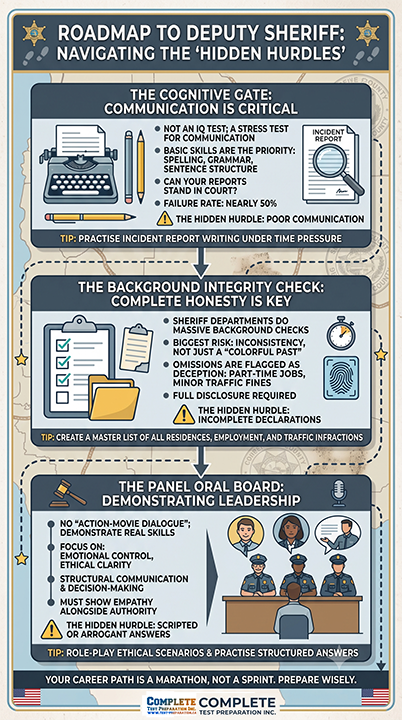
- The Cognitive Gate: This isn’t an IQ test. It’s a stress test for basic communication. Nearly half of all applicants fail because their spelling, grammar, and sentence structures cannot support a legally binding incident report.
- The Background Integrity Check: Sheriff departments carry out massive background checks. The biggest hurdle here isn’t a colorful past—it’s a lack of consistency. If you omit a single part-time job or a minor traffic fine from your youth, the system flags it as deception.
- The Panel Oral Board: When you stand before the command staff, they aren’t looking for action-movie dialogue. They want to see emotional control, ethical clarity, and structural communication. If you fail to demonstrate empathy alongside authority, your file gets shelved.
Stop Studying for the Wrong Test. Get the Law Enforcement Edge Now.
Most “Big Prep” companies sell you the exact same generic study guide whether you are trying to pass a college entrance exam, a corporate desk job test, or a county sheriff’s evaluation.
No textbook filler: Let’s be honest—you don’t need to know how the water cycle works to clear a patrol sector grid. You don’t need to memorize what apathetic means to spot a trap choice on a reading comprehension block. We skip the academic fluff and focus strictly on the exact skills you’ll use on the clock.
The detective’s mindset: You don’t need to solve abstract logic puzzles about white rabbits and black rabbits. You need to train your eyes to spot missing details in a room, identify vehicle patterns, and make split-second decisions under pressure. That is the exact mindset our judgment and logic sections build.
Math for the real world: You aren’t being tested to become an engineer or an accountant. We don’t drag you through complex algebraic proofs; we show you how to quickly calculate percentages, handle decimal shortcuts, and crack word problems without a calculator, just like you would on the fly.
Reports that stick to the facts: The composition section isn’t here to teach you how to write a literary essay. We focus on the exact grammar, punctuation, and capitalization rules that keep a notebook entry or an occurrence report clear, professional, and court-ready.
-
You will learn to tear apart and analyze an incident report from a convenience store robbery.
-
You will master high-stakes vocabulary metrics—like fully understanding what legally constitutes an imminent threat under pressure.
What’s Waiting Inside the Complete Test Prep Training Portal:
-
Hundreds of Law Enforcement Focus Questions: Zero filler, zero high school academic fluff. Every module is strictly tailored to multi-jurisdictional testing frameworks.
-
The Exclusive AI Study Hall Tutor: Available 24/7 right at your digital kitchen table. If you miss a spatial orientation map or mess up a weighted average calculation, the AI Tutor doesn’t just show you an answer key. It instantly deconstructs your exact error in plain English and generates custom micro-drills to make sure you nail it on the next try.
-
The “Under the Microscope” Social Media Audit: Exclusive to Complete Test Preparation Inc. Before you ever shake hands with a background investigator, you need to know exactly what they are going to find. This specialized toolkit walks you through a step-by-step audit to clean up, lock down, and secure your digital footprint so your social media history doesn’t deep-six your application.
Don’t risk landing in a mandatory 6-month civil service lockout window because you studied the wrong material. Get the targeted, down-to-earth tools you need to clear the gate on your very first try.
Unlock the Full Online Prep Course & AI Study Hall Tutor Now
What Is the Difference Between a Deputy Sheriff and a Police Officer?
Deputy sheriff and police officers have different jurisdictions. A deputy sheriff is responsible for an entire county, which often includes a number of small towns and even several larger cities.
A police officer is responsible for preventing crime within the city limits. This includes patrolling the city, issue tickets, and testifying in court.
Deputy sheriff’s job varies by state. This could include working in a county jails, investigating crimes or accidents, security in courts and issuing warrants.
Key Skills and Qualities to Become an Effective Deputy Sheriff:
Strong Communication Skills: Effective communication skills are essential to effectively interact with the public, other law enforcement agencies, and colleagues. The ability to communicate clearly and effectively is necessary for all law enforcement positions.
Physical Fitness: Deputy Sheriffs need to be in excellent physical condition. Duties often involve running, jumping, and physically restraining suspects.
Emotional Intelligence and Control: Deputies need to have a high level of emotional intelligence to manage their emotions to function in a high-pressure and sometimes dangerous environment. This includes the ability to remain calm, focused, and composed in stressful situations, and to exhibit empathy and understanding towards others.
Problem-Solving Skills: Deputy Sheriffs are often required to think on their feet and come up with quick solutions to problems that arise in the field. Deputies must be able to analyze situations, identify problems, and determine the most appropriate course of action.
Critical Thinking: Deputies are often required to make fast, informed decisions in complex or ambiguous situations. This includes, evaluating information, identifying risks. This is an essential skill for all law enforcement.
Ethics and Integrity: As representatives of the law, Deputy Sheriffs must be committed to maintaining high ethical standards and integrity. This includes honesty, respect, and fairness, upholding the law without bias or discrimination.
Effective Teamwork: Sheriffs work as part of a team and must collaborate with colleagues for common goals. This includes, communicating, sharing information, and supporting each other.
Challenges Sheriffs Face
Danger and Risk: Deputy Sheriffs often work in high-risk situations that can involve physical harm or injury. They may have to deal with violent suspects, dangerous weapons, and other hazardous situations on a daily basis.
Stress and Trauma: The nature of law enforcement work can be emotionally and psychologically taxing. Deputy Sheriffs are often exposed to traumatic events, such as accidents, crime scenes, and violent incidents, which can take a toll on their mental health and wellbeing.
Public Perception: Law enforcement officers, including Deputy Sheriffs, may be subject to negative public perception and scrutiny, especially in the wake of high-profile incidents or cases of misconduct. This can lead to increased stress, anxiety, and distrust among the communities they serve.
Limited Resources: Many law enforcement agencies, including sheriff’s departments, face budget constraints and limited resources, which can impact the ability of Deputy Sheriffs to effectively perform their duties.
Work-Life Balance: The nature of law enforcement work, with long hours, shift work, and irregular schedules, can also impact the work-life balance of Deputy Sheriffs, and may lead to increased stress and fatigue.
Deputy Sheriff Practice Toolbox
Reading Comprehension I
Vocabulary Practice Part I
Sentence Logic Practice Questions
Written by: Brian Stocker MA.,
Published by: Complete Test Preparation Inc.
Updated: Thursday, July 2nd, 2026
Published: Monday, January 4th, 2021