
What is the CritiCall Test and Why is it Hard?
The worst part of the Ontario CritiCall exam isn’t the typing speed. It’s the 6-month freeze-out.
If you fail the CritiCall test with a major Ontario police or ambulance service, you are locked out. You can’t re-apply for three to six long months. For someone trying to get their career started, pay the bills, and get into the headset, that waiting period is devastating.
You don’t need corporate buzzwords or generic study fluff. You need to pass on the first try.
Here at our kitchen table in Victoria, we’ve spent years analyzing exactly where candidates trip up. We built this Ontario CritiCall practice test program to do one thing: get you ready for the reality of the simulation. Whether you are aiming for the OPP or a local municipal service, our CritiCall dispatcher online course cuts through the noise. Skip the generic books. Get a targeted 911 dispatcher practice test and online simulator that actually trains you for the chaos, so you can turn “applicant” into “dispatcher” on day one.
(Plus, every time you use our tools to advance your career, a portion of your purchase goes directly to global educational charities. You learn, and you help someone else learn, too.)
The 2-Minute CritiCall Challenge: “The ONRoute scramble”
In the real world, callers don’t read from a neat script. They panic, they focus on the wrong details, and they correct themselves mid-sentence. The CritiCall data-entry module will intentionally feed you audio where the caller changes their mind. If you type what they say first without listening to the end of the sentence, you fail the module.
The Rules:
You have exactly 120 seconds. Read the transcript below once. Do not take notes. Then, scroll past the transcript and answer the four questions from memory.
Set your timer. Go.
Dispatcher: “9-1-1, what is your exact location and emergency?”
Caller: (Hyperventilating, background highway noise) “I’m at the King City ONRoute! On Highway 400! I just went inside to grab a coffee and someone just stole my SUV! My dog is in the back! It’s a 2022 silver Hyundai Tucson. The licence plate is… oh god, it’s Ontario plate Bravo-X-ray-Tango-9-1-4. No, wait! 9-4-1! BXT 941! The guy who jumped in had a bright yellow construction jacket and a black baseball cap. He just peeled out of the parking lot heading Northbound on the 400! Please, my Golden Retriever ‘Buster’ is in the back, he’s wearing a red collar, please don’t let them hurt him!”
(Stop reading the scenario. Do not look up. Answer these four questions out loud or type them immediately.)
The 4 Questions
The Vehicle: What is the exact make, model, colour, and licence plate of the stolen vehicle?
The Location & Direction: Where did the theft occur, and which way is the suspect heading?
The Suspect: What two specific pieces of clothing was the suspect wearing?
The Distractor: What is the name and breed of the dog?
Did you catch the correction? Did you get distracted by the dog? Let’s break down exactly how the CritiCall algorithm scores this type of data-entry scenario.
1. The Vehicle: Silver 2022 Hyundai Tucson. Licence Plate: BXT 941.
The Trap: The "Self-Correction Trap." The caller initially said 9-1-4, then panicked and changed it to 9-4-1. If you were typing blindly as the caller spoke and hit 'Enter' before they finished their thought, you just dispatched police to look for the wrong licence plate. You must learn to "buffer" information in your head for a half-second before committing it to the screen.
2. The Location & Direction: King City ONRoute, Highway 400, heading Northbound.
The Trap: Missing the direction of travel. In a highway scenario, knowing the starting point (King City ONRoute) is useless if the OPP don't know whether to set up observation points Northbound or Southbound.
3. The Suspect: A bright yellow construction jacket and a black baseball cap.
The Trap: Filtering out the filler. You have to ignore the caller's panic about their coffee and instantly grab the high-value descriptive data. High-visibility clothing is a crucial identifier for responding officers.
4. The Distractor: A Golden Retriever named Buster.
The Trap: Emotional flooding. When you hear a caller crying about their pet, your human instinct is to focus on the animal. The CritiCall uses emotional elements (pets, crying, screaming) to see if you will lose your focus on the cold, hard data (the licence plate and direction of travel). You need to note the dog, but you cannot let it override the vehicle description.
If you had to look back at the text to find the plate number, your memory and recall skills need work before you sit for the real exam. We see great candidates fail this module every day simply because they haven't practiced filtering out the noise.
Our CritiCall practice simulators are built to throw these exact curveballs at you. No generic fluff. Just the reps you need to pass.
Criticall Test Prep and Practice — Start a Free 5-Minute Practice Test Now
What Skills are Needed for a Criticall Dispatcher?
Scope of the CritiCall Dispatcher Test
The CritiCall test has 23 modules which take 3 hours to complete. The most common modules are map-reading, data entry, memory and recall and decision-making.
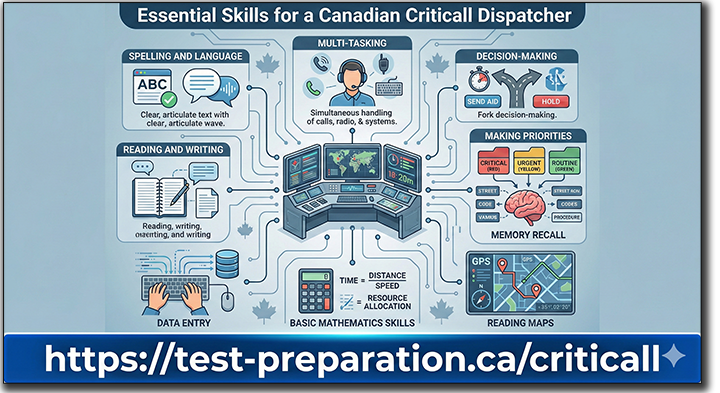
The CritiCall Dispatcher test measures these skills:
- data entry
- multi-tasking
- decision-making
- making priorities
- reading maps
- reading and writing
- spelling and language
- basic mathematics skills
- memory recall
Another vital skill tested by the CritiCall Dispatcher test is to ensure that candidates can work in different environments and do their job under pressure.
Jobs and Salary
Telecommunications Operator Trainee (9-1-1 Dispatchers)
Starts at $51,000
Opérateur ou Opératrice des Télécommunications Stagiaire
Starts at $51,000
Ambulance Communications Officer
$29.14 hour
Who Uses the CritiCall in Ontario?
Ontario Provincial Police (OPP)
Toronto Police Service
Peel Regional Police
Ottawa Police Service.
What is on the CritiCall Test? (23 Key Modules Explained)
The CritiCall Ontario test has 23 modules which take 3 hours. The most common modules are map-reading, data entry, memory and recall and decision-making
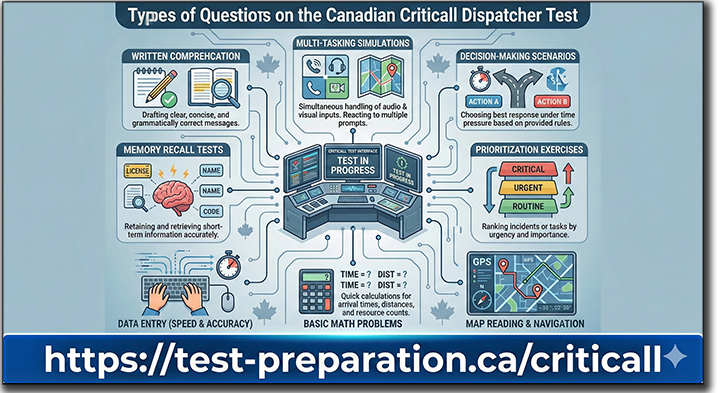
- Data entry and multi-tasking-Candidates are provided with names, (written or audio) phone numbers, addresses, and data, which they obligation to record into accurate fields in a simulated dispatch computer system.
- Candidates answer a range of decision-making questions, assessing their ability to make the right choices under pressure and multi-task.
- Cross-Referencing – This section requires the candidate to correctly read address books, quickly and precisely locate and record requested data. It also requires the candidate to record existing data verbally. The minimum mark is 70%.
- Character Comparison – Candidates are presented with two tables of data which are related and similar, but not the same. Candidates must scrutinize and compare the data. The minimum mark is 70%
Dispatcher Skills
- Decision making – This sections presents the candidate with a sequence of questions that a candidate uses to establish the most suitable emergency service to deploy to any happening event. Applicants use a microphone to give their responses.
- Prioritization – Candidates are given details of several incidents to be ranked accordingly to priority. This section tests your decision-making skills when responding urgently to incidents. The minimum mark is 70%
- Memory and Recall – Candidates are given the audio and written data, followed by questions. The minimum mark is 70%.
- Probability – Public safety officers very often work with partial or inconsistent information about a situation. They may not hear a caller clearly, due to background noise or a poor network. The probability section is used to judge how well a candidate can differentiate between a range of likely answers based on imperfect information.
- Map Reading – The map reading section tests an applicant’s ability to use maps for effectively planning the best route for emergency services units to reach a reported incident as quickly as possible. The minimum mark is 70%.
Basic Skills
- Call Summarization – This requires the candidate to pay attention to the public safety officer and the audio recordings before summarizing the data. Candidates are measured on speed and accuracy. The applicants are asked oral questions about the information gathered. The minimum mark is 70%.
- Reading Comprehension – This section tests the candidates ability to read and interpret information in written form, e.g., guidance materials and manuals, including written data recorded about the incoming call. The minimum mark is 60%.
- Spelling and Sentence Clarity – Public safety officers must have a high standard of written English to correctly transmit meaning. The spelling test focusses on workplace-related terms. The sentence structure tests candidates ability to use a simple sentence to pass a message.
- Mathematics This a test of basic math. Public safety officer must know basic math for incoming calls and distance calculations.
Types of Jobs
The CritiCall test scores are used for jobs in the public safety and emergency services sectors, such as:
- 911 Call-Takers
- Dispatchers
- Law enforcement officers
- Firefighters
- Emergency Medical Services (EMS) personnel
- Emergency Management personnel
- Corrections Officers
- Security personnel in hospitals, universities, and other public facilities
Navigating the Ministry of the Solicitor General Guidelines
When you apply to become a 911 communicator or communications operator in Ontario, you aren’t just applying to a local office; you are entering a system strictly regulated by provincial standards. The Ministry of the Solicitor General guidelines dictate the core competencies required for all civilian emergency personnel. Under the Police Services Act, individual services—whether you are aiming for the Ontario Provincial Police (OPP), Toronto Police Service, or regional departments like Peel or Ottawa—must ensure their hirees can handle immense cognitive load before they ever touch a live headset.
This is where the CritiCall test comes in. It serves as the primary operational benchmark used by these agencies to fulfill the Ministry’s strict mandate for public safety accuracy.
The Cross-Referencing Standard
The Ministry guidelines emphasize that a communicator must be able to verify information instantly using provincial databases and local address registries. On the test, the Cross-Referencing module directly reflects this requirement.
You will be forced to rapidly scan digital address books, alphanumeric codes, and geographic data under a strict countdown. The provincial standard requires a minimum score of 70% on this module. If you misread a single digit or a street suffix (such as mistaking “Street” for “Boulevard”), the system flags it as a critical failure.
Sample 911 Dispatch Call – Call Summarization
Try a Free Audio Data Entry Simulation
Instructions: Listen to the audio clip. While listening, enter the required information into the fields below exactly as you hear it.
1. Location of Emergency: [________________________________________]
2. Nature of the Emergency: [________________________________________]
3. Caller’s Name: [________________________________________]
Answers
Answer Key
-
Location: 459 Maple Leaf Drive (Mississauga/Blue house - optional extra info but address is key)
-
Nature: Husband collapsed / Not breathing
-
Name: Clara Wilson
Common Mistakes on the CritiCall Test
Not Reading the Instructions – slow down and make sure you understand what is being asked.
Rushing Through – slow down – work carefully and methodically – don’t rush through but don’t hang around either
Practice Practice Practice – the best test prep tip is know your stuff!
How to Study – the complete guide
Complete Guide to Test Preparation
Criticall FAQ
“Reverse Practice” Scenarios
Spot the Flaw (Because finding mistakes is half the job)
Instead of asking you for the answer, I’m going to give you a “broken” solution. Your job is to tell me why this dispatcher is about to fail their evaluation.
Scenario 1: The Math Mistake
The Problem: An ambulance is 30 kilometres away from a scene, travelling at 100 km/h. The dispatcher tells the caller, “Help will be there in 3 minutes.”
Where did this go wrong?
The Fix: They confused division with decimals. 30 km divided by 100 km/h is 0.3 hours. To get minutes, you multiply 0.3 by 60. The correct ETA is 18 minutes. Promising a 3-minute ETA puts the caller in danger and creates a liability nightmare. Brush up on your basic emergency math skills
Scenario 2: The Safety Mistake
The Problem: A caller reports an active, violent domestic dispute involving a weapon. The dispatcher immediately sends Paramedics to the front door, followed by Police two minutes later.
Where did this go wrong?
The Fix: You never send EMS into an unsecured scene involving violence or weapons. Police must be dispatched as Priority 1 to “stage and secure” the scene before paramedics are allowed to enter.
CritiCall Test Ontario Practice and Test Prep
✅ A multi-tasking feature (New)
✅ Speed typing test practice (New)
✅ 5 Decision-making tests
✅ 15 Data entry tests
✅ 4 Memory recall tests
✅ 10 Map reading tests
✅ 15 Checking tests
✅ 15 Reading comprehension tests
✅ 8 Numerical tests
Note: You will need to complete only specifically selected sections based on the preferences of the state or county where your test is held.
More Critcall Dispatcher Tests
 Written by, Brian Stocker MA.
Published by: Complete Test Preparation Inc.
Updated: Saturday, June 27th, 2026
Published: Monday, May 3rd, 2021