Back

Let’s be honest. You’ve been waiting months, maybe even years, just to get a shot at joining the union. But right now, there’s a legend going around the job sites that’s probably keeping you up at night: the dreaded “83-Second Math Trap.”

The reality? You have exactly 46 minutes to answer 33 brutal algebra questions. They take away your calculator. If you freeze up on the math, or run out of time on the reading passages, you aren’t just failing a test. You’re hit with a mandatory 6-month wait period. That’s half a year of lost wages, lost seniority, and watching someone else take your spot at the training centre.

You don’t need to be a math genius to pass, and you don’t need to study a massive textbook. You need strategy. With our IBEW online prep course Canada, we’ll show you the exact back-of-the-napkin shortcuts to beat the clock. And if you get stuck at 2 AM trying to figure out polynomials? Our new “Study Hall” AI Tutor steps in like a patient teacher, breaking down the problem step-by-step until it clicks.

Don’t risk the 6-month wait. Grab an IBEW aptitude practice test PDF download right now, practise the right way, and let’s get you into the union.

Dimension Canadian Focus Details
Who Roughly 60,000 to 70,000+ Canadian workers spanning dozens of local unions. Members include electricians (construction and industrial), power line technicians, telecommunications workers, utility employees, broadcasting and manufacturing staff, and government workers.
What A major international trade union that negotiates collective agreements for fair wages, secure pensions, and comprehensive benefits. It also runs world-class, standardized apprenticeship and safety-training programs to ensure elite craftsmanship across electrical and tech sectors.
When The parent international union was founded in St. Louis in 1891. The Canadian footprint took root shortly after, marked by the chartering of the first Canadian local (Local 93 in Ottawa) in 1899, expanding alongside Canada’s industrial and hydroelectric development throughout the 20th century.
Where Active across every province and territory in Canada, organized through roughly 80+ local unions stretching from local community halls and major infrastructure projects (like BC hydroelectric sites or Atlantic power grids) to nationalized utilities and telecommunication networks.
Why To protect electrical workers from dangerous, exploitative conditions, establish rigorous safety standards, guarantee equitable compensation, and give working people a unified, powerful voice in shaping Canada’s electrical, energy, and digital infrastructure.

Why Canadian IBEW Tests Are Different

If you study using US-focused prep books, you’re missing half the picture. Canadian IBEW aptitude tests and apprenticeship entry requirements reflect our provincial training standards, Red Seal pathways, and utility-specific hiring practices. Whether you’re testing for Local 353 in Toronto, Local 213 in Vancouver, or entering through a provincial utility like Hydro One or BC Hydro, our practice material is built from the ground up for Canadian candidates—using Canadian measurements, spelling, and localized problem sets. No fluff, no imported US content—just straight-shooting prep to help you get your ticket.

What math is on the Canadian IBEW aptitude test? “The Canadian IBEW aptitude test features algebra, fraction-to-decimal conversions, polynomial factoring, and equation solving under a strict no-calculator time limit.”
Can you use a calculator on the IBEW aptitude test in Canada? “No, calculators are strictly prohibited on the IBEW aptitude test across Canadian local union testing centres, requiring candidates to rely entirely on mental math and scratch-paper pacing strategies.”
How many questions are on the IBEW electrical entrance exam? “While question counts vary slightly by regional local union and testing battery, typical Canadian IBEW aptitude exams feature around 33 algebra questions paired with timed reading comprehension modules.”
What is the difference between US and Canadian IBEW aptitude tests? “Canadian IBEW aptitude tests reflect provincial apprenticeship standards, metric workplace standards, and local union structures, unlike US-focused guides that rely on American curricula and imperial measurements.”
How do I prepare for IBEW Local 353 or Local 213 intake testing? “Preparing for IBEW Local 353 or Local 213 intake testing requires mastering timed no-calculator algebra drills, reviewing technical reading passages, and preparing for composite interview scores.”

IBEW 2-minute Challenge

You’re sitting in the testing centre. They’ve just taken your calculator away. You have exactly 46 minutes to power through 33 algebra questions. That leaves you with roughly 83 seconds per question. In the electrical trades, you don’t get an hour to second-guess yourself on the job site, and you certainly don’t get that luxury on the IBEW aptitude test. You get a ticking clock and a choice to make.

Your Mission:

  • Do not look at the multiple-choice options below just yet.
  • Hit PLAY on the 2-Minute Challenge Coach below to launch your official countdown and get your tactical strategy tip.
  • Read the case study beneath the video, lock in your decision on a piece of scrap paper before the timer hits zero, and see if you survive the pressure.

The “2-Minute IBEW Math Challenge”

Start the video for our Canadian IBEW math practice test drill Put the calculator in a drawer. You have 120 seconds to simplify these three expressions using only a pencil and scrap paper.

  1. √144 – √49
  2. Simplify: 3/4  /  1/8
  3. Solve for x: 3x + 12 = 45

Anatomy of a Wrong Answer

The Trap: Factoring polynomials difference of squares practice
When yoku are rushing to hit that 83-second-per-question pace, your brain plays tricks on you.
Look at this equation: 4x2 – 36 = 0.
The Trap Answer: (2x – 6)(2x + 6)
Why you fell for it: You saw the difference of squares and immediately split the 4x2 and the 36.
But you forgot the golden rule of factoring: always pull out the Greatest Common Factor (GCF) first.
The Kitchen-Table Fix: Take a breath.
Pull out the 4 first: $4(x2 – 9) = 0.
Now factor the inside: 4(x – 3)(x + 3) = 0.
Boom. You just saved yourself 30 seconds and got the right answer.

PDF Download

Instant access. Grab the instant IBEW aptitude test questions download
Get the PDF

Online Course

Our top recommendation. Our full Canadian IBEW electrical test prep workbook package. Includes your personal A.I. Study Hall Tutor, exclusive 3-minute power drills, and more.
Start Studying

Amazon Paperback

The reliable, distraction-free classic for your kitchen table.

“Reverse Practice” Scenarios

The Broken Solution: We asked a student to solve a basic electrical math problem using Ohm’s Law and power formulas word problems.
They wrote this down:

Problem: Find the current (I) if Voltage (V) is 120V and Resistance (R) is 15 Ohms.

Student’s Work: I = V X R  -> I = 120 X 15 -> I = 1800 Amps.

Where did this go wrong?
Did they use the right formula? No. Ohm’s Law is V = I X R.
To find Current (I), the formula must be rearranged to I = V/R.
What’s the real-world consequence? 1800 Amps would melt your boots to the floor.
The correct math is 120/15 = 8 Amps.
Always pause and ask: Does this number make sense in the real world?

Provider Pricing (CAD)
Full Featured Prep with AI Coach at half the price of the Big Guys!
Complete Test Prep (PDF) $29.99 (as of November 2026)
JobTestPrep $62 CAD (as of November 2026)
Ultimate Electrician’s Guide ~$83 CAD (as of November 2026)

Electricians Tests

All of these are the same:

  • NJATC Aptitude Test / JATC Aptitude Test
  • Electrical Aptitude Test / Electrician Aptitude Test
  • Electrician Apprentice Test / Electrician Pre-Apprenticeship Test
  • Electrical Training Alliance Aptitude Test / NECA
  • Local 3 IBEW Test / Local 134 IBEW Test
  • Local 1245 IBEW Test / Local 26 IBEW Test
  • Local 11 IBEW Test / Local 1 IBEW Test
  • Local 47 IBEW Test / Local 77 IBEW Test
  • Local 98 IBEW Test / Local 103 IBEW Test

Electrician’s Salary

Average Electrician salary in Canada:   $66,300
Entry level: starts at $55,470
Experienced Electricians: up to $81,491

Average Salary in United States:  $55,190

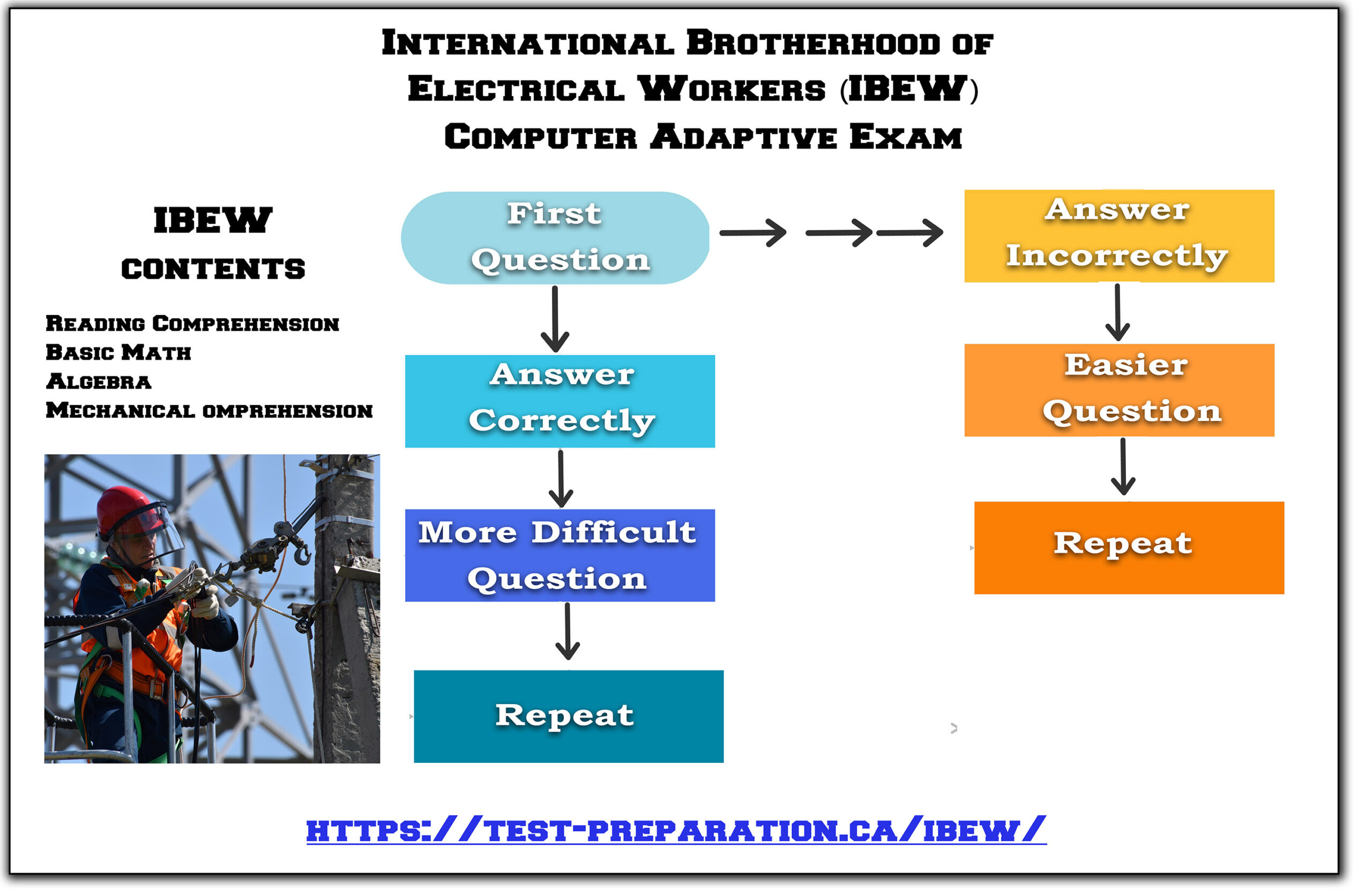
Whats on the IBEW
Test contents - click image for larger - https://test-preparation.ca/wp-content/uploads/2021/12/IBEW-300x180.jpg
https://test-preparation.ca/wp-content/uploads/2025/07/IBEW-scaled.jpg Click to Enlarge

Still Deciding? Let’s Find Your Perfect Study Match.

Published right here in Victoria, BC by a team that actually cares about your score. No boring, dry textbooks or corporate fluff—just practical, engaging prep designed specifically for Canadian tests.

Instant PDF Download

Best For: The Last-Minute Crammer
Realized the test is tomorrow? We’ve got you covered.
  • Instant 60-Second Access: Buy, download, and open your first practice question immediately—zero shipping wait times.
  • Find Answers in a Flash: Use Ctrl+F to track down tricky formulas in 2 seconds instead of flipping through 500 pages.
  • Print Only Weak Spots: Ace Basic Math? Print just what you need to save paper, ink, and sanity.
  • Wallet-Friendly: No printing or shipping costs means we pass massive savings straight to you.
Download the PDF & Start Passing Now →

All-Access Online Course

Best For: The Maximum-Score Seeker
Engineered for students who refuse to leave their score to chance.
  • Your 2 AM AI Mentor: Patient, step-by-step guidance from our exclusive AI Study Hall Tutor whenever lightning strikes.
  • 3-Minute Power Drills: Squeeze high-yield practice between classes, during lunch, or while your coffee brews.
  • Zero Guesswork: Smart roadmap tracks your wrongs, color-coding weaknesses red so you only study what raises your score.
Enroll Now & Unlock Your A.I. Tutor →

Amazon Paperback

Best For: The Focus-Driven Traditionalist
The reliable, distraction-free classic for your kitchen table.
  • Escape Notifications: No pop-ups, no Instagram tabs—just you, highlighters, and total mental immersion.
  • Make Knowledge Stick: Active learning in the margins builds deeper retention than swiping a screen.
  • Protect Your Sleep: Screen-free, battery-free study sessions that won't leave you with a headache.
  • Permanent Security Blanket: No logins, no passwords, no Wi-Fi. A trusty book you can keep on your shelf forever.

Also Available on Kindle, Kobo, and Barnes and Noble

Occupational Outlook

Electricians are in Demand!

Jobs for electricians are projected to grow 8 percent from 2019 to 2029, much faster than the average for all occupations. Homes and businesses need wiring!

Frequently Asked Question Canadian Focus Answer
What is the IBEW’s footprint in Canada? The International Brotherhood of Electrical Workers represents roughly 60,000 to 70,000+ members across Canada, organized through local unions spanning every province and territory—covering construction, utilities, telecommunications, and manufacturing.
How do I become an IBEW electrical apprentice in Canada? Applicants typically apply through local union training alliances (such as the Electrical Apprentice Training Alliance or local joint apprenticeship committees). Requirements include high school math and English credits, followed by aptitude testing, an interview, and registration with provincial training ministries.
What are the main benefits of joining the IBEW in Canada? Members receive higher industry wages, comprehensive health and dental benefits, secure pension plans, standardized safety training, and representation in workplace disputes and collective bargaining agreements.
Are IBEW qualifications recognized across provincial borders? Yes. Many electrical trades under the IBEW fall under the Red Seal Program (Interprovincial Standards Red Seal Program), allowing journeypersons to practice their trade across Canadian provinces and territories without re-testing.
How much are IBEW union dues in Canada? Dues vary depending on the specific local union and sector, typically consisting of a flat monthly base fee plus a small percentage of gross working wages. A portion of these dues supports international benefits, local representation, and strike funds, and parts may be tax-deductible.

Written by,


Updated:Friday, November 13th, 2026
Published:
Sunday, February 16th, 2020

Our Standards: Why Your IBEW Preparation Matters
Preparing for the International Brotherhood of Electrical Workers IBEW entrance test is a major step toward a secure, respected career. You deserve study materials that take your future as seriously as you do. Right here in Victoria, British Columbia, we throw out recycled, generic imports in favor of resources built specifically for adults preparing for the IBEW entrance test.

1. Experience: The “Real Classroom” Factor
For 20 years, we’ve operated right here in Victoria, BC—far away from corporate assembly lines. While others rely on mass-produced question banks, we put in real teaching hours. Every page of the International Brotherhood of Electrical Workers IBEW guide is physically crafted and triple-checked by educators who know where candidates stumble and how to catch you before you fall.

2. Expertise: The “Cognitive Standards” Factor
The International Brotherhood of Electrical Workers IBEW exam in Canada demands sharp reasoning, not surface-level guessing. That’s why our material is meticulously aligned with actual Canadian testing standards. Whether you’re mastering electrical aptitude math or tackling timed cognitive reasoning for Canadian civil service job applications, we focus entirely on defusing test anxiety and matching the exact format you’ll face on test day.

3. Authoritativeness: The “Independent” Factor
As an independent publisher, we answer to learners—not distant shareholders or automated call centers. There is zero room for lazy AI fluff here. Every question in the International Brotherhood of Electrical Workers IBEW prep package is human-written, expert-vetted, and designed to give you a genuine competitive edge.

4. Trustworthiness: The “Giving Back” Factor
We believe in doing right by people. When you invest in your career with the Canadian International Brotherhood of Electrical Workers IBEW resources, a portion of every sale goes directly to support educational charities and children’s literacy programs. No corporate runaround—just straightforward guidance from educators who want to see you succeed.