Navigating EQAO Secondary School Requirements without the Stress
If you’ve lived in Ontario for more than a minute, you’ve probably heard the acronym EQAO whispered in the halls like it’s some kind of ghost story. But here’s the kitchen-table truth: the Education Quality and Accountability Office isn’t a monster; it’s a measuring stick. The “why” behind this exam is actually quite simple, even if the provincial paperwork makes it sound like rocket science.
The Ministry of Education wants to ensure that every student heading out into the Ontario workforce or off to university has the same baseline “literacy pillar.” Whether you’re planning to be a master plumber in Windsor or a software engineer in Ottawa, you need to be able to read a technical manual and write a coherent email. The OSSLT is just the province’s way of verifying you have those “Life 101” skills.
Why It Matters (The “Graduation Limbo” Factor)
In Ontario, literacy isn’t just a suggestion—it’s a graduation requirement. You need this “check-mark” to earn your Ontario Secondary School Diploma (OSSD).
- The First Kick at the Can: Most students take the test in Grade 10.
- The Safety Net: If things don’t go according to plan, you can retake the test or enroll in the OLC4O (Ontario Literacy Course).
- The Real Cost: Failing doesn’t just hurt your pride; it creates “Graduation Limbo.” It means extra courses, potential summer school, and the stress of not knowing if you’ll graduate on time with your friends.
I’ve spent years deconstructing these provincial standards because I hate seeing good students get tripped up by bureaucratic wording. We don’t do “Big Prep” corporate-speak here. We just focus on the actual skills the EQAO is looking for—so you can get that OSSD and get on with your life.
Does that help clear up the “why,” or are you looking for a breakdown of the specific reading and writing tasks the EQAO focuses on?

| Pass the OSSLT on Your First Try | |
|---|---|
|
Stop the graduation stress with our 2026 Updated Online Course.
|
$39 CAD
START TRAINING
|
Master the OSSLT News Report Writing Prompts (Content-specific training)
One of the biggest hurdles on the OSSLT is the “News Report” task. I’ve talked to hundreds of Ontario students who treat this like a creative writing assignment. Big mistake. The EQAO markers aren’t looking for a Pulitzer Prize-winning novel; they are looking for a very specific, rigid structure that follows the “Inverted Pyramid” of journalism.
In my years of triple-checking these rubrics, I’ve found that students who fail this section usually do so because they wrote a story instead of a report.
The “Stocker” Strategy for a Perfect News Report
When you see the photo and the headline provided by the EQAO, don’t overthink it. Follow these “Kitchen Table” rules:
- The Lead is Everything: Your first paragraph must answer the “5 W’s” (Who, What, Where, When, and Why). If a marker has to read three paragraphs to find out that a car wash happened at a high school in London, Ontario, you’ve already lost points.
- The Third-Person Wall: Never, ever use “I” or “me.” Even if the prompt is about a student protest, you aren’t a protester—you are a reporter. It’s not “I saw the principal,” it’s “The principal was seen by onlookers.”
- The “Fake” Quote: You are required to include quotes. Since you aren’t actually at the scene, you have to invent a logical quote from a participant.
- Bad: “It was so cool!” said a kid.
- Good: “This event demonstrates the incredible spirit of our student body,” stated Principal Sarah Miller.
The Anatomy of the Inverted Pyramid
Think of your news report like a triangle turned upside down. Put the most important “heavy” information at the top, and let the minor details taper off at the bottom.
A Quick Training Drill
Look at this sample prompt:
Headline: Local Students Lead Environmental Cleanup
Photo: A group of teenagers holding recycling bags in a park.
The “Big Prep” Mistake: Writing about how much you love nature and why recycling is important for the planet.
The Winning Move: Writing a factual account of the “Green Valley High School Cleanup” that took place last Saturday at Riverside Park, including a quote from the lead organizer about how many bags of plastic were collected.
Our Online OSSLT prep course includes a library of these prompts with AI-assisted feedback that tells you instantly if your tone is too “chatty” or if you missed a crucial “W.” We turn the News Report from a guessing game into a repeatable formula.
Ready to try a practice prompt yourself, or should we move on to the “Series of Paragraphs” (the opinion piece)?
The “Series of Paragraphs Expressing an Opinion” Blueprint
If the News Report is about being a detached reporter, the Series of Paragraphs is where you finally get to say what you think—but there is a catch. The EQAO markers aren’t actually grading your opinion. You could argue that the moon is made of Ontario cheddar, and as long as you follow the structural blueprint, you can still get a perfect score.
The “Graduation Limbo” happens when students treat this like a text message or a casual chat. This task requires a very specific Canadian academic structure: a minimum of three paragraphs (though I always recommend four or five) that link your brain to the page using logic, not just “feelings.”
The “Stocker” Structure: The 4-Block Method
I’ve spent years at my desk in Victoria simplifying this for students who hate writing. Don’t stare at the blank white screen; just fill in these four blocks:
The Intro & The Anchor: Start by restating the question as a statement. This is your “Thesis.” Be clear—don’t “maybe” or “sometimes” your way through it. Pick a side and stick to it.
- The “Because” Paragraph (Body 1): Give your first reason. Use a transition word like First, or Primarily. Give a specific example—if the topic is about school uniforms, mention a real-life situation where they save time in the morning.
- The “Moreover” Paragraph (Body 2): Add a second, different reason. Use a “bridge” word like Furthermore or In addition. This shows the marker you have a “literacy pillar” strong enough to support more than one thought.
- The Summary Wrap-Up: Don’t just stop writing. Briefly restate your two reasons and end with a final thought that mirrors your intro.
The “Anti-Big-Prep” Cheat Sheet
Large corporate prep companies will tell you to memorize complex vocabulary. I’m telling you to master these Transition Anchors. They are the “secret sauce” that tells a marker, “Hey, I know how to organize a professional argument.”
| Instead of saying… | Use this “Stocker” Anchor |
| “Also…” | “Furthermore,” |
| “I think this because…” | “Evidence suggests that…” |
| “In the end…” | “In conclusion,” or “Ultimately,” |
| “But…” | “Conversely,” or “However,” |
| The Full OSSLT Prep Course: Your OSSD Fast-Track | |
|---|---|
|
It’s like having a teacher sitting at your kitchen table.
• The Midnight Mentor (AI Tutor): A helping hand that never sleeps. If you get stuck on a logic problem, the AI nudges you in the right direction without just "giving away" the answer.
• Realistic Simulation: Our "Timed Test" mode mimics the actual EQAO pressure. Better to sweat a little during practice than to freeze up on the big day.
• Dynamic Progress Tracking: The course remembers your mistakes. It shows you where you’re "Green" (ready) and where you’re "Red" (needs work), so you don’t waste time.
• Deep Question Bank: Hundreds of practice questions—you'll likely never see the same problem twice.
|
Investment
$39 CAD
One-time payment. Instant Digital Access |
Securing Your Ontario Secondary School Diploma (OSSD) Credits
At the end of the day, my goal is to make sure you aren’t just “taking a test,” but actually crossing the finish line. In Ontario, your OSSD is your ticket to whatever comes next—whether that’s a skilled trade, a university degree at U of T, or jumping straight into the workforce. But to get that diploma, the Ministry of Education requires you to check the literacy box.
Think of the OSSLT as the final piece of a puzzle. You’ve done the hours in the classroom, you’ve earned your math and science credits, and now you just need to prove you can handle the “Literacy Pillar.”
Don’t Let One Test Stall Your Future
I’ve seen too many bright students get stuck in “Graduation Limbo” because they didn’t take the literacy requirement seriously until the last minute. If you don’t pass the OSSLT, you have two choices:
- The Retake: Waiting another year to write the test again (which stalls your plans).
- The OLC4O Course: Taking the full Ontario Secondary School Literacy Course. While this is a great safety net, it’s a lot of extra hours in a classroom that you could be spending elsewhere.
Your “First-Time” Checklist
To ensure your credits stay on track, we recommend this simple “kitchen-table” plan:
- Confirm Your Eligibility: Most students write in Grade 10. Check with your guidance counsellor to ensure you’re on the list.
- Use Realistic Materials: Don’t just read—do. Use our OSSLT practice test PDF to get used to the layout.
- Master the “Big Three”: The News Report, the Opinion Piece, and the Information Paragraph. If you nail these, the rest is smooth sailing.
The “Pass or Your Money Back” Guarantee
I believe in these tools because I’ve spent years “triple-checking” them against the EQAO standards. We’ve helped thousands of Ontario students move past the stress and secure their diplomas. If our course doesn’t help you feel 100% ready, I want to hear about it. We’re a small, independent shop, and your success is the only reason we’re in business.
Ready to finish the job?
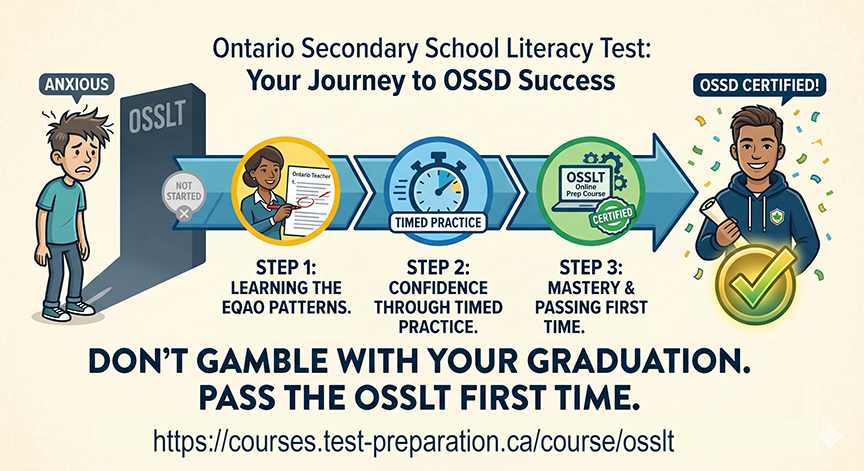
Don’t gamble with your graduation. Let’s get that literacy credit secured so you can focus on the fun stuff—like your graduation ceremony.
Instant Access • 2026 EQAO Updated
Cheers,
Brian Stocker, MA Complete Test Preparation Inc.
Victoria, BC (But always rooting for the Ontario students!)
My Practice Routine (For any test)
One thing that really helped me was practicing with questions that were just like the ones on the actual test. I always got old tests or practice questions. Here’s how I broke it down:
Reading: I practiced reading different kinds passages and then considering them. What is the main idea? Opinion or fact? Like that. The test has lots of different types of texts—stories, articles, opinions even charts. Practicing these helped me get faster at figuring out what the questions were asking and finding the right answers.
Writing: This part was a bit trickier for me, especially the opinion essay and the news report. But practicing writing these out over and over made a huge difference.
Grammar and Vocabulary: I spent some time brushing up on grammar rules and vocabulary too. Even though it wasn’t the most exciting part of studying, it definitely paid off on test day. Grammar questions aren’t really on the test but you gotta know your grammar to write an essay.
Written by, Brian Stocker MA.,
Published by, Complete Test Preparation Inc.
Updated: Friday, April 17th, 2026
Published: Tuesday, September 3rd, 2024