
The “Wait-List” Reality Check
Think about this: You’ve spent four years on the tools, logging hours in the rain and crawling through crawlspaces. You’re ready for your ticket. But in provinces like Ontario or BC, failing the Red Seal doesn’t just cost you a $150 exam fee—it puts you in “Wait-List Limbo.”
With testing centres backed up, a single “Fail” can keep you stuck at apprentice wages for another six months. That’s thousands of dollars in lost journeyman labour rates literally flushed away.
Our Red Seal Plumber Online Course Canada are designed for one thing: getting you past the National Plumbing Code of Canada 2020 hurdles the first time. We don’t do corporate fluff; we do result-driven practice that mirrors the actual Canadian Plumbing Exam Questions you’ll face at your local centre.

Red Seal Plumber Interactive Training
Here’s the thing: we know you’re busy, likely working a full shift before even opening a book. You don’t need a 500-page textbook; you need a tool that works as hard as you do. We’ve built this course to be the most direct path to your ticket.
Why this isn’t your average “Big Prep” course:
We’ve spent years in the classroom, and we know exactly where students trip up. This isn’t a passive slideshow; it’s a high-octane training ground.
- The A.I. Study Hall Tutor (Exclusive to Complete Test Prep): This is our “secret sauce.” Imagine having a tutor sitting at your kitchen table at 11:00 PM when you’re stuck on a complex venting calculation. Our A.I. Tutor doesn’t just blurt out the answer; it gives you a “nudge” in the right direction, asking the right questions to help you solve the problem. It’s a helping hand that never sleeps.
- Our Deepest Question Bank Yet: You won’t just memorize answers here. We’ve packed this course with a massive volume of practice questions across all Major Work Activities, ensuring you face fresh challenges every time you log in.
- Dynamic “Traffic Light” Tracking: Your time is money. Our system tracks every click and remembers what you missed. It shows you exactly where you’re “Green” (ready for the exam) and where you’re “Red” (need to put in some work). No more wasting hours on stuff you already mastered on the job site.
- Study Anywhere (The Mobile Classroom): Whether you’re on a lunch break in the truck or on the ferry, as long as you’ve got Wi-Fi, the classroom is open. Use your phone, tablet, or laptop to squeeze in a 2-minute drill whenever you can.
Brian’s Note: We built this specifically for the “forgotten” student—the one who knows the trade but hates the “trick” questions. We’re here to make sure the exam is just a formality so you can get back to work as a Journeyman.
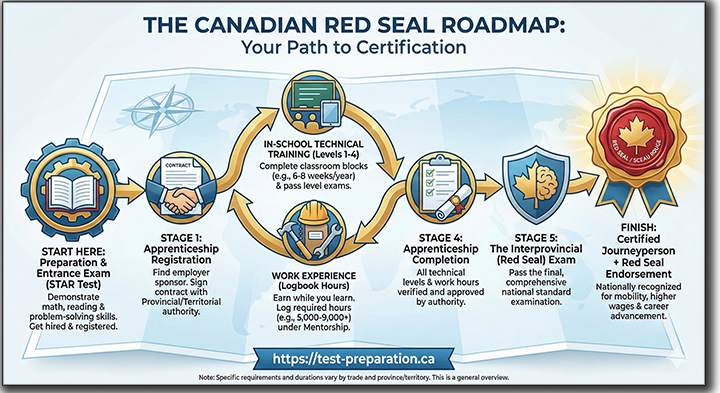
Navigating the Interprovincial Standards Red Seal Program
Getting your ticket isn’t just about knowing how to sweat a joint or size a grease trap; it’s about navigating a national system that ensures a plumber in Victoria is held to the same high standard as one in St. John’s. That’s the core of the Interprovincial Standards Red Seal Program.
It’s a bit of a “Red Seal Paradox”—the exam is national, but the gatekeepers are provincial. Whether you are dealing with Skilled TradesBC, Skilled Trades Ontario (STO), or Alberta Apprenticeship and Industry Training (AIT), you are ultimately aiming for that “Red Seal” endorsement on your provincial licence. This endorsement is your passport to work anywhere in Canada without having to re-test.
Understanding the Red Seal Occupational Standard (RSOS)
The exam isn’t a guessing game. It is built directly from the Red Seal Occupational Standard for Plumbing. Think of this as the “Master Blueprint” for your career. It breaks the trade down into Major Work Activities (MWAs), and every single one of the 125 questions on your exam is mapped to these specific tasks.
Regional Variations and the National Code
While the National Plumbing Code of Canada 2020 is the primary reference, we know that local rules sometimes “lean” a certain way. For example:
- Ontario: You’ll be working closely with the Ontario Building Code (OBC), specifically Part 7.
- Western Canada: There is a heavy focus on cross-connection control and specific backflow prevention requirements that are often highlighted in regional BC/Alberta Journeyman certification discussions.
Mastering the National Plumbing Code of Canada 2020
If there is one thing that keeps apprentices up at night, it’s the “Big Blue Book.” The National Plumbing Code of Canada 2020 is the referee for every job you’ll ever do. But here’s a secret the “Big Prep” corporate types won’t tell you: the Red Seal exam isn’t testing your memory; it’s testing your navigation.
Nobody memorizes every table in the NPC. Instead, you need to be able to hear a problem and know exactly which section to flip to without breaking a sweat. If you’re fumbling through pages for five minutes to find a venting table, you’re burning the time you need for those tricky drainage calculations.
The “Three-Pillar” Approach to the Code
In our Victoria-based workshops, we always teach the Code using three specific pillars. This is how we’ve helped thousands of Canadians get their ticket:
- The Index is Your Map: You need to treat the Index like a GPS. We run “Index Drills” where we give you a term—like interceptors or circuit venting—and you have to find the primary clause in under 30 seconds.
- Section 2.5 (Venting) is the Gatekeeper: Statistically, more people lose marks on venting requirements than almost any other section. We deconstruct the “Venting Logic” so you understand why the air needs to move, which makes the tables make a lot more sense.
- Table Mastery: You don’t need to know the numbers by heart, but you need to know which table overrides another. For example, knowing when to use the hydraulic load tables for potable water versus those for sanitary drainage is the difference between a “Pass” and a “Wait-List.”
The “Code-Speed” Advantage
Our Red Seal Plumber Online Course Canada includes a specialized module we call the Code-Speed Finder. We give you “Search-and-Destroy” missions to ensure that by the time you walk into that testing centre, you can navigate that book with your eyes half-shut.
Common Code “Traps” to Avoid
- The “Old News” Trap: Using the 2015 rules for a 2020 exam. Things change—especially in Cross-Connection Control requirements and water-efficiency standards.
- The Provincial Pivot: Remembering that while the Red Seal is national, your exam might lean on specific “Provincial Variations” if you are writing in a province that has adopted the NPC with specific amendments.
Brian’s Straight Talk: Don’t let the size of the book intimidate you. It’s just a tool, no different than a pipe wrench or a soldering torch. Once you learn how to handle it, the exam becomes a lot less scary. We’re here to show you exactly how to wield it.
Activity A Sample Questions
1. Which of the following is an unsanitary condition?
a. Any trap which does maintain a proper seal
b. Provided with an approved water-sealed trap
c. Any defective fixture, trap or pipe or fitting
d. Supplied with sufficient water
2. A trap which is integral with the fixture must
a. be no smaller than 2 inches
b. be no longer than 3 inches
c. be self-sealing
d. have a smooth waterway
Work Activity A
Activity A has questions on common occupational skills in five activities.
A-1: Safety-related functions
A-2: Tools and equipment maintenance.
A-3: Work organization.
A-4: Routine trade activities.
A-5: One question on communication and mentoring techniques.
Activity B Sample Questions
1. When notching the ends of joists to install water piping, the depth of the notches must not exceed ____ of the depth of the joists.
a. 1/16
b. 1/32
c. 1/8
d. 1/4
2. Which of the materials, is approved by the Code to secure water closets to a tile floor?
a. Brass
b. Bismuth
c. Babbitt metal
d. Tungsten
3. The code permits installation of elastomeric compression type joints as an alternative to _________ on hub and spigot cast-iron pipe.
a. Lead and oakum joints
b. Stainless steel no-hub couplings
c. Cement and oakum joints
d. Hot poured compound joints
4. What is the most acceptable code approved fitting to connect two pieces of galvanized steel pipe in the water supply?
a. Black steel dress coupling
b. Brass compression coupling
c. Galvanized union with graphite gasket
d. Galvanized metal to metal ground seat union
Work Activity B
Activity B tests has two tasks, and fifteen questions testing your knowledge of the preparation and assembly of pipes.
B-6: Preparing pipes.
B-7: Tubing, pipe, and joins.
Activity A Answer Key
1. Which of the following is an unsanitary condition?
a. Any trap which does maintain a proper seal – follows sanitary principles
b. Provided with an approved water-sealed trap – follows sanitary principles
c. Any defective fixture, trap or pipe or fitting
d. Supplied with water sufficient – follows sanitary principles
An unsanitary condition is something contrary to sanitary principles or injurious to health.
Answer: C
Major Work Activity A A-1
Unsanitary Conditions include the following:
Any trap which does not maintain a proper trap seal
Any opening in a drainage system. except where lawful, which is not provided with an approved water-sealed trap;
Any plumbing fixture or other waste-discharging receptacle or device. not supplied with water sufficient to flush it and maintain it in a clean condition;
Any defective fixture, trap, pipe or fitting;
Any trap, except were exempted in this Code, directly connected to a drainage system, the seal of which is not protected against siphonage and backpressure by a vent pipe
Any connection, cross-connection, construction or condition, temporary or permanent, which permit or make possible, by any means whatsoever, for any unapproved foreign matter to enter into a water distribution system used for domestic purposes;
And the foregoing enumeration of conditions which the term “insanitary” applies, shall not preclude the application of that term to conditions that are, in fact, insanitary.
2. A trap which is integral with the fixture must
a. be no smaller than 2 inches
b. be no longer than 3 inches
c. be self-sealing
d. have a smooth waterway
Answer: D
Major Work Activity A A-2
A trap that is integral must have a smooth waterway.
Activity B Answer Key
When notching the ends of joists to install water piping the depth of the notches shall not exceed ____ of the depth of the joists.
- 1/16
- 1/32
- 1/8
- 1/4
Answer: D
Major Work Activity B B-7
When notching the ends of joists, the depth shall not exceed 1/4 the depth of the joists.
2. Which of the following does not constitute part of a water supply system?
a. Brass
b. Bismuth – Bismuth metal is brittle and so it is usually mixed with other metals to make it useful. Its alloys with tin or cadmium have low melting points and are used in fire detectors and extinguishers, electric fuses and solders.
c. Babbitt metal – Babbitt metal is used as the lining for bearing shells of cast iron, steel and bronze. The Babbitt lining prevents friction and wear that is common when a lubricant is not able to prevent the bearing’s moving parts from welding together. The Babbitt therefore extends the life of the bearing.
d. Tungsten – Current uses are as electrodes, heating elements and field emitters, and as filaments in light bulbs and cathode ray tubes. Tungsten is commonly used in heavy metal alloys such as high speed steel, from which cutting tools are manufactured. It is also used in the so-called ‘superalloys’ to form wear-resistant coatings.
Answer: A
Major Work Activity B B-6
Screws and bolts must be brass
3. The code permits installation of elastomeric compression type joints as an alternative to _________ on hub and spigot cast-iron pipe.
a. Lead and oakum joints
b. Stainless steel no-hub couplings – The no-hub coupling shield is designed to adjust to variations in diameters of pipes to be connected. As the stainless-steel worm clamps are tightened, the corrugated shield interlocks with itself.
c. Cement and oakum joints – Except for repairs and connection to existing lines constructed with such joints, cement mortar joints are prohibited in new building
d. Hot poured compound joints
Answer: A
Major Work Activity B B-7
Elastomeric compression type joints may be used for joining hub and spigot cast iron soil pipe as an alternative to lead and oakum joints.
4. What is the most acceptable code approved fitting to connect two pieces of galvanized steel pipe in the water supply?
a. Black steel dress coupling – Allowing slight misalignment, vibration, expansion and contraction with a very simple and rapid installation process
b. Brass compression coupling – Compression fittings don’t require any special tools or specific skills to operate. Compression can be used in situations where a heat source, particularly a soldering torch cannot be used. Compression fittings are most ideal in situations where tubes of dissimilar materials need to be joined.
c. Galvanized union with graphite gasket – A flexible graphite filler also allows the gasket to be more tolerant of flange distortion and joint misalignment.
d. Galvanized metal to metal ground seat union
Answer: D
Major Work Activity B B-7
Metal-to-metal ground seat unions should be used in water distribution systems.
The Red Seal Plumber is a registered trademark. Complete Test Preparation Inc. is not affiliated with any Red Seal organization, who are not involved in the production of, and do not endorse this information. Complete Test Preparation Inc. is an un-official provider of test preparation material and are not affiliated with any red seal organization.
Written by, Brian Stocker MA.,
Published by, Complete Test Preparation Inc.
Updated: Wednesday, May 13th, 2026
Published: Thursday, June 30th, 2022