
If you are filling out your Canadian Armed Forces application paperwork right now, someone probably told you: “Don’t sweat the new screening forms. It’s just a basic work history questionnaire and a simple personality profile. There are no wrong answers.”
That advice is completely wrong. It is exactly how promising military careers stall out before they even start.
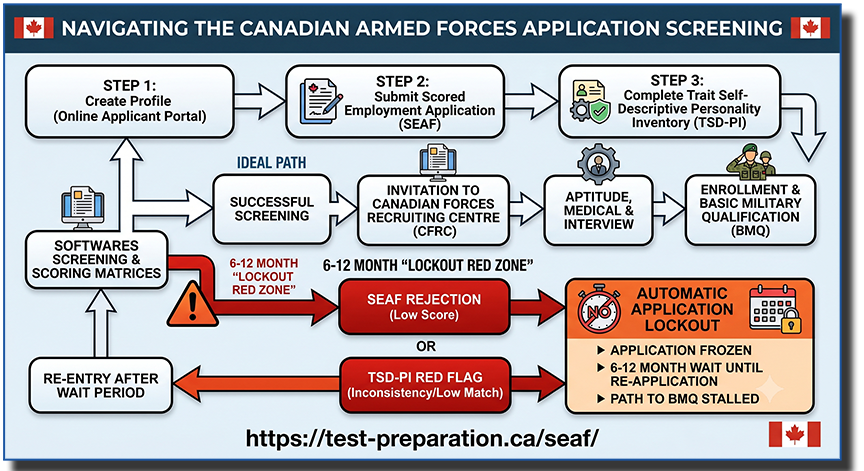
Canadian Forces recruitment process 2026. The Department of National Defence dropped the old CFAT for a reason. In its place, and in addition to the CFAT, they built a highly sophisticated, algorithmic gatekeeper. Today, you are being judged by software tracking two massive hurdles: the Scored Employment Application Form (SEAF) and the Trait Self-Descriptive Personality Inventory (TSD-PI).
If you treat the SEAF like a standard civilian resume or answer the TSD-PI with generic casualness, you will trigger an automatic software rejection. The worst part? There is no immediate retake. You will hit a crushing 6-to-12 month lockout period that freezes your file. Your entire life plan, career pivot, and journey to the Canadian Forces Recruiting Centre testing (CFRC) come to a grinding, bureaucratic halt while your peer cohort moves on to basic training without you.
We don’t do corporate fluff or academic theories here. Our hand-crafted CAF SEAF and TSD-PI practice test PDF modules strip away the jargon to show you exactly how the military’s screening software evaluates your background and traits.
By utilizing our step-by-step Canadian Forces SEAF preparation course online, you will discover the hidden scoring keys needed to build a flawless profile on day one. Let’s get your screening passed so you can secure your interview and head straight to basic training.
What is the CAF SEAF and TSD-PI? (The New Military Screening Explained)
If you’re looking at the Canadian Armed Forces application portal right now, you are probably drowning in acronyms. Up until recently, everyone just stressed over the CFAT. Now, there is a whole new system. When we sit around the kitchen table here in Victoria pulling apart these new tests, we always start by defining exactly what we are up against.
Before we look at practice strategies, here is the plain-English breakdown of the new algorithmic gatekeepers (SEAF vs CFAT differences):
Who takes it: All new applicants applying to join the Canadian Armed Forces (CAF).
What it is: The Scored Employment Application Form (SEAF) is a digital assessment that evaluates your education, leadership, and life achievements. It is paired with the Trait Self-Descriptive Personality Inventory (TSD-PI), a forced-choice personality test that checks if your character aligns with the military ethos.
When it started: The Department of National Defence introduced the SEAF in October 2024 to officially replace the traditional CFAT multiple-choice exam.
Where you take it: Both assessments are completed online through the digital CAF applicant portal.
Why it matters: The military changed the rules to speed up enrollment. If you pass this initial software screening, you can begin Basic Military Qualification during a new probationary period. But if your answers trigger a red flag on the TSD-PI, you face an automatic 6-to-12 month lockout period.
If you pass the SEAF, you can enter a new probationary period and head straight to Basic Military Qualification (BMQ) while the government finishes processing your reliability security status behind the scenes. But that only happens if you beat the algorithm first.
We don’t want you getting blocked by a piece of software before your career even starts. We spend our days checking our practice modules to make sure you understand exactly what the algorithm is looking for, because helping the folks who usually get forgotten by the system is exactly why we do this.
The 2-Minute TSD-PI Challenge
Can you maintain structural consistency under pressure? The military’s personality inventory doesn’t just look at what you say—it calculates your consistency score across dozens of forced-choice variations. Try these three sample items right now. Select the statement that is MOST like you and the statement that is LEAST like you.
The 2-Minute TSD-PI Challenge
A) I always ensure tasks are completed precisely to regulations, even under tight timelines.
B) I prefer to work independently without constant team alignment.
C) I find it easy to adapt when emergency directives disrupt my planned schedule.
If you selected B as MOST like you, you just triggered a major automated red flag.
Why it's a trap: Many applicants choose this thinking it shows self-reliance or high focus.
The Reality: The TSD-PI scores heavily against the Military Ethos Trusted to Serve core values. In a military environment, rogue individualists are a liability. The software interprets "preferring to work independently without constant team alignment" as a structural deficiency in Teamwork and Cohesion.
PDF Download
Exclusive: A.I. TSD-PI Interivew Coach
Online Course
Amazon Paperback
The Complete CAF Success Bundle
Reverse Practice: Spot the Broken Solution
Most test prep companies pump out endless multiple-choice questions. We believe the fastest way to learn is to step into the boots of the examiner. Below is a sample draft response submitted by a applicant on their digital CAF Scored Employment Application sample questions portal.
The Prompt: “Describe a time you faced a significant obstacle while leading a team project and how you resolved it.”
The Candidate’s “Broken Solution”:
“During my college group project, two members stopped contributing their work. I realized our grade was at risk, so I stayed up for two full nights and completed their sections myself. We submitted the project on time and achieved an A grade. The instructor praised my work ethic.”
Where Did This Go Wrong?
Review the candidate’s answer carefully. Why would the screening algorithm award this response a failing score for leadership competencies?
- The Flaw Breakdown:
- Zero Resource Management: The candidate completely failed to demonstrate leadership or conflict resolution. Instead of managing the team, communicating boundaries, or re-allocating assets, they simply absorbed the burden.
- Violating the Core Competencies: The algorithm searches for Collaboration and Accountability. By doing the work secretly, the candidate shielded non-performers and broke team cohesion.
- The Fix: A passing response must emphasize the structural steps taken to re-engage the missing members, the administrative balancing of the workload, and the successful navigation of interpersonal friction—not just working extra hours solo.
When the software forces you to choose between two seemingly harmless statements, it isn’t making small talk. It is mathematically calculating whether your personal character aligns with the strict military ethos expected of every service member.
The software isn’t impressed that you pulled an all-nighter to save a college project. It flags your file because your story demonstrated absolutely zero leadership competencies when faced with a struggling team.
CFRC Operational Alert: We are tracking a major formatting change within the Online Applicant Portal screening steps. Candidates processing through the Toronto, Edmonton, and Vancouver recruiting centres are reporting tighter time limits on the behavioral matrices. Do not casually click through the initial screens. The countdown timers are active, and an uncompleted section defaults to a zero score, locking your file.
PDF Download
Exclusive: A.I. TSD-PI Interview Coach
Online Course
Amazon Paperback
The Complete CAF Success Bundle
The CFAT vs. SEAF Comparison Matrix
| Assessment Area | The Old Way: CFAT | The New Way: SEAF |
|---|---|---|
| Format & Location | In-person at a recruiting centre (Paper/Pencil or supervised computer) | Completed remotely via the digital CAF applicant portal |
| Primary Focus | Traditional academics: Math, logic, spatial reasoning, and vocabulary | Algorithmic screening: Life-history, education, and leadership competencies |
| Timing & Pacing | Strictly timed across all sections | Untimed overall, but features strict countdown timers on behavioral matrices |
| The Next Step | Lengthy wait for standard processing and basic training slots | Unlocks the new probationary period to start Basic Military Qualification faster |
Canadian Forces SEAF & TSD-PI: Straight Answers from the Kitchen Table
Hey folks, Brian here. Running an independent publishing outfit out of Victoria, BC, means I hear from a lot of people across the Pacific Northwest and the rest of Canada who are gearing up for the Armed Forces. Lately, there’s been some terrible advice floating around about the new screening process. To clear the air, my team and I put together this quick FAQ.
I’ve been told the SEAF is just a basic work history form. Is that true?
I hear this all the time, and it is completely wrong. The Department of National Defence didn’t just update a few paperwork fields; they built a highly algorithmic gatekeeper using the SEAF (Scored Employment Application Form) and the TSD-PI (Trait Self-Descriptive Personality Inventory). If you treat the SEAF like a casual civilian resume, the software will automatically reject you.
What happens if I mess up the personality test? Can I just retake it?
I wish I had better news, but no. There is no immediate retake. A slip-up here hits you with a crushing 6-to-12 month lockout period. Your entire file gets frozen while the rest of your peer cohort packs their bags for basic training. After years spent in the classroom, I know exactly how heartbreaking it is to see someone get locked out over a completely avoidable mistake. That’s exactly why we built our practice guides.
How are your prep materials different from the rest?
Big Prep companies just pump out endless, repetitive multiple-choice questions without showing you how the test actually thinks. We don’t do corporate fluff or academic theories here. Instead, we do the painstaking work—like the endless triple-checking of questions—to find the hidden scoring keys. For example, if you say you “prefer to work independently” on the personality test, the algorithm flags you as a teamwork liability. We strip away the jargon so you can step right into the examiner’s boots. Use these tools to build a flawless profile on day one.
Which study package is right for me?
It depends on how you like to study. If you just want the raw guides to read over coffee, grab our instant PDF download for $24.99 CAD. If you want the full toolkit, our top recommendation is the Complete CAF Success Bundle. It gives you the SEAF/TSD-PI modules, full access to our online CFAT course, and our AI interview coach.
Whatever path you take, know that your choice matters. We aren’t some faceless corporation; we’re just a dedicated team working hard to help you succeed. Every time you pick up one of our study guides, you’re directly helping us support educational charities—like sustainable food projects in Nepal—and giving a leg up to the forgotten students out there who just need a fair shot.
Cheers,
Brian
Our Independent Publishing Standards
Every practice question, spatial reasoning drill, and study guide on this page is researched and checked against the current Canadian Armed Forces SEAF portal standards. Since 2005, we have combined deep research into military exam patterns with real-world teaching insights to offer practical readiness alongside test prep. Rather than serving up generic math or logic puzzles, our materials focus directly on the actual core skills candidates need to score high and secure their preferred military occupation. We designed these tools specifically for the Canadian recruitment process to get everyday folks into rewarding careers in the forces without the corporate runaround.
Written by, Brian Stocker MA.,
Since 2005, we’ve sat at the kitchen table here in Victoria helping Canadian applicants clear their recruitment hurdles. As independent publishers, our practice materials are shaped by years spent in the classroom and extensive research into the exact pain points where candidates stumble on military aptitude tests—and exactly how to fix them. We are fiercely committed to giving everyday folks the straight goods they need to step into the uniform and start a great career.
Published by, Complete Test Preparation Inc.
Official Policy Source: Based on the Department of National Defence’s October 2024 recruitment modernization mandate, which officially replaced the CFAT with the Scored Employment Application Form (SEAF).
Updated: Friday, September 18th, 2026
Published: Friday, June 19th, 2026