Back

OFAI FACT Success Guide – PDF Download

$34.99 GST ( For Canadian Residents only)

Your Career Roadmap, 3-Minute Power Drills, and the Blueprint for Mastering Personal Characteristics

  • Master the 55% of your score everyone else ignores.
  • Build the mental math speed to crush the Fireground sections.
  • Stop repeating your mistakes with our “Anatomy of a Wrong Answer.”
  • Get the confidence to walk into the testing center ready for anything.
  • Grab your copy today and join our mission to support global literacy.
-
+
Category:

Stop studying for the wrong test.

Most candidates fail because they treat the Personal Characteristics section—55% of your score—like a casual personality quiz. In reality, it is a rigorous Situational Judgment Test that measures integrity, teamwork, and emotional stability. If you don’t know the framework, you’re just guessing. And in this process, a guess can cost you a whole year.

I’m Brian, an independent publisher here in Victoria. Since 2005, we’ve been pushing back against “Big Prep” by creating materials that actually help students pass, rather than just selling them heavy textbooks filled with fluff.

What’s Inside:

  • The FACT Framework: A breakdown of how to think like a firefighter, not just a student.
  • Mental Math Bootcamp: Master flow rates and ratios without relying on a calculator.
  • 3-Minute Power Drills: Practice under real-time pressure to ensure you never run out of time again.
  • The Anatomy of a Wrong Answer: We don’t just give you the answer; we show you why the other options are traps.
  • A Realistic Career Roadmap: Insights into the 24-hour grind and the “Fireground Mindset” to keep you focused.

    Big Test Prep companies think problem-solving is a one-size-fits-all game.

    They’ll give you questions about zoo animals and math problems about buying apples to get you ready for the FACT.  We don’t do that. The math and Personal Charactistics questions in this book are built entirely around firefighter realities you will actually encounter—like calculating supply drops, understanding rank structures, and assessing mechanical systems. You aren’t just learning how to pass; you’re getting ready for day one of basic training.

    We do Test Prep + Job Prep.

Big Prep Questions Our Questions

Two trains leave a station at the same time. One has an average speed of 72 km/hr. and the other 52 km/hr. How far apart are they in 20 minutes?

a. 6.67 km.

b. 17.33 km.

c. 24.3 km.

You work in department that shares office space with others. Everyone in your department is given a new computer system and you are left out. What should you do?

a. Consider this as a small mistake and talk to the head of department.

b. Confront the head of department and ask him to explain why you are being treated unfairly.

c. Take a new computer from a colleague.

d. Make a complaint with the HR department.

A fire engine’s water tank holds 2500 litres. If the crew uses 850 litres to extinguish a vehicle fire, how many litres of water remain in the tank?

a. 1550 litres

b. 1650 litres

c. 3350 litres

d. 1750 litres

You are completing morning equipment checks. You notice a fellow firefighter quickly signs off on their Self-Contained Breathing Apparatus (SCBA) log without actually inspecting the mask or cylinder pressure. What is the BEST action?

a. Check their SCBA for them to ensure it is safe for the next call.

b. Report them immediately to the Captain for falsifying safety documents.

c. Ignore it; they are an experienced firefighter and probably know their gear is fine.

d. Pull them aside privately, point out that you noticed they missed the check, and remind them that their safety affects the whole crew.

We know how much this test weighs on you. That’s why we triple-check every question for accuracy. When you choose our materials, you’re also joining our mission. We take a portion of every sale to support literacy charities, because we believe everyone deserves a shot at a better life through education.

You aren’t just a number to us. You’re a future firefighter. Let’s get you ready.    

Contents

  • Crush the Personal Characteristics section: Stop guessing and start understanding the specific firefighter values OFAI is actually looking for.

  • Master mental math without a calculator: Get fast and confident at the flow rates and tank volumes you need to solve under pressure.

  • Ditch the “common sense” trap: Learn why your first instinct is often wrong and how to identify the “ideal candidate” answers in situational scenarios.

  • Stop rushing through the finish line: Use our 3-minute power drills to build the rhythm you need to finish every section without running out of time.

  • Get a clear roadmap for your career: Understand exactly what a 24-hour shift feels like and how to handle the rigors of the fireground before you ever step into the exam room.

  • Learn from your mistakes: Use our "Anatomy of a Wrong Answer" to stop repeating the same errors and start stacking up points.

Exclusive 3-Minute Power Drills

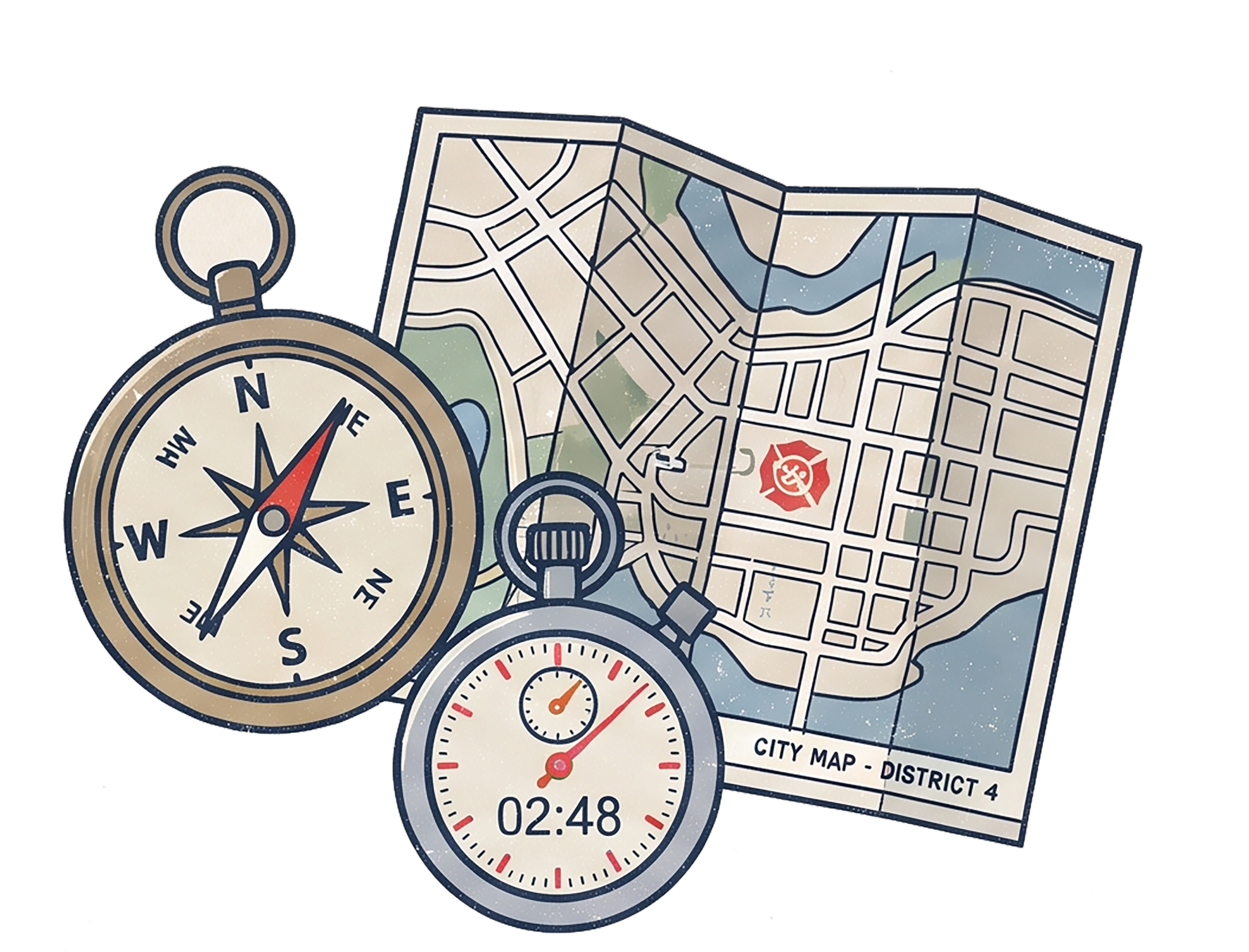
Try it out! Scan the code to start the 3-minute timer and answer these questions in 3 minutes 
1. You are driving the apparatus back to the hall after a routine medical call. A civilian aggressively tailgates the fire truck, honking their horn and waving their hands because you are driving the speed limit in the fast lane. What is the BEST response?
a. Tap your brakes to send a message that they need to back off.
b. Ignore the driver, maintain your speed, and safely change lanes when you have a clear opportunity to let them pass.
c. Pull the truck over to the shoulder, step out, and calmly explain to the driver that tailgating a fire apparatus is illegal.
d. Speed up to get out of their way and avoid a confrontation.
2. Read the scenario and the four actions (I-IV). Choose the option that correctly identifies the BEST and WORST actions. Scenario: You are tasked with rolling wet hose on the apron. A senior firefighter walks by, laughs, and says, “You’re rolling that way too tight, rookie. Loosen it up or it’ll never dry right.” You were explicitly taught at the academy to roll it tight.
I. Respectfully acknowledge the tip, loosen the roll slightly to show you are listening, and ask the Captain later for clarification on the hall’s preferred method.
II. Tell the senior firefighter that the academy taught you the correct way and you are going to stick with that.
III. Stop rolling, walk away, and refuse to finish the chore until the Captain tells everyone the official rule.
IV. Ignore the senior firefighter completely and keep rolling it tight without making eye contact.
a. Best is I; Worst is III.
b. Best is II; Worst is IV.
c. Best is IV; Worst is I.
d. Best is I; Worst is II.
3. Rate the effectiveness of the following action. Scenario: You are performing a routine fire inspection at a local bakery. The owner is very friendly and offers you and your partner a box of fresh pastries for the road, completely free of charge. Action: You thank the owner for their generosity but politely decline, explaining that department policy prohibits accepting gifts from businesses you are actively inspecting.
a. 1 - Highly Ineffective
b. 2 - Somewhat Ineffective
c. 4 - Somewhat Effective
d. 5 - Highly Effective

Answer Key and Analysis

1. B
Emotional stability behind the wheel is critical. You cannot control the public, but you can control the apparatus. Ignoring the aggressive driver and moving over safely diffuses the situation without compromising safety.
Option C is the ‘Common Trap’ here. Pulling over to “educate” the citizen sounds like taking initiative, but it actually escalates the conflict and delays your return to service. Firefighters are not traffic enforcement.
Option A is incorrect because tapping your brakes is aggressive and dangerous.
Option D is incorrect because speeding up violates traffic laws and endangers the public.
Test Tip: Never choose an answer that involves a firefighter getting out of the truck to confront an angry citizen. Let it go.
2. A
Navigating advice from senior members that contradicts academy training is a classic rookie problem. The Best action (I) shows respect, adaptability, and uses the chain of command (the Captain) to settle the issue later. The Worst action (III) is insubordination and abandoning a task—the fastest way to fail probation.
Option D is the ‘Common Trap’ because Action II (telling them you will stick to the academy way) feels like standing your ground for safety, but doing it bluntly to a senior over a non-emergency chore creates unnecessary hostility.
Option B is incorrect because Action IV (ignoring them) is highly unprofessional.
Option C is incorrect because it misidentifies the best and worst actions completely.
Test Tip: When academy rules clash with “firehall traditions” on non-emergency chores, be polite, adapt in the moment, and ask your officer for the final ruling later behind closed doors.
3. D
This is a textbook example of maintaining integrity. Accepting gifts from a business you inspect is a massive conflict of interest and violates public trust. Politely declining and citing policy removes the personal element and handles the situation perfectly.
Option C is the ‘Common Trap’. Students often pick “Somewhat Effective” because they worry declining a gift might offend the owner. Don’t hedge your bets—following a zero-tolerance policy perfectly is a 5 out of 5.
Option A is incorrect because the action is highly effective, not ineffective.
Option B is incorrect because following policy politely is never ineffective.
Test Tip: If a scenario involves a strict ethical rule or law (like accepting gifts), and the action follows it flawlessly, always score it a 5.  

The Anatomy of a Wrong Answer

A truly dangerous wrong answer is usually 90% correct. Test writers know that if an answer is completely ridiculous, you will cross it out immediately. Instead, they use a technique I call the “Half-Right Trap.” They take a true statement from the passage and attach a false condition to the end of it.
Here is how it looks in practice:
The Passage:
“When performing overhaul operations to check for hidden fire extension, firefighters must wear their full structural personal protective equipment (PPE), including Self-Contained Breathing Apparatus (SCBA), until the Incident Commander uses a calibrated multi-gas meter to declare the atmosphere safe.”
The Question:
According to the passage, when is a firefighter permitted to remove their SCBA during overhaul?
The “Half-Right” Wrong Answer:
When the Incident Commander declares the atmosphere safe because the main fire has been completely extinguished.
Commentary
Look closely at that wrong answer. The first half is perfect: “When the Incident Commander declares the atmosphere safe...”
If you are rushing because of the clock, your brain sees those familiar words, assumes the rest of the sentence is fine, and selects it. But look at the second half: “...because the main fire has been completely extinguished.”
Does the passage say anything about the main fire being completely extinguished? No. In the real world, obviously, the fire needs to be out before overhaul finishes. But on this test, if it isn’t on the page, it does not exist. The test writer used a real-world truth to poison the second half of the answer. Always read the entire answer choice. One single word can make the whole thing wrong.

Choose your Version

Best For: The Last-Minute Crammer

Instant PDF Access

Did you just realize the test is tomorrow? We've got you.

  • Start in 60 seconds: Buy it, download it, and open the first practice question immediately—zero shipping wait times.
  • Find answers in a flash: Use Ctrl+F to locate that tricky formula in 2 seconds, rather than flipping through 500 pages.
  • Only print your weak spots: If you ace everything except Geometry, print only the Geometry section. Save paper, ink, and time.
  • Keep your wallet happy: Because we don't print or ship, we pass massive savings onto you. Premium content, bargain price.
Flagship Experience
Best For: The Maximum-Score Seeker

All-Access Online Course

This is our closest thing to having a personal tutor on speed dial, minus the hourly rate.

  • Instant, Human-Like Help at 2 AM: Our exclusive A.I. Study Hall Tutor acts as a patient mentor, teaching you how to untangle problems yourself.
  • Turn "Dead Time" into Progress: Exclusive 3-Minute Power Drills let you squeeze in high-yield practice between classes or during lunch.
  • Kill Test-Day Anxiety: "Timed Test" mode recreates the exact clock-ticking environment of the real exam so you feel completely ready.
  • Never Get Blindsided: Encounter every possible twist and tricky wording with the deepest question bank available anywhere.
  • A Laser-Focused Roadmap: Tracks every wrong answer, color-coding strengths as green and weaknesses as red so you study smarter.
  • Your Classroom is Everywhere: Study from your library, home, or coffee shop—anywhere with Wi-Fi.

Not for you if: You despise screens, have unreliable internet, or prefer the tactile feel of paper. We recommend the Classic Paperback instead.

Best For: The Focus-Driven Traditionalist

Amazon Paperback

The old-school approach isn't broken—it's scientifically proven to build deeper focus.

  • Escape the Notification Nightmare: No pop-ups, email chimes, or Instagram temptations. Just you, the page, and total mental immersion.
  • Make Knowledge Stick: Physically underline, circle, and scribble notes in the margins to turn passive reading into active mastery.
  • Protect Your Eyes & Sleep: Strain-free, battery-free, and requires zero charging for marathon study sessions.
  • A Tangible Trophy: Physically watch those dog-eared pages stack up to fuel your motivation.
  • The Ultimate Security Blanket: Permanent, reliable, and requires no subscriptions, Wi-Fi, or passwords.

Not for you if: Your test is tomorrow and you need to start cramming in the next 60 seconds.

Reviews

There are no reviews yet.

Be the first to review “OFAI FACT Success Guide – PDF Download”

Your email address will not be published. Required fields are marked *