
Taking a Situational Judgement test like TOJ 375? We can help! TOJ 375 Practice and Test Information
Let’s sit down and have a straight-talk conversation about the email invitation you just received from the Public Service Commission of Canada. If you are looking at a notice to write the supervised Test of Judgement 375, your immediate future in the federal public service is officially on the line.
Here is the brutal truth that “Big Prep” corporate companies won’t tell you: if you treat this like a standard common-sense quiz, you are setting yourself up for a devastating setback.
Failing this exam triggers a strict, mandatory 180-Day Wait Penalty. If you don’t hit the required percentile, the Personnel Psychology Centre locks your profile out completely. You cannot retake the assessment for six full months. For a Canadian job seeker, that means watching active recruitment inventories, pool selections, and immediate officer-level career placements vanish until next season.
You do not have six months to waste waiting around on a regional testing facility calendar.
That is why we designed our Canadian Federal Public Service TOJ 375 Prep Course and downloadable tools to stop you from guessing. We strip away the heavy academic fluff and teach you the exact behavioural psychology framework evaluators use to grade your options.
Whether you need a high-intent Test of Judgement 375 PDF Download to print out at your kitchen table tonight, or interactive online training to simulate the exact exam environment, we ensure you learn to see through the trap choices, spot the correct operational logic, and pass on your very first attempt.
The “2-Minute Canada-Wide Drill”
Can you make the “Canadian Choice” under pressure? You have 90 seconds to review Scenario 1 and Scenario 2 below.
The Goal: Identify the “Most Effective” and “Least Effective” responses.
The Reality: 70% of first-time testers pick the “Passive” or “Aggressive” options.
Set the TIMER
Question 1: The “Duty of Care” (Public Safety & Ethics)
Scenario: You work for a provincial regulatory body. You notice a minor safety protocol is being skipped to meet a high-volume deadline. Your supervisor is aware and says they will “fix it in the next cycle.”
A) Follow the supervisor’s lead to ensure the department meets its performance targets.
B) Document the shortcut and wait for the quarterly audit to report it.
C) Politely raise the concern with the supervisor, citing the specific provincial safety mandate.
D) Immediately report the supervisor to the provincial ombudsman.
Question 2: The “Inclusion” Trap (Diversity & Respect)
Scenario: During a team brainstorming session for a new municipal program, a colleague’s cultural perspective is being dismissed by the group as “not applicable to the current Canadian market.”
A) Stay neutral to avoid office politics and keep the meeting on schedule.
B) Suggest a private meeting with the colleague later to hear their ideas.
C) Intervene and ask the colleague to elaborate on how their perspective could enhance the program’s reach.
D) Tell the group they are being biased and demand an apology.
Question 3: The “Front-Line” Conflict (Citizen Service)
Scenario: An angry citizen is at your desk demanding a service that they are clearly ineligible for based on current BC/Ontario (Province-Specific) legislation.
A) Firmly tell them they are ineligible and ask them to leave the office.
B) Empathize with their situation, explain the legislative requirement, and offer an alternative resource or appeal path.
C) Give them the service anyway to avoid a public scene and “de-escalate” the situation.
D) Refer them directly to your manager without trying to handle it first.
1. The "Nuance" Reveal: Most people pick B (too passive) or D (too aggressive). In the Canadian Public Service, C is the winner. It demonstrates stewardship and accountability without breaking the chain of command unnecessarily.
2. The "Nuance" Reveal: C is the high-scoring answer. Canadian competencies place a massive weight on Active Inclusion. B is "nice," but it doesn't foster a culture of respect within the team environment.
3. The "Nuance" Reveal: B is the only answer that hits the "Citizen-Centred Service" competency. C is a "Policy Violation" (automatic fail), and D shows a lack of "Self-Management."
How did you do? Beat the Clock?
3/3: Impressive. You have the “Professional Lens.” But can you maintain this under the 50-question pressure of the real SJT? [Button: Take the Full Practice Test]
0/3 to 2/3: You’re falling into the “Nuance Gap.” You’re choosing common-sense answers instead of competency-based ones. [I Need the Study Guide – PDF Download]
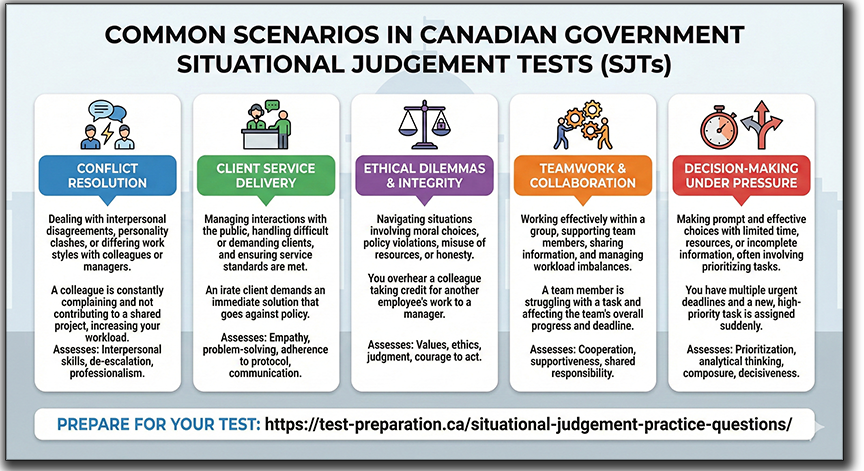
Canadian Context" Diagnostic Table
| Situation | "General" Answer (Likely Fail) | Canadian Professional Standards (Pass) |
|---|---|---|
| Team Conflict | Siding with the most productive member to ensure the project stays on schedule. | Facilitate a collaborative "Win-Win" dialogue. Focuses on psychological safety and long-term team cohesion. |
| Public Safety | Waiting for a senior manager’s sign-off before taking action to follow hierarchy. | Act decisively according to the "Duty of Care." Prioritizes immediate public protection over administrative protocol. |
| Diversity & Inclusion | Treating everyone exactly the same to maintain "neutrality." | Recognize and accommodate specific needs. Aligns with Equity and the Canadian Human Rights Act. |
| Workplace Ethics | Strictly following a rule even if it causes a clear harm to a citizen. | Apply the "Spirit of the Policy." Balancing rules with empathy and professional ethics. |
PDF Download
Online Course
Situational Judgement Practice Video
Tips for taking the TOJ 375
The average time that a candidate needs to complete one question is approximately 90 seconds. Unlike many tests, a candidate is not under extreme time pressure but still has to utilize each second wisely. The questions are not technical; hence no calculations and deep analytical reasoning is required.
Make sure that you understand the situation thoroughly before proposing the best action. The following steps are crucial when taking the test of judgment test:
- Use approximately 40-45 seconds reading and understanding the situation- then think of the most effective action.
- Utilize approximately 30-35 seconds reading and internalizing the proposed solution. Compare the proposed solution and your ideal solution to the situation.
- Mark a solution and move to the next question. Don’t spend too much time on any question. If you are not sure about a question, make a note and revisit at the end.
- Unethical options are wrong- If an action evolves around dishonesty, provocative actions, and disguising personal errors, the choice is incorrect.
Tips for Taking Situational Judgement Tests
Other essential tips that ensure one succeeds in TOJ 375 are:
- Know your role
- Identify the main quality being assessed
- Understand the mechanisms and patterns of your responses
- Be yourself
- Study the solutions carefully
- Read the instructions carefully
- Don’t overthink the answers
- Consider the context carefully
- Practice situational judgment tests
Effective practice gives greater confidence in the format of the written test and reduces test anxiety. Adequate preparation ensures high scores on any test.
Common Mistakes on a Situational Judgement Test
- Not reading the question carefully: Situational judgement questions are often complicated with multiple scenarios. As with any multiple choice question – read the question and all the choices carefully before selecting your answer.
- Not considering the context: The context of the situation often determines the best answer. In a different context, the correct answer will be different. Take into account all details of the scenario, the people involved, the setting, and the goals of the organization.
- Not considering the ethical implications: Many situational judgement questions have ethical considerations. In choosing your answer, consider not only the legal and professional implications, but also the moral and ethical implications of your actions.
- Choosing the most drastic option: Some questions may present extreme options as choices, but in a real-life situation, the drastic option is almost never the best. Extreme actions presented as solutions are designed to distract and are rarely the best course of action. Usually, but not always they can be eliminated right away.
- Not considering the long-term consequences: Some decisions have short-term benefits but long-term consequences. Consider the potential consequences of your actions before making a decision.
- Not thinking critically: Consider multiple perspectives and options when answering. This is a critical skill that situational judgement questions are designed to test.
Common Mistakes on a Situational Judgement Test
Situation Judgement Practice and Explanation Video
Test of Judgement FAQ
The Quick-Start: PDF
- Instant access: No waiting for the mail. Start right now.
- Searchable: Use Ctrl+F to find exact formulas fast.
- Print what you need: Save ink by only printing the tricky sections.
- Budget-friendly: We pass the printing savings straight to you.
The Gold Standard: Course
- ★ EXCLUSIVE: A.I. Study Hall Tutor. A helping hand that nudges you in the right direction without giving the answer away.
- ★ EXCLUSIVE: 3-Minute Power Drills. Build speed without the burnout.
- Dynamic Tracking: Know exactly where you're ready and where you need work.
- Realistic Simulation: Mimics the pressure of the real exam.
Written by, Brian Stocker MA.,
Published by, Complete Test Preparation Inc.
Updated: Thursday, June 11th, 2026
Published: Thursday, October 21st, 2021
3 Comments
Helpful indeed.
I have to purchase more quizzes.
Try the course – https://courses.test-preparation.ca/course/sjt-318
Really an eye opener. I learnt so much from the little exercise.