
GCT2 & PSEE Analytical Practice | Pass in Canada First Time
Let’s have a little straight talk about the federal hiring process. If you are staring down the barrel of the GCT2 or the PSEE, you already know what is on the line. The Public Service Commission isn’t just testing your smarts; they are testing your ability to cut through noise under pressure.
Here is the reality that keeps most candidates awake at night: the 180-Day Deep Freeze. If you misread a single analytical reasoning puzzle and fail by one mark, you are banned from re-testing for six months. You have to sit on the sidelines and watch a half-year of salary and seniority pass you by.
Don’t let a manufactured logic puzzle stall your career. Our GCT2 analytical reasoning practice test PDF and federal public service exam prep online are hand-crafted to decode the exact patterns the PSC uses. No fluff. No corporate jargon. Just the exact strategies you need to pass the first time and get to work immediately without the six-month penalty.

Analytical reasoning questions, sometimes called AR, assess the ability to look at qualitative or quantitative information, such as a group of facts or rules, discern a pattern and conclude what must be true from four multiple-choice options. Analytical reasoning employ deductive reasoning and generally do not require any specialized or background knowledge. Examples of the skills analytical reasoning questions use are, comprehending the structure of a set of relationships; recognizing logically equivalent statements; and inferring what could be true or must be true from the given facts or rules.
However, some tests, such as the Canadian Public Service Entrance Test (PSEE) require knowledge of the actual relations between items in order to answer correctly. Other questions reverse the relationships between nouns or ignore the real relationships to answer correctly.
PSEE PDF Download
PSEE Online Course
GCT2 Online Course
The 3-Minute Incident Report Drill: The Pressure is On
Let’s get real for a second. Sitting at your kitchen table with a coffee and an untimed practice test is easy. Sitting in a dead-silent testing centre with a clock glaring at you? That is when the sweat starts.
The giant corporate prep companies just hand you a massive textbook and say, “Read this.” That doesn’t help you when you are actually in the room. To pass the GCT2, PSEE, or Public Service Commission (PSC) exams, you have to know how to perform when your heart rate is up. So, we are going to bring that pressure right here.
Below are three hand-picked analytical reasoning questions. You have exactly three minutes to solve all of them. That is 90 seconds per question .
Here is how we do this:
- Clear the deck. Put away the phone and close your browser tabs. Grab a physical pencil and a blank piece of scrap paper. Some federal testing centres are very strict about digital scratchpads, so we always train how we play.
- Start the video timer
- Map it, do not read it. Do not sit there pondering the paragraph. The second the timer starts, your pencil should be moving. Translate the confusing text into simple symbols on your paper (e.g., A > B = C < D).
- Trust the map. Look at the multiple-choice options and pick your answer based only on the symbols you drew. Do not bring in outside common sense, and do not re-read the paragraph unless your map is broken.
- Drop the pencil. When the alarm goes off, you stop. Even if you are halfway through reading an option.
Take a breath. Start the timer. Let’s get to work.
1. For this question, you must use your knowledge of the real relations between the existing nouns to determine the best response
A CRUX resembles LILO but is closer to the Sun
A TIGO resembles Jupiter but is farther from the Sun
A LILO resembles Earth but is closer to the Sun
Which of the following is the best response?
a. LILO is farther from the Sun than Jupiter
b. CRUX is closer to the Sun than Jupiter
c. Jupiter is closer to the Sun than LILO
d. LILO is farther from the Sun than TIGO
2. For this question, you must use your knowledge of the real relations between the existing nouns to determine the best response
A CUXA is stronger than iron
A BUXA is weaker than wood
A SAMSA is weaker than BUXA
Which of the following is the best response?
a. CUXA is not the strongest
b. BUXA is weaker than iron
c. SAMSA is not the weakest
d. None of the above
1. B
Based on the relations outlined in the first & third statements, we know that a CRUX is closer to the Sun than a LILO, which is closer than Earth. We also know that Earth is closer than Jupiter from the knowledge we have of these existing nouns, and, from the second statement, we know that Jupiter is closer than a TIGO. From closest to farthest, the order of the words is: CRUX, LILO, Earth, Jupiter, TIGO. Therefore, t choice B is the correct answer.
[CRUX<LILO<Earth<Jupiter<TIGO in terms of distance from the Sun]
2. B
Based on real relations, iron is stronger than wood. From the first statement, we know CUXA is stronger than iron which is stronger than wood. From second statement, we know that BUXA is weaker than wood, and therefore weaker than iron and CUXA. From third statement, we know that SAMSA is weaker than BUXA and therefore weaker than other three as well. From weakest to strongest, the order of the words is: SAMSA, BUXA, wood, iron, CUXA. Therefore, choice B is correct.
[SAMSA<BUXA<wood<iron<CUXA in STRENGTH]
The Post-Drill Review – How did you Do?
The sprint builds your speed, but the review is where you actually secure your passing grade.
When the three minutes are up, do not just move on. You need to do the “Anatomy of a Wrong Answer” check. If you missed a question, figure out exactly where your pencil betrayed you. Did you miss a reversed relation? Did you assume a connection between two nouns that the text never actually made? Find the flaw in your logic map so you never make that same mistake on exam day.
Put in the three minutes. It is uncomfortable at first, but it works. And knowing that every time one of our students nails these exams it helps us fund education charities across the globe—well, that keeps us writing these drills every single day.
The Anatomy of a Wrong Answer
The Trap: Applying “Real World” common sense to a “Reverse Logic” question.
Let’s look at a classic trap.
The Question:
SOTA is taller than TATI.
KOTI is shorter than a giant.
SOTA is taller than a dwarf.
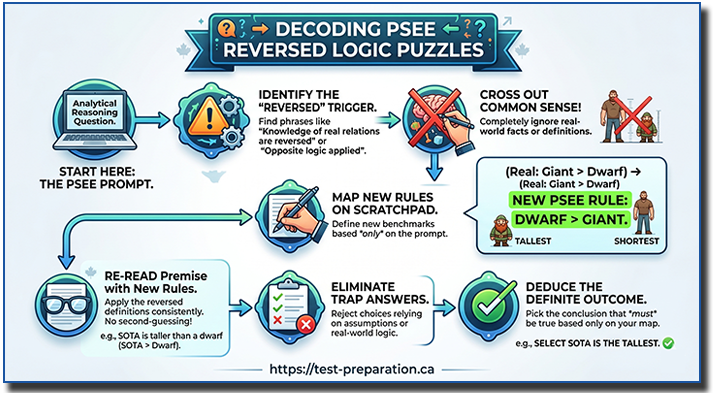
(Assume reversed real relations: a dwarf is taller than a giant).
Who is the tallest?
Why smart people pick the wrong answer (KOTI):
When the clock is ticking, your brain panics and defaults to the real world. You see “giant” and assume it’s the tallest benchmark. You see KOTI is shorter than the giant, and your brain scrambles the logic. But the PSC explicitly told you to reverse the real relation.
The Fix: The moment you see a reversed relation, cross out the nouns and write in the new reality. Dwarf = Tallest benchmark. Giant = Shortest benchmark. Since SOTA is taller than the dwarf (the new highest benchmark), SOTA must be the tallest.
Reverse Practice Scenarios
Instead of answering the question, play the role of the examiner. Find the flaw in this student’s broken logic.
Broken Solution 1:
The Rules: RUNI is lighter than PINI. WITI is denser than rubber. PINI is as light as steel. (Assume reversed relations: steel is lighter than rubber).
The Student’s Deduction: “Since steel is usually heavy, PINI must be heavy. Therefore, WITI is the lightest.”
The Flaw: The student ignored the “Reversed Relations” rule and applied outside knowledge.
In this specific universe, steel is lighter than rubber. The student failed to map the new reality: RUNI < PINI = Steel < Rubber < WITI.
WITI is actually the densest.
Broken Solution 2: The Rules: NONO is longer than a meter. BONO is smaller than a micron. SONO is longer than BONO.
The Student’s Deduction: “SONO must be the longest because it’s mentioned last and is bigger than BONO.”
The Flaw: The student made an assumption not supported by the text. We know SONO > BONO, and NONO > Meter > Micron > BONO.
But we have absolutely zero information connecting SONO to NONO. The only true deduction is that BONO is the smallest.
Never invent relationships the prompt didn’t give you.
How to Answer Analytical Reasoning Questions
Here are some tips on how to answer analytical reasoning questions:
- What are the Relationships Start by identifying the relationships between the nouns. Here, you have three statements that describe relationships between CRUX, TIGO, LILO, Earth, Jupiter, and the Sun. These relationships will be described by words like, “resembles,” “closer to,” “farther from.”
- Picture the Relationships Visualize or create a mental diagram of the relationships.
- Analyze Analyze each statement individually and extract as much information as possible. For example:
- CRUX resembles LILO but is closer to the Sun.
- TIGO resembles Jupiter but is farther from the Sun.
- LILO resembles Earth but is closer to the Sun.
- Look for common elements or patterns Here, you can see that the relationships are objects (CRUX, TIGO, LILO) and planets (Earth, Jupiter) and their positions relative to the Sun (closer or farther).
- Draw Conclusions What conclusions can you make about the relationships between CRUX, TIGO, LILO, Earth, Jupiter, and the Sun. For example, you can infer that CRUX is similar to Earth, but is closer to the Sun, and TIGO is similar to Jupiter, but is farther from the Sun.
- Logic Make inferences. For example, since CRUX is closer to the Sun and LILO is closer to the Sun as well, you can conclude that CRUX and LILO are both closer to the Sun than TIGO (A TIGO resembles Jupiter but is farther from the Sun). More logic tutorials and practice
- Eliminate Incorrect Options Eliminate choices that don’t fit the relationships or inferences. Narrow down your choices based on the logic you’ve applied. More on how to answer multiple choice.Here, Options C and D can be eliminated right away as incorrect.c. Jupiter is closer to the Sun than LILO
d. LILO is farther from the Sun than TIGO
- Double-Check Before finalizing your answer, double-check your answer is consistent with the information provided in the statements.
Analytical Reasoning Practice Questions
1. For this question, you must use your knowledge of the real relations between the existing nouns to determine the best response
A DJANGO resembles a watermelon but is heavier
A VANGO resembles an apple but is lighter
A TANGO resembles a DJANGO but is heavier
Which of the following is the best response?
a. DJANGO weighs less than an apple
b. VANGO weighs as much as TANGO
c. TANGO is the heaviest
d. None of the above
2. For this question, you must use your knowledge of the real relations between the existing nouns to determine the best response
KAKA is thicker than milk
SUKA is of same thickness as water
BUKA is thinner than water
Which of the following is the best response?
a. SUKA is the thinnest
b. BUKA is thicker than milk
c. milk is thicker than SUKA
d. KAKA is not the thickest
3. For this question, you must use your knowledge of the real relations between the existing nouns to determine the best response
NONO is longer than meter
BONO is smaller than micron
SONO is longer than BONO
Which of the following is the best response?
a. BONO is the smallest
b. NONO is the longest
c. SONO is the longest
d. SONO is smaller than nano
Answer Key
1. C
Based on real relations, milk is thicker than water. From first and second statements, KAKA is thicker than milk, which is thicker than water, which is of same thickness as SUKA. From third statement, BUKA is thinner than water and therefore the lightest. From heaviest to thinnest, the order of the words is KAKA, milk, water & SUKA, BUKA. Therefore choice C is correct.
[KAKA>milk>water=SUKA>BUKA]
2. A
Based on real relations, meter is longer than a micron (1 meter = million microns). From first statement, NONO is longer than meter ,which is longer than micron. From second statement, micron is longer than BONO. From third statement, SONO is longer than BONO, making BONO the smallest. Relationship between SONO and NONO is unclear.
Therefore choice A is correct. All other choices are inconclusive.
3. A
Reversing real relations, lizard is longer than a crocodile. From first statement, MOLO is longer than lizard, which is longer than crocodile. From second statement, crocodile is longer than VEL. From third statement, THOL is longer than VEL, making VEL the smallest. Relationship between THOL and MOLO is unclear.
Therefore, choice A is correct. All other choices are inconclusive.
PSEE PDF Download
PSEE Online Course
GCT2 Online Course
Written by, Brian Stocker MA.,
Published by, Complete Test Preparation Inc.
Updated: Wednesday, June 3rd, 2026
Published: Thursday, January 6th, 2022