
The CCAT Kindergarten Test
Let me guess. You just found out your five-year-old has to sit for the CCAT in a few weeks, and panic is starting to set in.
You’ve probably heard the hallway chatter at school: “You can’t study for a cognitive test” or “If they are gifted, they’ll just pass.” But let’s be honest. We are talking about five and six-year-olds. A brilliant child can easily bomb a test simply because they don’t understand how a bubble sheet works, or because they got distracted by the colourful pictures in the wrong section. The anxiety of this “one shot” to get into a specialized educational track is real, and the fear that your bright child might slip through the cracks of a busy Canadian school system is exactly why we built this.
You don’t need to turn your living room into a stressful classroom. You just need a tear-free, confident test day. If you are looking for Kindergarten gifted test practice Canada actually uses, you are in the right place. Our complete CCAT kindergarten practice test online course will make sure that when your child opens that booklet, there are no surprises—just a chance for their natural abilities to shine.

CCAT Kindergarten Test sections and descriptions
Demystifying Nelson Education Gifted Testing
If you look at the official documents from Nelson Education (the folks who publish the CCAT here in Canada), they make the test sound like an exam for a secret government agency. “Quantitative reasoning,” “Norm-referenced batteries,” “Cognitive domains.” Big Prep companies love to copy and paste this corporate-speak to make you feel like you need a Ph.D. just to help your five-year-old.
Let’s translate that into plain English.
This test is just broken down into three sections—what they call “batteries.” The school board might give them all in one morning or spread them out over a few days. Here at the kitchen table in Victoria, my team and I have spent months tearing apart the format of these three batteries so you don’t have to.
The Verbal Battery (Hint: It’s not a reading test)
When you hear “verbal,” you probably think of reading and vocabulary. But for Kindergarteners, this section is almost entirely picture-based and audio-guided. Kids look at Picture Analogies and Picture Classification—basically, grouping images that belong together. They also do a Sentence Completion section where they listen to instructions and pick the right picture. The real challenge here isn’t the vocabulary. It’s testing their ability to sit still and listen to a recorded voice. We spend hours triple-checking our practice audio because I hate seeing a smart kid get a low score just because they got distracted by clunky school headphones.
The Nonverbal Battery (Shapes and more shapes)
This is the section that often trips up the most creative kids. It’s all about spatial awareness and logic using shapes instead of words. They’ll face Figure Matrices (finding the missing shape in a grid), Figure Classification, and Paper Folding. Yes, paper folding. They have to imagine what a piece of paper would look like if you folded it, poked a hole in it, and unfolded it. Big Prep just throws hundreds of random shape quizzes at you. Instead, we teach you how to grab a paper napkin at dinner and physically show your child how the folds work. Once they see it with their own eyes, the anxiety disappears.
The Quantitative Battery (Math without the numbers)
Don’t worry, nobody is asking your five-year-old to do long division. This battery is about spotting mathematical patterns using pictures. The questions cover Number Analogies, Number Series, and Number Puzzles. At this age, they are usually looking at pictures of abacus beads or train cars, figuring out how many beads need to go on the last string to make the pattern work. The biggest hurdle here? Kids rush. They see a pattern they think they recognize and bubble in the first answer. We write our practice questions to include those common “trap” answers so your child learns to slow down and look at every option.
When you understand how simple the bones of this test actually are, the whole process gets a lot less scary. And that’s exactly why we do this. Every time a parent uses our tools to help their kid confidently walk into that testing room, a portion goes toward funding our local educational charity partners. We believe every single student—especially the forgotten ones who might not test perfectly out of the gate—deserves a fair shot at these programs, not just the kids whose parents can afford an expensive tutor.
The CCAT Kindergarten 2-Minute Drill: What It Is & How to Use It
Most “Big Prep” corporations think test prep means strapping a five-year-old into a chair and forcing them to stare at a screen for an hour. Anyone who has actually spent five minutes in a real Kindergarten classroom knows exactly how that story ends: tears, tantrums, and a flat-out refusal to look at another shape matrix.
That is why we built the 2-Minute Drill. It is a fast, entirely stress-free way to build test familiarity right at your kitchen table, without making your child feel like they are being cross-examined.
Think of it as a conversational game rather than a flashcard quiz. We take a single, tricky style of question from the Canadian Cognitive Abilities Test, strip away the scary testing atmosphere, and give you a quick, bite-sized moment of connection that fits right between afternoon snacks and tying shoes.
CCAT Challenge Timer
How to Run a 2-Minute Drill at Home
We keep the rules simple because we know your day is already busy enough. Here is exactly how to do it:
1.Pick Your Single Question: Do not overwhelm them with a whole page.
Select just one question below. Do not show them a giant packet of papers. If you are using our printed pages, cover the other questions with a blank piece of paper so their eyes don’t wander or get overwhelmed by all the options.
2. Set the Video Timer: Keep it hidden if your child gets anxious.
If your child is the type who gets stressed out by ticking clocks, keep the phone facing down. The timer isn’t there to pressure them—it is there to protect their attention span and keep the energy light.
3. Let Them Think Out Loud:The magic happens in their reasoning, not just the final answer.
Give them a full minute to process. If they guess quickly and get it wrong, don’t say “No.” Instead, use our “Reverse Practice” approach. Ask them: “Why do you think that one matches?” You might find out they picked the squirrel because it has fur, or they picked the fish because they love swimming. Understanding how they think is how we catch the common traps before the real school board screening day.
Why this works when heavy studying fails
The secret sauce isn’t just the accuracy of our questions—it’s how your child encounters them.
By keeping the practice down to a tight, two-minute window, you prevent the cognitive fatigue that causes bright kids to shut down. They start to view the CCAT questions as fun little puzzles to solve with you at the table, rather than a heavy administrative hurdle that determines their school track.
It keeps the confidence high and frustration at zero.
Give a 2-Minute Drill a shot tonight before dinner. You’ll be amazed at how quickly those pattern-recognition skills start to click when the pressure is entirely off.
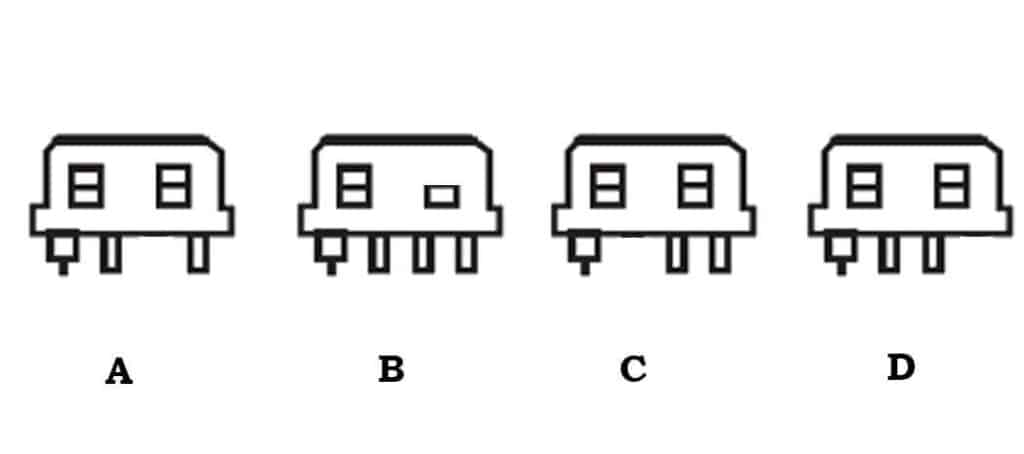
Choose the figure that is different
1.
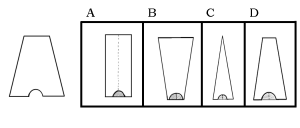
2. When the two longest sides touch what will the shape be?
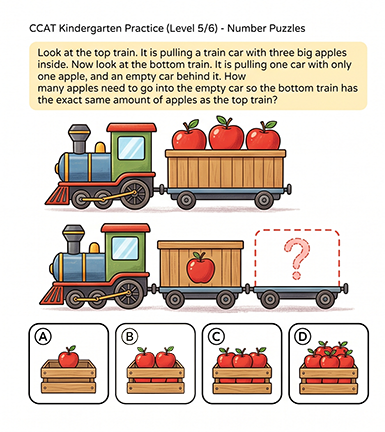
3. The Prompt (Read this to your child): “Look at the top train. It is pulling a train car with three big apples inside. Now look at the bottom train. It is pulling one car with only one apple, and an empty car behind it. How many apples need to go into the empty car so the bottom train has the exact same amount of apples as the top train?”
1. B
Choice B has 3 prongs and a half rectangle in the upper portion.
2. D
3. B 2 apples
-
If they chose (A) 1 apple: They just copied what was already in the first car of the bottom train.
-
If they chose (C) 3 apples: They saw three apples on the top train and just matched the picture, forgetting that the bottom train already has one apple loaded.
Reverse Practice” Scenarios
Spot the Flaw (For Parents)
Instead of grilling your child, let’s train you on how to spot their thought process. Here is a broken solution to a Figure classification problem.
The Problem: The prompt shows three shapes: a blue triangle, a red triangle, and a yellow triangle. The choices are (A) a blue square, (B) a green circle, (C) a purple triangle, and (D) a red star.
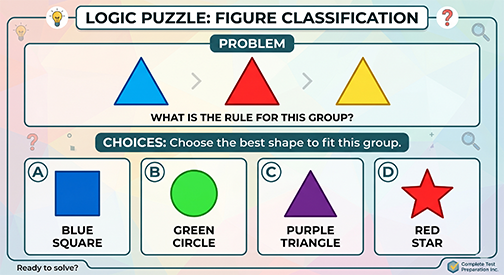
The Flawed Logic: Your child proudly points to (A) the blue square. Why did they do that?
The Explanation: They saw the blue triangle in the prompt and matched the colour blue. They missed the underlying rule that the category is “Triangles.” When you know why they make the mistake, fixing it takes ten seconds.
How to prepare for the CCAT Kindergarten Test
- Start preparations a month before the scheduled test day. Allowing a child to have enough time to go through and familiarize with the material will increase their chances of doing well in the test. Try to practice with your child regularly for a few hours as they have to learn gradually without feeling pressured or stressed. Avoid waiting until the last minute to rush your child through the material.
- To familiarize your child with the concept of time, use a timer in your practice. Each section of the test has a time limit so practice sessions will really help. Ensure that your child understands they cannot take most of the time on one question or section. If you are dealing with a slow test taker, having regular timed tests is very important. Your child is supposed to be familiar with the amount of time they should take to answer every question.
- Go through the explanation of each question in detail. Make sure your child goes through explanations even when they answer the questions right. Explanations are important as they provide vital insights into the questions and answers.
Written by, Brian Stocker MA.,
Published by, Complete Test Preparation Inc.
Updated: Tuesday, June 2nd, 2026
Published: Friday, April 1st, 2022