Stop Betting on Your Child’s Educational Future.
In many Canadian school districts, if a student doesn’t hit the mark on the CCAT 2 and 3 verbal analogies, they are locked out of gifted programming for up to two full years. That’s 730 days of missed enrichment because of one confusing morning.
I’ve spent years at my kitchen table in Victoria deconstructing these tests because “Big Prep” corporate guides are too generic. You don’t need an Americanized manual; you need a CCAT Level 2 Practice Test Canada edition. Whether you are looking for a CCAT Verbal Analogies PDF Download or a full CCAT Level 3 Online Course, we’ve built these tools to ensure your child walks into that testing centre with zero “test-day jitters.”
Unlike dictionary memorization, mastering CCAT verbal analogies relies entirely on identifying the underlying structural relationship—the ‘bridge sentence’—between the first word pair.
Understanding CCAT Verbal Analogies: Levels 8 & 9
If your child is getting ready for standardized testing, you’ve likely come across the Canadian Cognitive Abilities Test (CCAT). To put it simply: CCAT Level 8 is the standardized cognitive assessment administered to Grade 2 students in Canada, and CCAT Level 9 is the standardized cognitive assessment administered to Grade 3 students. Originally published by Houghton Mifflin Harcourt, these exams look beyond routine school subjects to measure a student’s general cognitive ability and reasoning potential.
Within the test battery, the verbal analogies section doesn’t ask kids to memorize a massive dictionary. Instead, it measures inductive reasoning and pattern recognition by testing how well a student can spot relationships between words.
The Kitchen Table Secret: “Bridge Sentence” Logic
The best way for a 7 or 8-year-old to master analogies without burning out is through “bridge sentence” logic. By teaching students to turn word pairs into a simple descriptive sentence (e.g., “A puppy grows up to be a dog”), they can bypass confusing trick wording and solve the puzzle using pure conceptual relationships.
CCAT Grades 2 & 3 Verbal Analogies: The Essentials
Who: Designed for Grade 2 (Level 8) and Grade 3 (Level 9) students preparing for standardized cognitive ability assessments.
What: Verbal analogies measure a child’s inductive reasoning and pattern recognition by testing the relationship between word pairs (e.g., following the “A is to B as C is to D” format).
When: Administered during regular school testing windows, best prepared for using short, daily 2-minute power drills rather than stressful marathon cram sessions.
Where: Tested as a core component of the verbal battery on school-administered CCAT exams, with practice available online, via instant PDF download, or through structured print workbooks.
Why: Unlike memorizing vocabulary lists, mastering analogy logic helps students uncover the underlying semantic relationship between words, building lifelong problem-solving skills and boosting test-day confidence.
Navigating Ontario Gifted Program Testing & Western Canadian Standards
I’ve seen how the Ontario Gifted Program testing cycle can feel like a high-stakes marathon. In boards like the TDSB or Peel, the CCAT is often the “first look” at a student’s potential for specialized enrichment. But it isn’t just an Ontario thing; out west, the Western Canadian Learning Outcomes increasingly rely on these cognitive benchmarks to identify students who need more than the standard classroom fare.
Whether you’re dealing with the specific Grade 4-8 Provincial Curriculum Standards or the younger primary levels, the “Big Prep” companies often miss the nuances. They might give you a CAT-4 vs. CCAT comparison that looks good on paper, but fails to account for how our local testing centres actually operate. Around here, we focus on the specific verbal logic and “Canadian-isms” that show up in our schools, ensuring your child isn’t tripped up by American spelling or unfamiliar cultural references during those critical 90 minutes.
The 60-Second “Kitchen Table” Micro-Challenge
Before you buy a single practice test, I want you to try a little experiment. Sit down with your child and ask them these three specific Canadian-themed analogies.
Don’t just look for the right answer—ask them why they chose it.
1. Skate is to Ice as Kayak is to…
2. Toque is to Head as Mitten is to…
3. Loonie is to Gold as Quarter is to…
1. Most kids will shout "Paddle!" because they associate kayaks with paddles. The Relationship: Surface. You skate on ice; you kayak on Water.
2. Kids often pick "Cold" or "Snow" because that's when you wear them. The Relationship: Location. A toque goes on your head; a mitten goes on your Hand.
3. They might pick "Twenty-five" because that's the value. The Relationship: Colour/Material. A loonie is gold-coloured; a quarter is Silver.
How did they do?
If your child jumped at the “Trap” answers, don’t worry—that is exactly what the CCAT is designed to do. It tests Classification and Relationship Logic, not just vocabulary.
This is the difference between a student who is “bright” and a student who is “test-ready.” In our CCAT Grade 2 (Level 8) and CCAT Grade 3 (Level 9) Online Courses, we don’t just give them a list of words to memorize; we teach them to spot these relationship patterns in seconds.
Brian’s Tip: If they missed more than one, it’s usually because they are thinking associatively (what goes together) rather than logically (how are they related). We can fix that in about a weekend of practice.
CCAT Grade 2 Practice Test PDF vs Online Course
| Target Grade Level | The "Premium" Training Ground |
|---|---|
|
CCAT Grade 2 (Level 8 Assessment) |
Enroll in Online Course |
|
CCAT Grade 3 (Level 9 Assessment) |
Enroll in Online Course |
|
Teacher and Tutor (Lesson Plans and Bundles) |
CCAT Grade 2 Teacher Tutor Lesson Plans and Workbook Bundle |
Cracking the Verbal Analogies for Canadian Students
If your child is a big reader, they might walk into the Verbal Battery with a lot of confidence. But the CCAT doesn’t just want to know if they know big words—it wants to know if they can spot the “bridge” between them.
In the Grade 3 Level 9 exam, an analogy looks like a puzzle. It’s usually presented as:
A is to B, as C is to [?].
The “Bridge” Method
The secret we teach in our CCAT Grade 3 Prep Course is to build a simple sentence (the bridge) that connects the first two words. Then, you just drop the third word into that same sentence.
- The Question: Apple is to Fruit, as Carrot is to [?]
- The Bridge: “An apple is a type of fruit.”
- The Solution: “A carrot is a type of… Vegetable.”
Watch Out for the “Big Prep” Traps
Generic study guides often use American terminology or logic that doesn’t quite sit right with our curriculum. At the kitchen table, we focus on the three most common “bridges” seen in the Nelson Education Assessment Canada:
- Part to Whole: Finger is to Hand as Leaf is to Tree.
- Function: Hammer is to Nail as Pen is to Paper.
- Opposites (Antonyms): Ice is to Hot as Quiet is to Loud.
Teacher Tip” for Grade 2 and 3s
At this age, students often pick an answer just because the words are “related.” For example, if the question is Bird is to Fly, they might pick Water because birds drink water.
The Fix: Always ask your child, “Does the bridge stay the same?” If a bird does flying, does a bird do water? No. A bird does chirping. That’s how you find the right answer every single time.
When you zoom in on the verbal analogies section, success doesn’t come from memorizing giant dictionary lists. Instead, the test is measuring inductive reasoning and how well a student can group items into proper word categories. When a child learns to look past the individual words and identify the underlying semantic relationship connecting them, answering the question becomes a breeze.
Of course, even the brightest kids can feel rushed when the clock starts ticking. Teaching them smart timed test strategies—like moving past a tricky question and returning to it later—takes the panic out of the room so they can focus on what they do best.
The 2-Minute CCAT Challenge: Are You Ready?
For Grade 2 (Level 8) and Grade 3 (Level 9) students, 2-minute daily power drills build cognitive pattern recognition without triggering study burnout.
Think of this as a quick “brain warm-up” before diving into our full CCAT Grade 3 Practice Test PDF.
The Goal: See if your child can maintain their logic while the clock is running.
The Setup:
1. Clear the table of distractions.
2. Have an HB pencil and a piece of scratch paper ready.
3. Set a timer (or use the analog visual above) for exactly 120 seconds.
4. Encourage: “It’s okay if you don’t finish them all—just focus on the pattern!”
CCAT Challenge Timer
Verbal Analogies Practice Questions
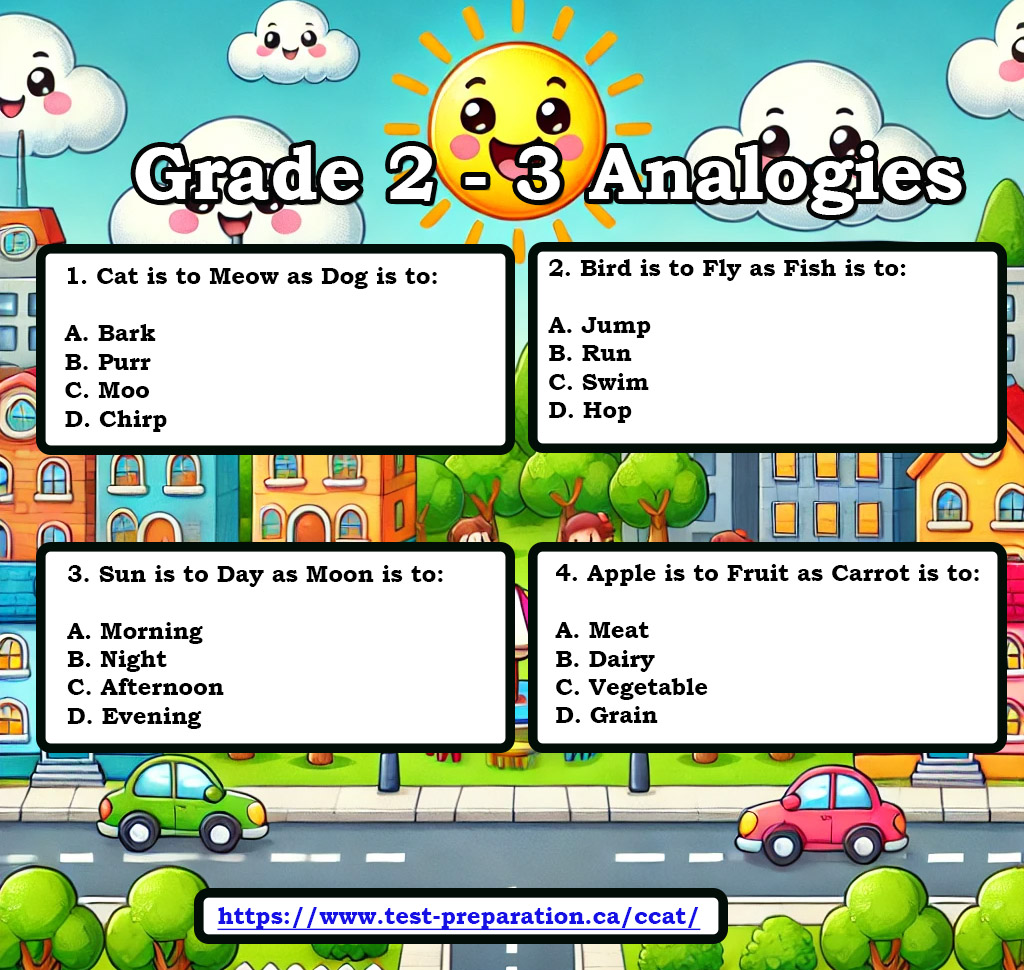
1. Cat is to Meow as Dog is to:
A. Bark
B. Purr
C. Moo
D. Chirp
2. Bird is to Fly as Fish is to:
A. Jump
B. Run
C. Swim
D. Hop
3. Sun is to Day as Moon is to:
A. Morning
B. Night
C. Afternoon
D. Evening
4. Apple is to Fruit as Carrot is to:
A. Meat
B. Dairy
C. Vegetable
D. Grain
5. Book is to Read as Piano is to:
A. Write
B. Draw
C. Sing
D. Play
6. Tree is to Leaf as Flower is to:
A. Root
B. Petal
C. Branch
D. Trunk
1. A Bark
Cats make a "meow" sound, and dogs make a "bark" sound.
2. C Swim
Birds fly in the air, and fish swim in the water.
3. B Night
The sun is out during the day, and the moon is out during the night.
4. C Vegetable
An apple is a type of fruit, and a carrot is a type of vegetable.
5. D Play
You read a book, and you play a piano.
6. B Petal
A leaf is part of a tree, and a petal is part of a flower.

| Target Grade Level | Choose Your Format & Training Ground |
|---|---|
|
CCAT Grade 2 (Level 8 Assessment) |
Enroll in Online Course (Flagship)
Instant PDF Download
— Zero Wait Time, Ctrl+F search, print only weak spots, big savings.
Amazon Paperback
— Screen-free focus, active learning, tangible record of progress.
|
|
CCAT Grade 3 (Level 9 Assessment) |
Enroll in Online Course (Flagship)
Instant PDF Download
— Zero wait time, selective page printing, budget-friendly.
|
|
Teacher & Tutor (Lesson Plans & Bundles) |
CCAT Grade 2 Teacher Tutor Lesson Plans and Workbook Bundle
|
Frequently Asked Questions: CCAT Verbal Analogies (Levels 8 & 9)
What exactly is a verbal analogy on the Grade 2 and 3 CCAT?
Verbal analogies test how well a child spots relationships between words, following the classic “A is to B as C is to D” pattern (e.g., Puppy is to Dog as Kitten is to Cat). For Level 8 (Grade 2) and Level 9 (Grade 3), it’s less about knowing big dictionary words and more about understanding how concepts connect—like categories, functions, or opposites.
Why do young students often stumble on analogies?
Usually, it’s not because kids lack ability; it’s because they jump to conclusions too fast based on a single word rather than the underlying bridge. If they see “hot” and “cold,” they might automatically look for another temperature word instead of checking whether the first pair was actually opposites.
How can we practice these at the kitchen table without causing burnout?
Keep it short and punchy. Try our 2-minute power drills rather than marathon study blocks. Turn it into a light game over breakfast or on the way to school: “If a bird has feathers, what does a fish have?” Short, daily bursts of focus build pattern recognition naturally without tiring them out.
Should we focus on memorizing word lists or learning logic?
Always focus on the relationship. Memorizing thousands of words is an uphill battle for a 7 or 8-year-old. Once they learn to articulate how two words relate (e.g., “part of,” “used for,” or “opposite of”), they can figure out almost any puzzle the test throws at them.
Date Modified: Sunday, September 20th, 2026
Our Independent Publishing Standards
Every practice question, 2-minute drill, and study guide on this page is researched and checked against current cognitive testing standards for young learners. Rather than serving up generic, imported materials or dry corporate question banks, our CCAT Grade 2 prep focuses on age-appropriate verbal, non-verbal, and quantitative reasoning puzzles that help children build real confidence. Since 2005, we have combined years of real-world classroom experience with good old-fashioned hard work to give families the straight goods, without the corporate runaround from "Big Prep".Written by, Brian Stocker MA., Complete Test Preparation Inc.
Since 2005, we’ve operated right here out of Victoria, British Columbia, sitting at the kitchen table and helping students clear academic hurdles. As an independent publisher, I make sure our practice materials are shaped by real classrooms and a deep understanding of the exact pain points where young learners stumble—and how to fix them. We are fiercely committed to helping the often-forgotten student unlock their potential and move forward with purpose. Plus, a portion of every purchase goes directly to supporting global educational charities and literacy programs, because everyone deserves a chance to learn.
Published by: Complete Test Preparation Inc.