
CFAT & SEAF Practice Tests: Pass the Canadian Exam
Let’s talk straight. If you are applying to the Canadian Armed Forces right now, the biggest hurdle isn’t the physical training—it’s the waiting room.
I talk to recruits every week who are terrified of blowing their one shot at the test, failing, and getting thrown into the Department of National Defence’s 3-to-6-month administrative backlog. They watch the specific trade they wanted slip away while they wait to rewrite.
Don’t let a generic test score decide your career. You need to pass the first time so you can get to work immediately. Whether you are prepping for the new Scored Employment Application Form (SEAF) or need a complete CFAT practice test PDF download to master the math and spatial sections, we have you covered. Grab our Canadian Forces SEAF study guide online, skip the waitlist, and lock in your chosen trade.
Canadian Armed Forces Aptitude Test Qualification
The New Reality: Navigating Department of National Defence recruiting centres
If you’ve walked into any of the Department of National Defence recruiting centres lately, or spent ten minutes reading the military forums online, you are probably scratching your head. Half the people say the CFAT is dead, and the other half say you still have to study for it.
Let me shoot straight with you: The rules changed in late 2024, and you need to understand both tests to survive the process.
Here is the plain-English breakdown of what you are actually facing:
- The SEAF (The Gatekeeper)
The Scored Employment Application Form (SEAF) is the new first hurdle. It’s an online assessment you complete early in the application process.
- What it is: It is essentially a heavy-duty resume audit. There is no math and no shape-folding here.
- What it tests: It evaluates your life experience—things like teamwork, physical fitness habits, and achievement orientation.
- The Trap: A lot of folks treat it like a regular civilian job application and fail. The military grading algorithm isn’t looking for someone who just “shows up on time.” You have to know how to translate your civilian jobs (like managing a busy retail shift or coaching local hockey) into the specific leadership points the CAF is looking for.
- The CFAT (The Trade Decider)
The Canadian Forces Aptitude Test (CFAT) is the classic, timed, multiple-choice exam. The rumours that it was cancelled are completely false—it was just moved further down the pipeline for some recruits.
- What it is: A strict, timed test covering Verbal Skills, Spatial Ability (folding 3D shapes), and Problem Solving (math and logic).
- What it tests: Your raw cognitive processing speed under pressure.
- The Trap: If you want a competitive, specialized trade (like Intelligence, Aircrew, or specific technical roles), or if you are aiming for an Officer path, you are still writing the CFAT. Even if your recruiter puts you on the expedited trial, you will likely still sit down to write this test at Basic Training. If your math skills are rusty, this is the test that will bump you out of the trade you actually want.
The Bottom Line:
The SEAF gets your foot in the door and proves you have the character to serve. The CFAT proves you have the cognitive speed to handle the specific trade you are applying for.
You cannot afford to wing either of them.
PDF Download
Commander la Version Française
Online Course
Amazon Paperback
The 2-Minute Recruiter’s Desk Challenge
Imagine you are finally sitting across from a Canadian Armed Forces recruiter. They look at your file, slide a piece of paper across the desk, and tap their watch. You have 120 seconds to prove you can process information under pressure. No calculators allowed. Go.
1. The Convoy Problem (CFAT Math / Problem Solving)
A resupply convoy travels at 60 km/h. They need to reach a forward operating base 150 km away before 14:00 hours. What is the absolute latest time they can depart the staging area?
2. The Grid Problem (CFAT Logic / Spatial Awareness)
You are navigating a grid map on a night exercise. From your starting position, you move 3 grids North, 2 grids East, 1 grid South, and 3 grids West. What direction are you currently facing relative to your starting point?
3. The SEAF Audit (Civilian Translation)
The recruiter points to a line on your civilian resume: “I managed a busy restaurant shift when two staff members called in sick on a Friday night.”
The Challenge: In one sentence, rewrite that experience to prove to the military algorithm that you possess the “Adaptability and Crisis Management” competency.
1. The Convoy: 11:30 hours. (150 km divided by 60 km/h is 2.5 hours. Two and a half hours before 14:00 is 11:30). The Trap: A lot of students panic at the 2.5 and just subtract 2 hours, guessing 12:00. The CFAT tests your ability to stay calm and finish the math.
2. The Grid: North-West. (You went 3 North, 1 South = Net 2 North. You went 2 East, 3 West = Net 1 West). The Trap: Trying to draw the whole map in your head instead of just cancelling out the opposites.
3. The SEAF Audit: If you wrote something about "working hard to serve food fast," you failed the audit. The CAF doesn't care about the food. A winning SEAF answer looks like: "Reallocated team resources on the fly to maintain operational output during a sudden 30% reduction in manpower."
Need more than 2 minutes?
Access the full CFAT SEAF online course Canada with our Study Hall AI Tutor.”
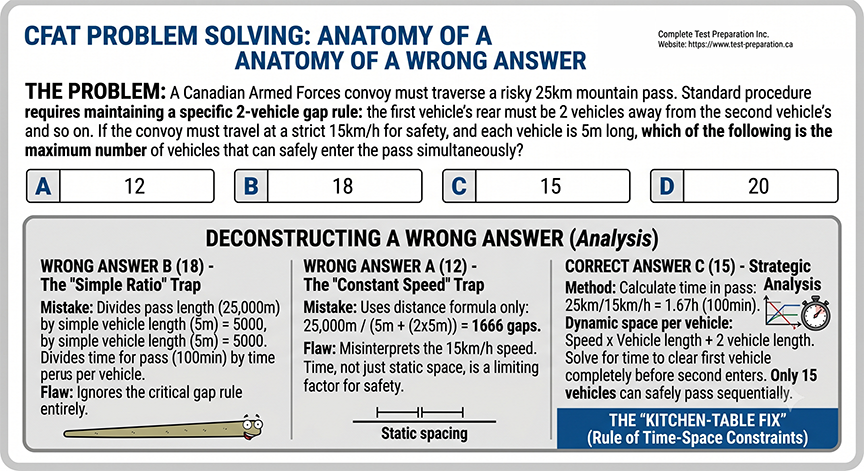
Reverse Practice Scenarios
Instead of giving you a question, I’m giving you a broken solution. Find the flaw.
Scenario 1 (Problem Solving):
The Setup: A CAF vehicle uses 12 litres of fuel per 100 km. The driver calculates that for a 450 km trip, they need 50 litres of fuel.
Where did this go wrong?
The Flaw: The driver rounded down the math in their head to save time. 12 litres x 4.5 (for 450 km) equals 54 litres. On the CFAT, “close enough” is the trap answer designed to catch folks who rush.
Scenario 2 (SEAF Application):
The Setup: An applicant fills out their SEAF experience section and writes: “I am a very hard worker and always show up on time for my construction job.”
Where did this go wrong?
The Flaw: The CAF doesn’t award points for baseline expectations. Showing up on time is the bare minimum. The SEAF algorithm looks for initiative. A fixed, high-scoring answer is: “Trained two new hires on site safety protocols while maintaining daily construction deadlines.”

The Myth-Buster: Why the Scored Employment Application Form didn’t replace the CFAT
Walk into any online forum or chat room for Canadian military applicants right now, and you’ll see the exact same rumour repeated over and over: “The CFAT is dead. They replaced it with the SEAF, so you don’t need to study math or spatial patterns anymore.”
It sounds great. It’s exactly what a nervous applicant wants to hear. But it is a dangerous myth, and falling for it is the fastest way to get your application rejected.
Here is the truth about what is actually happening behind the scenes at recruiting centres across Canada.
The Bureaucratic Reality: Two Tests, Two Different Jobs
The Department of National Defence did not launch the Scored Employment Application Form (SEAF) to eliminate testing. They launched it to fix a massive backlog.
Before the SEAF, every single applicant—whether they wanted to be an infantry soldier or a fighter pilot—had to wait months just to book a seat for the CFAT at a physical testing centre. It created a bottleneck that stretched on for miles.
By introducing the SEAF as an online, at-home initial assessment, the military can instantly screen applicants based on their background, character traits, and fitness habits. It acts as an automated triage system.
The “Trade Decider” Catch
Here is why you still need to prepare for the CFAT: The SEAF cannot measure your cognitive processing speed, and the military absolutely requires that metric for competitive occupations.
-
If you are applying for a specialized trade: Roles like Intelligence Officer, Pilot, Air Traffic Controller, Signals Officer, or Marine Systems Engineering still strictly require a high CFAT score. The SEAF merely qualifies you to be considered; the CFAT determines if you actually have the mental agility to handle the job.
-
The Basic Training Verification: Even if your chosen trade allows you to bypass the initial proctored exam because of a high SEAF score, the military reserves the right to test your cognitive skills later. Thousands of recruits arrive at Saint-Jean-sur-Richelieu for Basic Training only to find out they still have to sit down and verify their aptitude under pressure.
Don’t Let “Big Prep” Mislead You
Giant, corporate test-prep companies love this myth because it means they can sell you a cheap, generic “personality test guide” and call it a day. They don’t want to spend the time building hard math drills or spatial reasoning modules.
At Complete Test Preparation Inc., we don’t gamble with your career. We know that skipping the math and spatial prep because of a internet rumour is a shortcut straight to the waiting list. Our materials cover both the character-translation strategies for the SEAF and the rigorous logic drills for the CFAT, ensuring you pass the first time—no matter which piece of paper the recruiter slides across the desk.
The Personality Test: Surviving the Trait Self-Descriptive Personality Inventory (TSD-PI)
Once you clear the SEAF, the military slides another puzzle across the desk: the Trait Self-Descriptive Personality Inventory (TSD-PI).
Big Prep companies will tell you that you can’t study for a personality test. They’ll say, “Just be yourself!” That is terrible advice. If you go into a military behavioural screening without understanding how the algorithm grades your answers, you are going to flag your own profile as a risk.
The CAF isn’t looking for a generic “nice person.” They are looking for specific operational traits: emotional stability, conscientiousness, and team cohesion under extreme stress.
The “Perfect Soldier” Trap
The TSD-PI presents you with dozens of statements like: “I never lose my temper,” or “I always put others before myself.” You have to rate these from Strongly Disagree to Strongly Agree.
Here is where most applicants blow it. They try to guess what the military wants to hear. They think, “An ideal soldier never gets mad and always works perfectly,” so they click Strongly Agree to every single positive trait on the page.
The Flaw: The TSD-PI has a built-in “Lie Scale” (Uncommon Virtues). If you claim to be a perfect human being who never experiences normal human flaws, the algorithm flags your test for “social desirability bias”—meaning it thinks you’re faking it. Your test is tossed out, and your application stalls.
The Kitchen-Table Strategy for the TSD-PI
To pass the personality audit, you need to understand the Three Pillars of Military Consistency:
- Own the Minor Flaws: It is okay to admit to minor, normal human behaviours. Answering Agree or Neutral to “Sometimes I get frustrated when plans change” shows the algorithm you are honest, which validates your high scores on the important traits like integrity and duty.
- Spot the Rephrased Statements: The test will ask you the same question three different ways to check if you are lying. It might ask if you enjoy group projects on page 2, and then ask if you prefer working alone on page 10. If your answers don’t match up, the system flags you as inconsistent.
- Answer Through the Lens of Duty: When the test asks about rule-following or structure, there is no middle ground. The CAF needs to know you can follow orders when things go sideways. Traits involving compliance, safety, and reliability should always reflect a strong commitment to structure.
Our online course includes a full breakdown of the behavioral traits the DND looks for, helping you understand how to answer honestly without accidentally triggering the system’s red flags.
“Day in the Life” Career Roadmaps: Navigating the Hidden Hurdles
Getting from your kitchen table to Basic Military Qualification (BMQ) prep isn’t just about showing up at a recruiting centre with a pen. The Canadian military enrolment pipeline is a journey with specific administrative traps that catch unprepared applicants off guard.
Let’s look at the actual roadmaps for two major entry paths in the Canadian Armed Forces, mapping out the exact hurdles where most people stumble.
Roadmap 1: The Non-Commissioned Member (NCM) Path
Examples: Combat Systems Technician, Infantry Soldier, Aviation Systems Technician
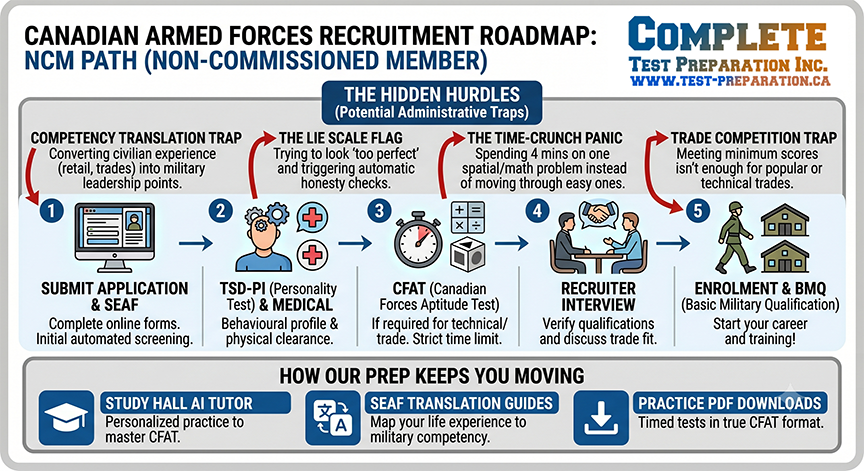
Step 1: The Online Portal & SEAF: You submit your initial paperwork and fill out the Scored Employment Application Form.
The Hidden Hurdle: The Competency Translation Trap. If you list your past employment using civilian retail or labor jargon, the automated screening system scores your background poorly. You have to translate that experience into military competencies right out of the gate.
Step 2: The Interview, Medical, and TSD-PI: You head in for physical clearances and personality screening.
The Hidden Hurdle: The Lie Scale Flag. As we mentioned above, trying to look “perfect” on the personality inventory triggers a reliability flag, locking your file for review.
Step 3: The CFAT (Trade Qualification): If your chosen trade is highly competitive or technical, you sit down for the aptitude test.
The Hidden Hurdle: The Time-Crunch Panic. Many brilliant candidates fail the CFAT spatial ability section or problem-solving math because they spend four minutes wrestling with one difficult question instead of moving through the easy ones.
Roadmap 2: The Officer Entry Path (ROTP / DEO)
Examples: Pilot, Intelligence Officer, Logistics Officer
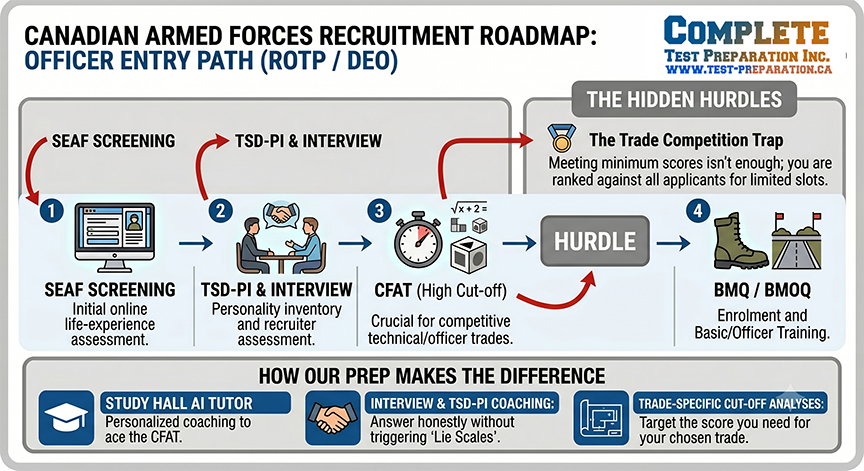
Step 1: The High Cut-off CFAT: Officers face significantly higher cut-off scores on the Canadian Forces Aptitude Test than NCMs.
The Hidden Hurdle: The Trade Competition Trap. Unlike the NCM path where meeting the minimum score often gets you in, Officer trades are strictly competitive. If there are only 15 Pilot slots open across Canada this quarter, the DND ranks every applicant by score. Meeting the minimum cut-off isn’t enough; you need an excellent score to beat out the competition.
Step 2: The Aircrew / Specialist Selection (Trenton): For paths like Pilot or Air Traffic Control, you are sent for specialized simulation testing.
The Hidden Hurdle: Mental Fatigue. These multi-day tests push your spatial awareness and cognitive processing speed to absolute exhaustion. If you haven’t conditioned your brain to handle timed logic drills under pressure, you will burn out by afternoon two.
Satisfied Customer
I’ve taken the CFAT course recently and I can say for sure that studying with the CFAT app trainer and this website will greatly improve your odds of achieving the necessary score for the trade you want. Understand how to do long division, Multiplication, Subtraction, and Division will help you. I took the test and missed the trade I wanted by 2 points. If you study these points you will surely achieve the trade you’re looking for. Good Luck. J.
Don't Let a Single Test Score Put Your Life on Hold.
Failing the CFAT or bombing your SEAF profile isn't just a blow to your confidence—it’s an administrative nightmare. The moment you drop below the required cut-off, your file is flagged, and you are thrown straight into the Canadian Armed Forces' 3-to-6-month administrative rewrite backlog. That is half a year of waiting around, missing out on seniority, and watching your peers head off to Basic Training while you sit at home.Skip the waiting room. Master the exact types of questions the recruiters are going to slide across the desk and lock in your test date with total confidence.
The Quick-Start: PDF
- Instant access: No waiting for the mail. Start right now.
- Searchable: Use Ctrl+F to find exact formulas fast.
- Print what you need: Save ink by only printing the tricky sections.
- Budget-friendly: We pass the printing savings straight to you.
Commander la Version Française
The Gold Standard: Course
- ★ EXCLUSIVE: A.I. Study Hall Tutor. A helping hand that nudges you in the right direction without giving the answer away.
- ★ EXCLUSIVE: 3-Minute Power Drills. Build speed without the burnout.
- ★ EXCLUSIVE: A.I. Interview Coach Practice for the SEAF!
- Dynamic Tracking: Know exactly where you're ready and where you need work.
- Realistic Simulation: Mimics the pressure of the real exam.
The Classic: Paperback
- Zero distractions: No notifications. Just you and the material.
- Tactile learning: Pencil to paper is proven to help memory retention.
- No blue light: Save your eyes from screen fatigue.
- The security blanket: A permanent resource for the kitchen table.
The Canadian Armed Forces are not involved in the production of, and do not endorse this product.
Written by, Brian Stocker MA.,
Published by, Complete Test Preparation Inc.
Updated: Saturday, June 20th, 2026
Published: Thursday, June 12th, 2014
2 Comments
Where can I find the paperback version of Pass the CFAT?
You can find the paperback version under a different title (same content) on Amazon
https://www.amazon.com/Review-CFAT-Complete-Canadian-Questions/dp/1928077056/ or you can order at any bookstore (i.e. chapters) with ISBN 978-1928077053