
CCAT Grade 6 Practice Test PDF | Made in Canada
Let’s be honest: sitting at the kitchen table watching your 11-year-old stress over a school test is a terrible feeling.
For parents eyeing the gifted and talented track, the pressure is immense. You know your child is smart, but there is a very real fear of the “One-Shot Window.” The anxiety isn’t that they lack the intelligence; it’s that they will freeze up at a weird, unfamiliar question format on a Tuesday morning—and suddenly, they miss out on the middle school gifted program. There are no re-dos for school board screenings.
Big Prep companies want you to think you can’t prepare for this. They are wrong.
You can’t teach raw IQ overnight, but you can completely eliminate the element of surprise. Our Canadian Cognitive Abilities Test grade 6 prep materials do exactly that. We strip away the anxiety so your child’s true abilities can shine. Enroll today in our interactive CCAT level 12 online course Canada, and make sure there are no surprises on test day.
Interactive Online Course
The Myth Buster: Why Brilliant Kids Freeze on the CCAT
If you’ve spoken to a teacher or guidance counsellor lately, you have probably heard some variation of this: “Don’t bother studying for the CCAT. It’s a cognitive test. You can’t teach intelligence.”
They aren’t entirely wrong—we can’t magically boost your child’s IQ over a weekend. But here is the secret that Big Prep and the testing companies don’t want to admit:
The CCAT does not look like normal Canadian schoolwork.
When a bright 11-year-old sits down in a noisy cafeteria on a Tuesday morning and is suddenly asked to mentally unfold a piece of paper with a hole punched in it, or solve a bizarre “Figure Classification” matrix, they often panic.
They don’t freeze up because they aren’t smart enough for the gifted track. They freeze because the format is completely alien to them. It’s like taking a kid who is a fantastic hockey player and suddenly dropping them into a lacrosse game without explaining the rules. The skills are there, but the environment is entirely confusing.
This is the biggest trap of the “One-Shot Window.” If they guess wrong because they don’t understand how the question is being asked, the school board just sees a low score.
Our job—yours and mine—isn’t to turn them into something they aren’t. It’s to sit down at the kitchen table, strip away the element of surprise, and make these weird question formats feel boringly familiar.
When you take the mystery out of the test, the anxiety drops. And when the anxiety drops, your child’s natural intelligence gets to do the heavy lifting.
Active Drills: Let’s Put It to the Test
Reading about a test won’t help your child pass it. To beat the CCAT, you have to get in the reps.
We use active learning models to build confidence quickly. Let’s push the theory aside for a minute and try out two of our favorite methods right now. Grab a scrap piece of paper and call your 6th grader over to the screen.
The 2-Minute CCAT Challenge
The CCAT is tightly timed, which is why we rely heavily on 3-Minute Power Drills in our premium course. Below is a bite-sized version.
Instructions: Start the video timer below. You have exactly 120 seconds to answer all three questions.
Don’t stress if you don’t finish—the goal here is just to find your baseline. Ready? Go.
CCAT Challenge Timer
1. Verbal Analogy
Pebble : Boulder :: Pond : _____
A) Ocean
B) River
C) Drop
D) Rapids
2. Number Series
What number comes next?
5, 6, 11, 17, ___
A) 28
B) 34
C) 36
D) 27
3. Equation Puzzle
(8 x 2) x (2 x 3) = ___
A) 60
B) 72
C) 96
D) 92
1. Answer: A (Ocean).
A boulder is a massive version of a pebble. An ocean is a massive version of a pond. This tests the relationship of scale.
2. Answer: A (28).
Did you get stuck looking for a multiplication rule? Here, each number is simply the sum of the previous two numbers (5 + 6 = 11, 6 + 11 = 17, 11 + 17 = 28).
3. Answer: C (96).
Solve the brackets first! 8 X 2 = 16, and 2 X 3 = 6.
Multiply those together (16 X 6) to get 96. If your child hesitated here, our timed practice drills will get their mental math up to speed.
Meet Study Hall A.I.: The Tutor That Never Gets Tired
We’ve all been there. It’s 7:00 PM at the kitchen table, you've been working all day, and now you are staring at a bizarre paper-folding puzzle trying to figure out how to explain it to your 11-year-old without both of you ending up frustrated.
You want to help them prepare, but sometimes you just don't know how to explain the logic of a CCAT Figure Matrix. That’s exactly why we built Study Hall A.I. into our interactive online course.
Exclusive to Complete Test Preparation, this isn't just a generic chatbot or a corporate "learning module." It is a patient, interactive tutor trained specifically on Canadian CCAT logic.
How it works:
When your child gets stuck on a tough Number Series or a Verbal Analogy, Study Hall A.I. doesn't just spit out the right answer. Instead, it acts like a real teacher sitting right next to them. It walks them through the reasoning step-by-step, dropping gentle hints, and helping them untangle the logic until they have that "Aha!" moment.
It knows the curriculum, it understands the common traps, and best of all? It never loses its patience, no matter how many times it has to explain the same math problem.
For just $39 CAD, you can hand the heavy lifting over to us.
Reverse Practice: Spot the Flaw
Sometimes the best way to learn the rules of the CCAT is to see them broken.
In our “Reverse Practice” exercises, we don’t ask your child for the correct answer. Instead, we give them a broken solution and ask: Where did this go wrong? This forces them to think like the test-maker. Let’s try two.
Scenario 1: Number Analogies
- The Broken Solution: “The prompt is 5 is to 10 as 6 is to ___. The answer is 11, because 5 + 5 = 10, so I just added 5 to the 6.”
- Where did it go wrong? The student applied addition instead of multiplication. While it’s true that 5 + 5 = 10, the CCAT almost always prioritizes multiplication or division for scaling. 5 doubled is 10, so 6 doubled is 12.
- The Fix: Always test a multiplication or division rule first before defaulting to addition.
Scenario 2: Verbal Analogies
- The Broken Solution: “The prompt is Nest : Bird. My answer is Dog : House. Birds live in nests, and dogs live in houses. It makes perfect sense.”
- Where did it go wrong? Order of operations! The original prompt gave us a Location first, and then the Animal (Nest : Bird). The student answered with the Animal first, and then the Location (Dog : House).
- The Fix: On the CCAT, the sequence is just as important as the relationship. The correct answer would need to be reversed: House : Dog.
Navigating Middle School Gifted Placement Alberta & Beyond
We hear from parents all the way from the Prairies to our own backyard here in Victoria who are stressed about local testing rules. If you are looking at middle school gifted placement in Alberta, for example, the Grade 6 CCAT is usually the main gatekeeper for junior high GATE (Gifted and Talented Education) programs.
Unlike standard provincial exams that test what a teacher covered on the chalkboard last week, the CCAT is looking for raw reasoning skills. Whether your child is testing in Calgary, Edmonton, or a smaller regional board, the test doesn’t care if they memorized the textbook. It cares if they can spot a hidden pattern or solve a number puzzle under pressure. The goal across the board is to find students who need that extra academic challenge—and our practice materials are built to help them show exactly what they are capable of.
Unpacking the Ontario CCAT Assessment Format
Things look a little different when we head east. Major school boards in Ontario, like the TDSB or Peel, often run large-scale or universal screenings. This means your child might be taking the CCAT Level 12 alongside their entire Grade 6 class.
Here is what you need to know about the Ontario CCAT assessment format:
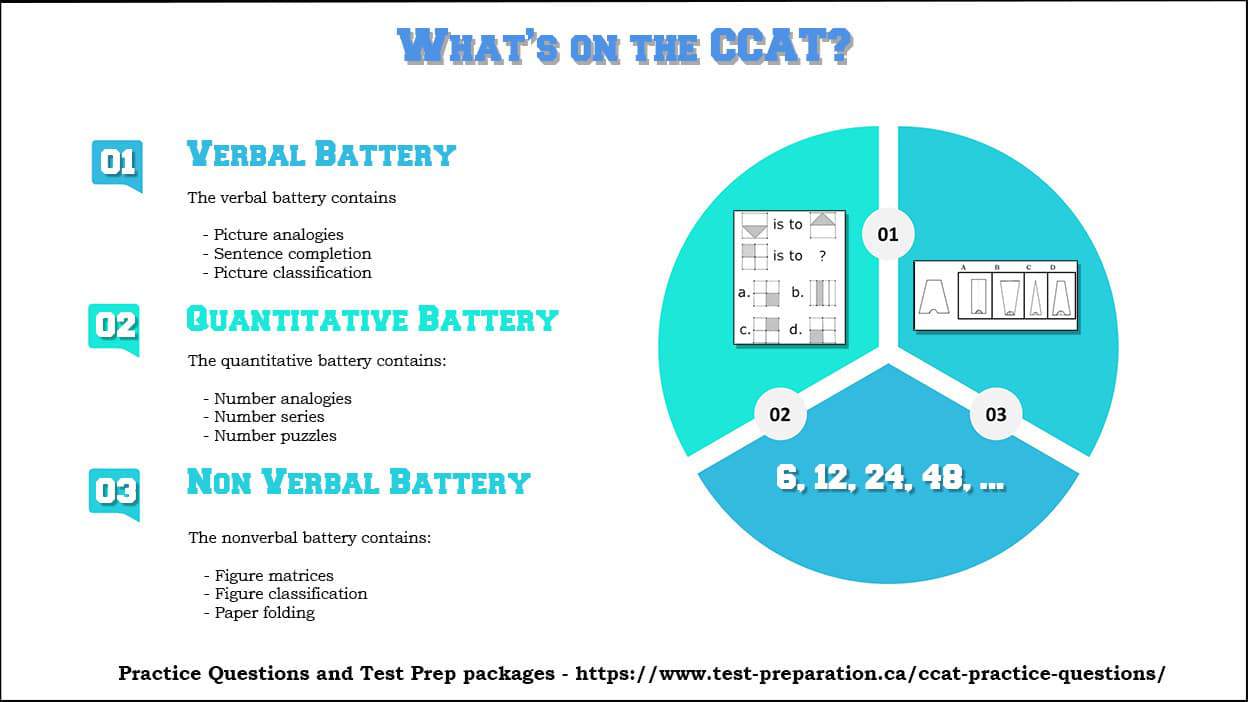
The test is broken down into three sections, or “batteries”—Verbal, Nonverbal, and Quantitative. Each battery is further split into three smaller subsections (making nine in total). Depending on the principal and the school’s schedule, they might spread these sections out over a few days, or they might sit the kids down for one long, grueling session.
A Kitchen Table Tip: Big Prep companies treat a test in Toronto exactly the same as a test in Texas. We don’t. We know that taking an exam in a loud Canadian school gymnasium or cafeteria is incredibly distracting. When your child takes our practice tests at home, don’t demand total silence. Leave the radio on low or let the dog walk around the room. Get them used to tuning out everyday noise so that when test day comes, the only thing they have to focus on is the question in front of them.
Interactive Online Course
Written by, Brian Stocker MA.,
Published by, Complete Test Preparation Inc.
Updated: Friday, May 22nd, 2026
Published: Wednesday, April 27th, 2022