
Stop Waiting for the “Enriched” Letter—Start Earning It.
In most Canadian school boards, your child gets exactly one shot at the Gifted screening per developmental stage. If they miss the mark in Grade 3, the “One-Shot” Anxiety becomes a reality: you could be looking at a 3-year wait time for re-evaluation. While your child sits in a classroom that doesn’t challenge them, they lose precious time.
Our CCAT 2 Vocabulary Practice Course and CCAT 3 is built specifically for the Canadian Cognitive Abilities Test. We don’t use generic US prep. We focus on the CCAT Level 8 Vocabulary Download and Level 9 verbal logic that Canadian teachers actually use. Don’t let a “near-miss” score keep your child out of the provincial learner profiles they belong in. We ensure there are no surprises on test day—just the confidence to pass the first time and get to work in an enriched environment immediately.
Grade 3 CogAT vs. CCAT: Why the Canadian Context is the Deciding Factor
When parents search for prep materials, they often stumble upon the CogAT (Cognitive Abilities Test). While the CogAT and the CCAT (Canadian Cognitive Abilities Test) share a common ancestor, treating them as identical is a strategic mistake that can lead to “The One-Shot” failure.
To meet the Nelson Education Assessment Standards, the CCAT is specifically normalized for Canadian students. Here is why that distinction matters for your child’s placement.
1. The Spelling Trap: Canadian Spelling Analogies
On a verbal battery, timing is everything. If a student is presented with a word they recognize but see “spelled incorrectly” (according to their Canadian classroom training), their cognitive load increases. They pause, they second-guess, and they lose momentum.
- The CogAT (US) Focus: Uses American conventions like Color, Center, Defense, and Labor.
- The CCAT (Canadian) Focus: Adheres to Canadian Spelling Analogies. Your child will see words like Colours, Centres, Defence, and Labour.
If a Grade 3 student sees “Center” on a test, they may subconsciously flag it as an error or a “trick,” diverting mental energy away from the actual logic of the analogy. Our practice materials ensure they see the language they use in their local Canadian workbooks every day.
The “Logic Bridge” Difference
In Grade 3 (Level 9), the test moves from pictures to words. This is where the CCAT Level 9 Vocabulary Download becomes essential. In the CogAT, a verbal classification might include terms specific to American history or geography. The CCAT replaces these with terms found in the Canadian social studies and science curricula.
The Bottom Line: Using CogAT materials to prepare for a CCAT screening is like practicing for a hockey game by playing floorball. The rules are similar, but the “feel” and the equipment are different enough to throw off your performance when it counts.
Master the Canadian Difference
Don’t let your child be distracted by Americanisms during the most important 90 minutes of their academic year.
| Target Grade Level | The "Premium" Training Ground |
|---|---|
|
CCAT Grade 2 (Level 8 Assessment) |
Enroll in Online Course |
|
CCAT Grade 3 (Level 9 Assessment) |
Enroll in Online Course |
The 2-Minute CCAT Challenge: Are You Ready?
Think of this as a quick “brain warm-up” before diving into our full CCAT Grade 3 Practice Test PDF.
The Goal: See if your child can maintain their logic while the clock is running.
The Setup:
1. Clear the table of distractions.
2. Have an HB pencil and a piece of scratch paper ready.
3. Set a timer (or use the analog visual above) for exactly 120 seconds.
4. Encourage: “It’s okay if you don’t finish them all—just focus on the pattern!”
CCAT Challenge Timer
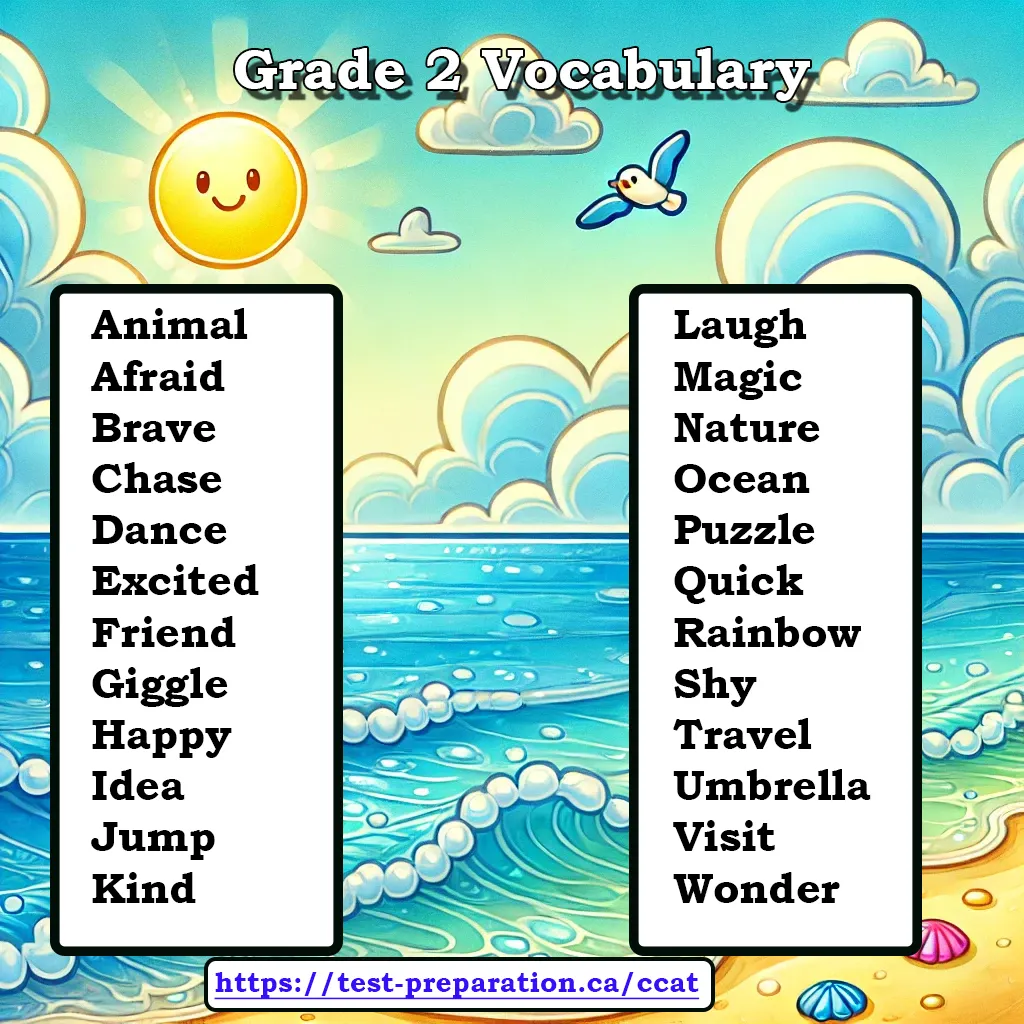
Grade 2 Vocabulary
- Animal
- Afraid
- Brave
- Chase
- Dance
- Excited
- Friend
- Giggle
- Happy
- Idea
- Jump
- Kind
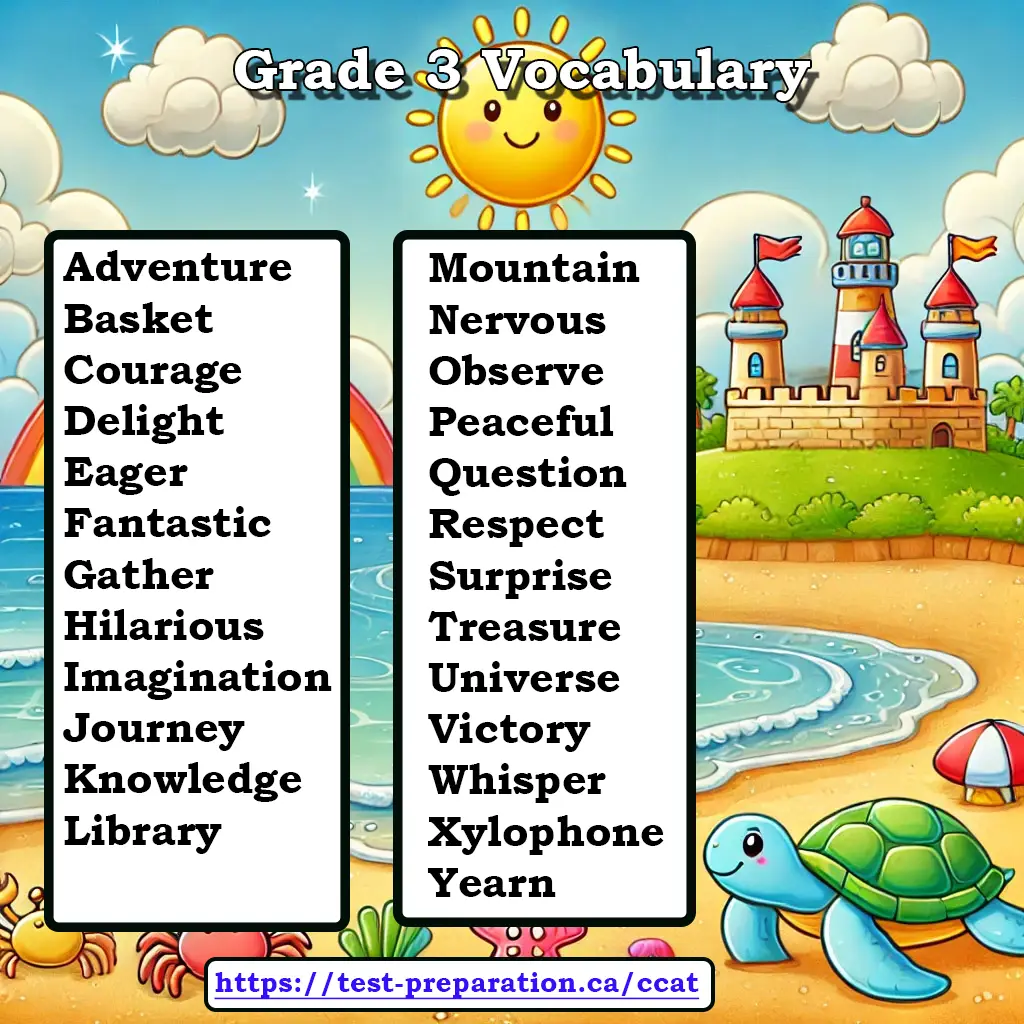
Grade 3 Vocabulary
- Adventure
- Basket
- Courage
- Delight
- Eager
- Fantastic
- Gather
- Hilarious
- Imagination
- Journey
- Knowledge
- Library
Teaching Vocabulary to Grades 2 and 3
Teaching vocabulary to students in grades 2 and 3 can be engaging and effective with the following tips:
1. Learning in Context
Use Stories and Books to integrate vocabulary especially reading aloud.
Incorporate new words into everyday classroom conversations.
2. Interactive Activities
Play word games like word bingo, crossword puzzles, or word searches.
Use flashcards for review.
3. Make it Visual
Use picture dictionaries to associate words with images.
Create a word wall and post new vocabulary with pictures and definitions.
4. Repetition and Practice
Revisit new words daily in different contexts to reinforce learning.
Write sentences or short stories using new vocabulary words.
5. Hands-On Learning
Incorporate vocabulary into art projects, such as drawings or crafts related to new words.
6. Multiple Learning Styles
Acting Out Words with physical activities like charades.
Use songs, rhymes, and chants.
7. Personal Connections
Connect vocabulary to students’ experiences and interests.
Storytelling promotes personal connection and use. Have students share stories using new vocabulary words.
8. Use Technology
Use educational apps, online games and interactive whiteboards for engaging vocabulary lessons.
9. Peer Learning
Divide students into groups where students can learn from each other through discussions and collaborative tasks.
Pair students to teach each other new words, reinforcing their understanding.
10. Assessment and Feedback
Have short, informal quizzes to assess retention.
Catch them do8ing it right. Positive feedback and encouragement motivates students to keep going.
| Don't Leave Test Day to Chance — Choose Your Version | ||
|---|---|---|
| CCAT Grade 2 (Level 8) | ||
| Online Course | PDF Download | Paperback |
| CCAT Grade 3 (Level 9) | ||
| Online Course | PDF Download | Paperback Coming Soon |
All orders support global education charities. Secure checkout with Canadian-made practice materials.
Written by, Brian Stocker MA.,
Published by, Complete Test Preparation Inc.
Updated: Thursday, April 23rd, 2026
Published: Friday, August 2nd, 2024