
Mechanical Aptitude Practice Tests | Canadian Trade Exams
Most people think failing a mechanical test just means a “try again next week” scenario. In Canada, it’s much worse. Whether you’re at a testing centre in Victoria, Calgary, or Toronto, a fail doesn’t just bruise your ego—it puts you at the back of the line. We’re talking about a 30-to-90-day mandatory wait period, a hefty re-examination fee to the Ministry, and thousands in lost labour wages while your career sits on ice.
Don’t let a confusing pulley diagram be the reason your application stalls. Our Mechanical aptitude practice test Canada PDF and interactive modules are designed to help you clear the hurdle the first time. We’ve stripped away the “Big Prep” corporate fluff to give you exactly what you need: Mechanical reasoning practice test with answers that actually look like the ones you’ll see on exam day.




Not seeing your specific exam above?
Just looking for a general Mechanical Aptitude boost?
If you’ve been told you have a “mechanical reasoning” test but weren’t given a fancy acronym, don’t sweat it. Whether you are prepping for the Wiesen Test (WTMA), the Bennett (BMCT), or a private employer’s custom screening, the “physics of the shop floor” remains the same.
Large Canadian employers—from BC Hydro and Hydro Québec to mining operations in the North—use these tests to see if you have “The Knack.” They aren’t testing your ability to memorize a textbook; they’re testing your intuition.
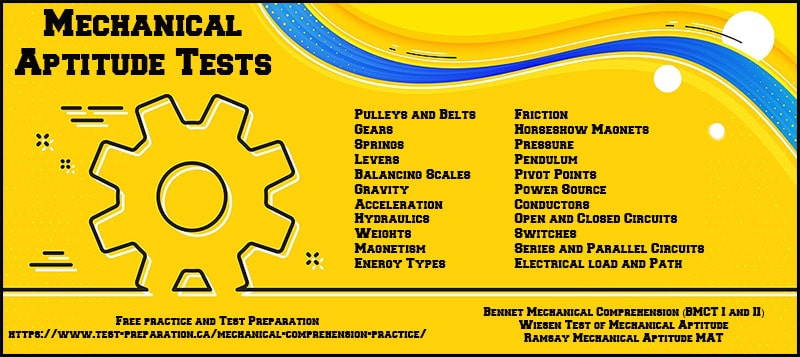
Our “Universal” Mechanical Training covers the core pillars used in 95% of Canadian industrial exams:
- Pulleys & Levers: Identifying mechanical advantage without a calculator.
- Gears & Belts: Tracing rotation and speed changes across complex systems.
- Fluid Logic: Understanding hydraulics and pressure in closed systems.
- Tool Identification: Knowing the right tool for the job (and the provincial safety standards that go with them).
Stop guessing and start visualizing.
Cracking the Code of Canadian Trade Entrance
Navigating the paperwork for a Canadian apprenticeship can feel like trying to read a blueprint in the dark. Every province has its own “secret handshake,” and if you don’t know the specific Ontario trade entrance exam requirements or the Alberta apprenticeship entrance exam clusters, you might end up studying the wrong material entirely.
At our Victoria office, we’ve seen too many good folks get turned away because they weren’t prepared for the specific way their province tests “Shop Logic.” Here is the ground-level truth on how the two biggest provinces handle their entrance gates.
1. Ontario: The Skilled Trades Ontario (STO) Standard
In Ontario, the game has changed with the shift to Skilled Trades Ontario. While many “Big Prep” sites still reference old Ministry guidelines, the reality is that entrance requirements are often tied to your National Occupational Classification (NOC) trade codes.
- The Requirement: If you don’t have your Grade 12 Math or English credits, you’ll likely face an aptitude assessment often administered by local colleges (like Conestoga or St. Clair) or union locals, CAEC diploma.
- The Mechanical Focus: For trades like Millwright (433A) or Electrician (309A), the focus is heavily on Spatial Ability and Technical Reasoning. They want to know if you can interpret a three-dimensional diagram before they let you near the heavy machinery.
- The Trap: Don’t assume your “High School Physics” from a decade ago will carry you. Ontario tests are notorious for using blueprint-style logic—asking you to identify the missing view in a mechanical drawing.
2. Alberta: The AIT “Cluster” System
The Alberta Apprenticeship and Industry Training (AIT) system is unique because it groups trades into five different “Clusters.”
- The Exam Structure: You’ll face 100 multiple-choice questions over 3 hours. To get your start, you need a 70% or higher.
- The Science Gap: While most provinces stick to math and reading, Alberta’s Entrance 5 (for Electricians and Communication Techs) includes a heavy dose of Science. This isn’t biology—it’s the science of fluids, pressure, and structural design.
- Cluster 3 & 4 Power: If you’re heading into Automotive or Gasfitter trades, your mechanical aptitude questions will focus on energy transfer and simple machines. You need to know your levers from your inclined planes.
Alberta vs. Ontario: At a Glance
| Feature | Alberta (AIT) | Ontario (STO/College) |
| Pass Mark | Strict 70% | Varies (often 60-70% avg) |
| Format | 100 Questions / 3 Hours | Varies by College/Local |
| Key Emphasis | Science & Trade Clusters | Spatial & Blueprint Logic |
| Re-write Rules | Mandatory wait periods | Varies by institution |
Jobs that use Mechanical Aptitude Entrance Tests
Mechanics
Most types of mechanics need a solid understanding of mechanical systems and concepts to install, maintain, and repair these systems as well as diagnose and fix problems.. Types of mechanics include, automotive, aircraft mechanics, industrial machinery mechanics, and diesel mechanics.
Technicians
Technicians, such as HVAC technicians, Marine technicians, Elevator technicians, and robotic technicians require extensive knowledge of mechanical concepts
Other Professions
Heavy Equipment Operator. Heavy equipment operators operate and maintain large machinery used in construction, mining, and other industries. They must have a good understanding of mechanical systems and be able to troubleshoot and perform basic maintenance tasks.
Power Plant Operator. Power plant operators oversee the operation and maintenance of power generation equipment, such as turbines and generators. They need to understand the mechanical components of these systems and be able to identify and resolve issues.
The Challenge: 4 Questions. 120 Seconds.
This isn’t a classroom quiz; it’s a high-speed simulation of the actual testing centre environment. We’ve hand-picked 4 “Must-Know” problems covering:
- Gear Rotation (Speed & Direction)
- Pulley Logic (Mechanical Advantage)
- Lever Balance (Force & Torque)
- Fluid/Spatial Intuition (Pressure & Flow)
Instructions for the Drill:
- No Calculators: In the trades, you often have to estimate on the fly. Use your intuition.
- The “First Look” Rule: Don’t over-analyze. Your first instinct on a gear or lever is usually right. If you’re staring for more than 30 seconds, you’ve already lost the time-battle.
- Read the Arrows: Pay close attention to the direction indicators. One missed arrow means a wrong answer.
- Beat the “Back of the Line” Fear: If the timer hits zero and you aren’t done, it’s a sign that the “bureaucratic wait” is a real risk.
Ready to see if you’re “Shop Ready”? Start the Video
The 2-Minute Drill: Mechanical Aptitude Challenge
Question 1: Gear Rotation (Speed & Direction)
Scenario: Gear A is 10cm in diameter and is rotating Clockwise. Gear A is meshed with Gear B (20cm diameter), which is meshed with Gear C (10cm diameter).
Question: In what direction and at what relative speed is Gear C rotating?
A) Clockwise, Same speed as Gear A
B) Counter-Clockwise, Slower than Gear A
C) Clockwise, Faster than Gear A
D) Counter-Clockwise, Same speed as Gear A
Question 2: Pulley Logic (Mechanical Advantage)
Scenario: You have a “Block and Tackle” system. One end of the rope is anchored to a ceiling beam. The rope goes down around a movable pulley attached to a 100kg crate, then back up over a fixed pulley on the beam, and finally down to your hands.
Question: Neglecting friction, how much force (effort) is required to lift the 100kg crate?
A) 100 kg
B) 50 kg
C) 25 kg
D) 200 kg
Question 3: Lever Balance (Force & Torque)
Scenario: A 3-metre see-saw is balanced on a fulcrum exactly in the middle (1.5m mark). A 40kg weight is placed on the far left end.
Question: If you want to balance the see-saw using only a 20kg weight, where must it be placed?
A) 0.5 metres from the fulcrum on the right side
B) 1.0 metre from the fulcrum on the right side
C) At the far right end (1.5m from the fulcrum)
D) It is impossible to balance 40kg with 20kg
Question 4: Fluid/Spatial Intuition (Pressure & Flow)
Scenario: Three identical water tanks (A, B, and C) are connected by narrow pipes at their bases. Tank A is being filled from a hose at the top.
Question: If the pipes between the tanks are open, which tank will reach the “Full” mark first?
A) Tank A
B) Tank B
C) Tank C
D) All three will reach the mark at the same time
The Answer Key: How Did You Do?
1. Answer: A (Clockwise, Same speed as Gear A)
The Logic: Don't get tripped up by the middle gear! In a series of meshed gears, Gear 1 and Gear 3 will always rotate in the same direction if there is an odd number of gears (1, 3, 5...). As for speed, Gear A and C are the same size (10cm), so they must rotate at the same RPM regardless of how big the "idler" gear B is in the middle.
2. Answer: B (50 kg)
The Logic: Look at the number of rope segments supporting the load. In this setup, two segments of rope are pulling up on the movable pulley attached to the crate. This cuts the required effort in half (100 / 2 = 50). The fixed pulley on the beam only changes the direction of your pull, not the weight.
3. Answer: D (It is impossible to balance 40kg with 20kg)
The Logic: This is a classic "Trap Question." To balance a weight that is twice as heavy (40kg), the lighter weight (20kg) would need to be twice as far from the fulcrum. Since the 40kg weight is already at the very end (1.5m), the 20kg weight would need to be at 3.0m—but the board only extends 1.5m on the right side. You’d need a longer board!
4. Answer: D (All three will reach the mark at the same time)
The Logic: This is the "Law of Communicating Vessels." Gravity and air pressure ensure that liquid in connected containers will always seek the same level. Unless one pipe is restricted or a tank is airtight, they will fill up as one unit.
Post-Drill Debrief
If you got 4/4, you’ve got a natural eye for how things work.
If Question 3 caught you out, don’t sweat it—that’s exactly the kind of ‘trick’ the Alberta Trades or CFAT examiners love to use to see if you’re actually paying attention to the measurements.
It’s not just about math; it’s about looking at the whole picture.
The Anatomy of a Wrong Answer
On exams like the CFAT or the Alberta Trades Entrance, examiners don’t pick wrong answers at random. They use “Distractors”—answers designed to catch you if you are over-thinking, rushing, or relying on “school math” instead of “shop logic.”
Let’s look at a classic Pulley Logic trap:
The Question:
“To lift a 100kg crate using a single fixed pulley attached to a ceiling beam, how much effort (force) is required?”
A) 50 kg (The “Over-Thinker” Trap)
B) 100 kg (The Correct Answer)
C) 200 kg (The “Confusion” Trap)
1. The “Over-Thinker” Trap (Choice A: 50 kg)
Why it looks right: You’ve likely heard that “pulleys make things easier.” Your brain remembers a rule about halving the weight, so you reflexively jump to 50kg.
The “Anatomy” of the Mistake: This is a Fixed Pulley. A fixed pulley only changes the direction of the pull so you can use your body weight; it provides zero mechanical advantage. You are still lifting 100kg.
Brian’s Tip: If the pulley isn’t moving up and down with the load, the weight doesn’t change. Don’t let your “memory of a physics class” override what your eyes are seeing.
2. The “Confusion” Trap (Choice C: 200 kg)
Why it looks right: Some students get “formula fatigue.” They think, “If it’s not 50, maybe it’s doubled?” or they confuse force with friction.
The “Anatomy” of the Mistake: This usually happens when a student is stressed by the 2-minute clock. They see a pulley and think there’s a “multiplication” happening.
The Reality Check: Machines are built to help us, not make the job twice as hard! Unless you’re pulling against an opposing force, the effort won’t exceed the load.
Why “Big Prep” Fails You Here
Most generic sites will just tell you: “The answer is B because the mechanical advantage is 1.” That’s corporate-speak.
Our Approach: We show you the “visual cues.” We teach you to look for the Movable Pulley. If the pulley is bolted to the ceiling, you’re working for every gram of that 100kg. If the pulley is attached to the crate, you just gave yourself a 50% discount on the labour.
The “Stocker” Strategy for Avoiding Traps:
- Freeze the Frame: Before looking at the answers, ignore the numbers. Ask: “What is actually happening in this picture?”
- Identify the ‘Helper’: Is there a lever arm? A moving pulley? A smaller gear? If there isn’t a “helper” mechanism, the force doesn’t change.
- Check the Units: Canadian exams love to swap kg for Newtons or pounds just to see if you’re paying attention. Always double-check your labels.
| Exam Preparation | The "Gold Standard" Full Online Course |
The "Quick-Start" PDF Download |
|---|---|---|
|
CFAT Canadian Forces |
Start Online Course |
Download CFAT PDF Instant Study Access |
|
Alberta Trades AIT Entrance |
Start Online Course |
Download Alberta PDF Print & Practice Today |
|
Canada Trades National Prep |
Start Online Course |
Download Canada PDF Mobile-Friendly Version |
|
RCMP Officer Entrance |
Start Online Course |
Course Recommended Comprehensive Digital Prep |
Mechanical Reverse Logic Practice
Here is another challenge
Think of these “Reverse Practice” exercises as the mental equivalent of a field training officer checking your work. Instead of just picking A, B, or C, you’re the one holding the red pen. By taking apart a “broken” answer, you develop a much sharper eye for the specific traps mechanical aptitude tests love to set—the kind of subtle errors that look right at first glance but fall apart under scrutiny.
We’ve found that when you learn to spot a flaw in someone else’s logic, you stop making those same mistakes yourself. It moves you past simple memorization and into true mastery. This isn’t just about passing a test; it’s about building the analytical “spidey-sense” you’ll need every day in your new career.
Scenario 1: The “Magical” Pulley System
The Setup: A student is looking at a block and tackle system with three pulleys. They are told that to lift a 100 kg weight, they only need to apply 10 kg of force.
The Broken Logic:“Since there are three pulleys in the system, each one reduces the effort by half. Therefore, the force required is divided by 23 (which is 8), and then we round down for efficiency, meaning you only need 10 kg of pull to lift that 100 kg crate.”
The Flaw: Mechanical advantage in a pulley system isn’t an exponential "magic trick." It’s generally determined by the number of rope segments supporting the load.
The Reality: If you have three pulleys rigged in a standard way, you might have three or four rope segments. You can't just "round down"
The Fix: We count the lines. If there are 4 lines, the effort is 100 / 4 = 25 kg. (ignoring friction).
Scenario 2: The Impossible Lever
The Setup: We have a 10-foot seesaw (lever). A 50 lb weight is sitting 2 feet away from the center (fulcrum) on the left side.
The "expert" claims that to balance it, you must place a 25 lb weight 10 feet away from the center on the right side.
The Broken Logic:
Because the weight on the right (25 lb) is exactly half of the weight on the left (50 lb), it simply needs to be placed at the very end of the 10-foot board to compensate for the difference. Since 10 is a bigger number than 2, the extra distance more than makes up for the lighter weight.
Mechanical Aptitude and Spatial Relations
Mechanical aptitude tests often have a section on spatial reasoning, which measure your ability to mentally manipulate and visualize objects in three-dimensional space. Spatial relations questions are included in test for industries such as engineering, construction, and manufacturing.
Tips for Making the Most of Your Study Time for Mechanical Comprehension Tests
1. Practice. Incorporate practice tests into your study routine. These tests are designed to familiarize you with the types of questions you may encounter and help you improve your mechanical reasoning skills.
2. Understand the concepts Familiarize yourself with mechanical concepts and understand the basic principles behind them so you can answer questions confidently.
3. Get a study guide Use study guides that cover the topic areas typically assessed in mechanical comprehension tests. These guides often include clear explanations and examples, helping you grasp the necessary information efficiently.
4. Pay attention to correct answers and incorrect answers. Look at your answers to practice questions and see where you need to study and where you are OK. After attempting practice questions, analyze the correct answers and the underlying reasons for their accuracy. This will strengthen your knowledge of mechanics and improve your ability to identify the correct answer choices.
5. Manage your study time. Create a study schedule that allocates specific time slots studying. Prioritize challenging areas and dedicate more time to them. Breaking your study time into smaller, focused sessions can improve retention. 20 minutes is optimum.
Written by, Brian Stocker MA.,
Published by, Complete Test Preparation Inc.
Updated: Wednesday, April 29th, 2026
Published: Friday, July 7th, 2023