
Stop Worrying About the GED—The CAEC Is Here, and It’s Actually Built for You.
If you’ve been scrolling through outdated forums wondering where the Canadian GED went, you can breathe out now. As of May 2024, the Canadian Adult Education Credential (CAEC) officially replaced the GED as the recognized high school equivalency standard across Canada. To earn the CAEC credential, candidates must achieve a minimum passing score of 55% on all five subject tests: Reading, Writing, Mathematics, Science, and Social Studies.
I know the rumour at the local coffee shop: “The new CAEC Math is twice as hard as the old test.” That’s a myth. The truth? The Alberta Ministry of Advanced Education and Ontario’s TVO ILC helped design this to be more relevant to your life here in Canada. The CAEC removes American-centric questions, requiring candidates to understand the Canadian metric system, the Canadian Constitution, and Indigenous perspectives. You won’t be stuck calculating miles or gallons; you’ll be working with the kilometres and litres you actually use.
Whether you’re aiming for a promotion or a new apprenticeship, you need a CAEC Practice Test PDF Canada that doesn’t waste your time with American fluff. We’ve spent years in the classroom and at the editor’s desk triple-checking our CAEC Math Questions and Answers to ensure they match the provincial standards. We have even included a Math A.I. Tutor in our online course. Let’s get you that credential so you can move forward with purpose.
What is the CAEC?
What: The Canadian Adult Education Credential (CAEC) is Canada’s new standard high school equivalency diploma, replacing the GED.
Who: It is designed for Canadian adults who need a high school credential for college admissions, apprenticeships, or career advancement.
When: The CAEC officially launched in May 2024.
Where: Tests are administered in-person at authorized provincial testing centres across Canada (usually computer-based).
Why: Unlike the American GED, the CAEC was co-developed by Canadian provinces to feature relevant Canadian history, government, and metric math systems.
Teaching This CAEC?
Got Questions about the CAEC?
 Taking the CAEC high school equivalency Canada and have questions? Ask me!
Test Day Logistics: The CAEC Format Breakdown
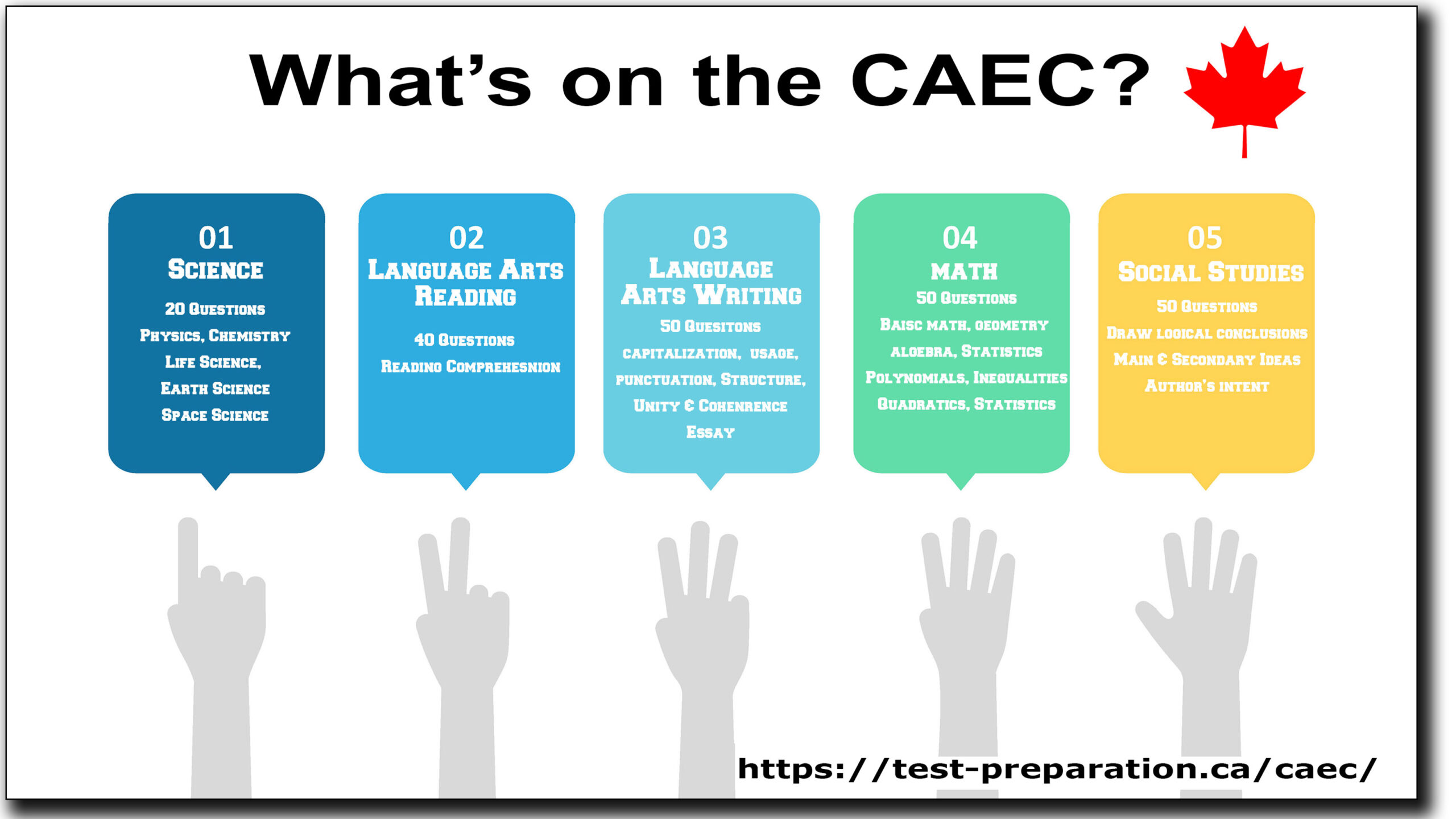
To earn your credential, you will need to complete approximately 7.5 hours of computer-based testing across five subjects. Here is the exact breakdown of what to expect:
| Subject | Time Limit | Format |
|---|---|---|
| Mathematics | 120 minutes | 42 Questions (Part I: No Calculator, Part II: Calculator) |
| Reading | 75 minutes | 50 Questions |
| Writing | 75 minutes | 1 Persuasive Essay |
| Science | 90 minutes | 35 Questions (Data & Inquiry Focus) |
| Social Studies | 90 minutes | 40 Questions (Canadian Content Focus) |
| CAEC Study Guide PDF | Complete CAEC Online Course |
|---|---|
|
The Portable Essential Best For: The Last-Minute Crammer Did you just realize the test is tomorrow? We've got you.
|
The Interactive Training Ground Best For: The Maximum-Score Seeker This is our flagship experience—the closest thing to having a personal tutor on speed dial, minus the hourly rate. You aren't just aiming to pass; you want to dominate.
Not for you if: You despise screens, have unreliable internet, or prefer the tactile feel of paper. We recommend the Classic Paperback or PDF instead.
|
Can You Beat the Clock?
The CAEC doesn’t just test what you know; it tests how you handle the pressure. In the real exam, you’ve got about 90 seconds per question.
The Challenge:
1. Hit Start on the timer.
2. Answer these 12 questions before the 20-minute mark hits.
3. No calculators for the Math section—just your brain and a scrap of paper.
4. If you finish with time to spare, you’re on the right track. If the timer runs out… well, that’s why we’re here to help.
Ready? Take a breath. Let’s get to work.
The 12-Question CAEC “Stocker Special” Drill
Section 1: Mathematics (The Metric & Logic Check)
No calculators allowed for these three.
1. The Carpentry Cut
A construction crew in Victoria needs to divide a 4-metre timber into 5 equal sections for a deck frame. How many centimetres long is each section?
A) 8 cm
B) 40 cm
C) 80 cm
D) 125 cm
2. The HST Headache
You are buying a new set of safety boots for work. The subtotal is $120.00. If the Harmonized Sales Tax (HST) is 13%, what is the total cost at the register?
A) $133.00
B) $135.60
C) $121.30
D) $156.00
3. The Recipe Scale
A cafeteria recipe calls for 750 mL of milk. You need to triple the recipe for a larger lunch crowd. How many litres of milk do you need in total?
A) 2.25 L
B) 22.5 L
C) 2,250 L
D) 1.5 L
Section 2: Social Studies (The Canadian Citizen)
4. Provincial Powers
Under the Canadian Constitution, which of these responsibilities falls primarily under Provincial jurisdiction?
A) National Defence
B) Postal Services
C) Education and Healthcare delivery
D) Currency and Banking
5. Geography Check
Which of the following bodies of water borders the largest number of Canadian provinces?
A) The Pacific Ocean
B) The Atlantic Ocean
C) The Arctic Ocean
D) Lake Superior
6. Indigenous Perspectives
What was the primary purpose of the Truth and Reconciliation Commission (TRC) of Canada?
A) To manage provincial land tax disputes.
B) To document the history and lasting impacts of the residential school system.
C) To oversee the election of federal members of parliament.
D) To create new border crossing regulations with the United States.
Section 3: Science (Data & Discovery)
7. The Scientific Method
A researcher is testing a new fertilizer on wheat crops in Saskatchewan. What is the independent variable in this experiment?
A) The height of the wheat.
B) The amount of rainfall.
C) The type of fertilizer used.
D) The date the wheat was harvested.
8. Life Science: The Human Body
Which system is responsible for transporting nutrients and oxygen to cells while removing waste products like carbon dioxide?
A) Respiratory System
B) Circulatory System
C) Digestive System
D) Nervous System
9. Chemistry Basics
If a substance has a pH level of 3, how would it be classified?
A) Highly Alkaline (Base)
B) Neutral
C) Acidic
D) A Gas
Section 4: Reading (The Workplace Pro)
Read this short memo:
To: All Staff
From: Management
Subject: New Safety Gear Policy
Starting Monday, all employees entering the warehouse floor must wear Grade 1 steel-toe boots. Visitors are exempt but must remain within the yellow-painted walkways at all times. Failure to comply will result in a formal warning.
10. Main Idea
What is the primary purpose of this memo?
A) To announce a sale on safety boots.
B) To explain new safety requirements for the warehouse.
C) To invite visitors to a warehouse tour.
D) To describe how to paint walkways.
11. Identifying Exceptions
According to the memo, who is not required to wear steel-toe boots?
A) Warehouse supervisors.
B) New employees.
C) Visitors.
D) Management.
12. Inferring Meaning
What can be inferred about an employee who enters the warehouse floor without proper boots on Tuesday?
A) They will be asked to paint the floor.
B) They will receive a formal warning.
C) They will be promoted.
D) They will be asked to lead the visitor tour.
Section 1: Mathematics
1. Answer: C (80 cm)
-
The Stocker Logic: 4 metres is 400 cm (4 X 100). 400 \ 5 = 80. If you chose A, you missed a zero. If you chose B, you likely divided by 10 instead of 5. In Canada, we think in 100s for metres—don't let the imperial "12 inches to a foot" clutter your brain here.
2. Answer: B ($135.60)
-
The Stocker Logic: 13% of $120 is $15.60. Add that to the $120 base, and you’re at $135.60. A quick "kitchen table" shortcut: 10% is 12, and 1% is $1.20. Three of those ($3.60) plus the $12 gets you to your $15.60 tax.
3. Answer: A (2.25 L)
-
The Stocker Logic: 750 mL X 3 = 2,250 mL. Since there are 1,000 mL in a litre, move that decimal three spots to the left. You need 2.25 L. If you picked D, you only doubled it!
Section 2: Social Studies
4. Answer: C (Education and Healthcare delivery)
-
The Stocker Logic: This is a classic "division of powers" question. The Feds handle the big "national" stuff like the Army (A) and the Mail (B). The Provinces handle the things that affect your day-to-day life, like schools and hospitals.
5. Answer: B (The Atlantic Ocean)
-
The Stocker Logic: Count 'em up: Newfoundland & Labrador, PEI, Nova Scotia, New Brunswick, and Quebec all touch the Atlantic (or its gulf). The Pacific only hits BC.
6. Answer: B (To document the history and lasting impacts of the residential school system.)
-
The Stocker Logic: The CAEC focuses heavily on Indigenous perspectives. The TRC was a landmark process in Canada to acknowledge the truth of the residential school system—it’s a "must-know" for the Social Studies section.
Section 3: Science
7. Answer: C (The type of fertilizer used.)
-
The Stocker Logic: The "Independent" variable is the thing you change to see what happens. You change the fertilizer to see if the height of the wheat (the dependent variable) changes.
8. Answer: B (Circulatory System)
-
The Stocker Logic: Think of the Circulatory system as the "delivery truck" of the body. It uses blood to haul oxygen in and carbon dioxide out. The Respiratory system (A) gets the air into the building, but the Circulatory system moves it around.
9. Answer: C (Acidic)
- The Stocker Logic: The pH scale goes from 0 to 14. 7 is neutral (like pure water). Anything lower than 7 is an acid (like lemon juice or battery acid). Anything higher is a base (like bleach).
Section 4: Reading
10. Answer: B (To explain new safety requirements for the warehouse.)
-
The Stocker Logic: The "Main Idea" is always the "Why" behind the text. The memo exists to tell people about the new boot policy.
11. Answer: C (Visitors.)
-
The Stocker Logic: The text explicitly states: "Visitors are exempt." In "adult" reading tests, they love to test if you caught the exception to the rule.
12. Answer: B (They will receive a formal warning.)
-
The Stocker Logic: This is an inference. The memo says the policy starts Monday and failure to comply results in a warning. Since Tuesday is after Monday, the consequence applies.
| Don't Risk Your Provincial Exam Fee—Pass the First Time | |
|---|---|
The PDF Study GuidePerfect for printing and studying away from the screen. Includes the core essentials to build your confidence.
|
The Full Online CourseOur most popular choice. This is where we put the "Big Prep" companies to shame with actual Canadian support.
|
| "We've helped thousands of Canadians get their high school equivalency since 2005. You're in good hands." — Brian Stocker, MA | |
Looking to Level Up Your Entire Classroom?
If you’re an educator, you know that the shift from the GED to the CAEC wasn’t just a name change—it was a curriculum overhaul. We’ve spent years in the classroom and at the drafting table so you don’t have to.
Our CAEC White-Label Curriculum gives your school or testing centre a “turnkey” solution. Instead of your instructors spending hours hunting for reliable Canadian history and source analysis materials, they can focus on what they do best: teaching.
Why schools across Canada are switching to our licensed material:
- Keep Your Budget Under Control: Forget “pay-per-student” models that get more expensive as you grow. Our licensing is straightforward and transparent.
- Your Brand, Our Expertise: You can white-label our materials to maintain a consistent look for your institution.
- Comprehensive Coverage: From World History “Clues” to Math strategies, we cover every module your students need to succeed.
Ready to see how we can support your program?
View our Curriculum Licensing Options or reach out to us for a custom quote.
CAEC Resource Hub – Practice Questions and Transitions
The Kitchen Table FAQ: Tackling the Toughest CAEC Subjects
Q: I haven’t looked at basic math in years. Am I going to be left behind?
A: Not at all. We know how intimidating it is to stare at a blank page. The good news is the new CAEC focuses on the kind of math you actually use here in Canada—like metric measurements and practical arithmetic. We break everything down into bite-sized, 2-minute drills so you can build your confidence step-by-step, without getting overwhelmed.
Q: Word problems always trip me up. How do I get past the confusion?
A: The secret to word problems is learning how to cut out the fluff. We’ll show you our simple method to spot exactly what the test is asking, using real-world Canadian scenarios. There are no trick questions here—just straightforward logic that we’ll practice together until it clicks.
Q: Do I need to memorize a bunch of complicated grammar and punctuation rules?
A: You definitely don’t need to be an English professor! The writing section is really about clear, everyday workplace communication. If you can understand a standard office memo or write a plain English email, you have a solid foundation. We’ll give you the simple tools to polish up your commas and sentence structures.
Q: The reading section asks me to “infer” things. What does that actually mean?
A: “Inference” is just a fancy Big Prep word for reading between the lines. If a story says someone is stomping their boots and slamming the truck door, you infer they are angry. Our practice tests show you exactly how to spot these hidden clues quickly, while expanding your vocabulary without the academic jargon.
Q: Is the CAEC math harder than the GED?
A: It’s not harder, just different—and honestly, it makes a lot more sense for us here in Canada. The old GED relied on American imperial measurements that frustrated a lot of our students. The new CAEC focuses on the metric system (litres, kilometres) and practical problem-solving you’ll actually find in a Canadian workplace or apprenticeship.
Q: What is the CAEC passing score in Canada?
A: To earn your credential, you need a minimum score of 55% on each of the five subject tests. You don’t need to be perfect; you just need to meet the standard. The best part? If you don’t hit that 55% mark on one subject, you only have to retake that specific test, not the whole exam.
Q: How much does the CAEC cost?
A: The cost depends entirely on your province, as they each manage their own testing centres. In Ontario, it is typically a flat fee of $100 to register for all five tests. Out in Alberta, you’ll usually see a fee of $75 per subject test. Some provinces even offer it at no cost. Always check directly with your local authorized testing centre for the exact fees—and never pay a third-party website claiming to sell you the actual exam.
Transitioning from a CAEC to an Apprenticeship?
Our Independent Publishing Standards
Every practice question, 2-minute drill, and study guide on this page is researched and checked against the new Canadian Adult Education Credential (CAEC) standards. Rather than serving up generic, imported American GED materials, our prep focuses on the actual Canadian content and metric math skills you need to pass. Since 2005, we have combined years of real-world classroom experience with good old-fashioned hard work to give everyday folks the straight goods, without the corporate runaround from “Big Prep.”
Written by, Brian Stocker MA.,
Since 2005, we’ve operated right here out of Victoria, British Columbia, sitting at the kitchen table and helping adult learners clear their high-school equivalency hurdles. As an independent publisher, I make sure our practice materials are shaped by real classrooms and a deep understanding of the exact pain points where students stumble—and how to fix them. We are fiercely committed to helping the often-forgotten student finally get their credential and move forward with purpose. Plus, a portion of every purchase goes directly to supporting global educational charities and literacy programs, because everyone deserves a chance to learn.
Published by: Complete Test Preparation Inc.
Updated: Thursday, September 17th, 2026
Published: Wednesday, January 21st, 2015