
List Comparisons Practice
- Posted by Brian Stocker
- Date July 12, 2024
- Comments 1 comment
Mastering List Comparison: The “Easy” Section That Traps Everyone
Let’s be honest for a second. When you first open a study guide and see “List Comparison” questions, your first thought is probably, “Well, I don’t need to study this. I know how to read.”
It looks deceptively simple. You have two lists—List A and List B. You check them for differences. Simple, right?
Here is the trap: On the actual exam, you aren’t just checking a list. You are fighting the clock, your own eyes, and the pressure of the test environment. Whether you are aiming for the CBSA Officer Trainee Entrance Exam (OTEE) or the Public Service Entrance Exam (PSEE / GCT2), this section isn’t testing your ability to read; it is testing your Clerical Speed and Accuracy.
Why This Matters (The Real World Context)
Why do the CBSA and the Public Service Commission care about this? Because in the real world, a small “clerical error” can be a major security breach.
-
For a Border Services Officer: It’s the difference between a passport number ending in
801and810. One is a tourist; the other might be on a watch list. -
For Public Service roles: It’s verifying financial data, coding forms, or cross-referencing massive databases where accuracy is non-negotiable.
What Are List Comparison Questions?
List comparison questions are a type of clerical speed test used in the CBSA OTEE and PSEE. They assess a candidate’s ability to quickly and accurately identify discrepancies between two sets of data, such as names, addresses, or identification numbers.
In a typical List Comparison or Clerical Checking question, you will be presented with two columns of information—names, addresses, identification numbers, or codes. Your job is to identify:
-
Identical Matches: The information is exactly the same.
-
Discrepancies: There is a subtle difference (a transposed number, a missing letter, or a substituted digit).
The test is designed to force your eyes to “skip” over these errors. To get a high score, you need to retrain how you look at data. Below, we’ll break down exactly why your eyes miss these details and give you the tools to stop it from happening.
Where do Most People go Wrong?
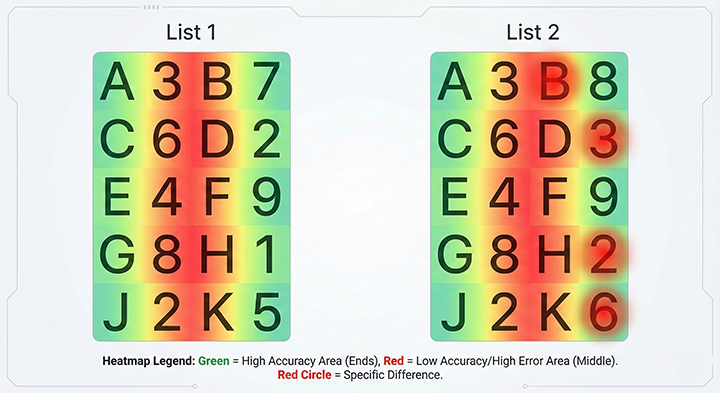
The Human Error Heatmap: Why Your Eyes “Skip” the Middle
When performing rapid checks under pressure, your brain takes shortcuts. This graphic illustrates a common psychological phenomenon in list comparison tasks: the visual attention sag.
As the heatmap demonstrates, human attention is highest at the “anchors” of data strings—the beginning and the very end.
-
The Green Zones (High Accuracy): Your eyes naturally focus on the first character to establish a match and the final character to confirm completion. These areas are usually checked with high accuracy.
-
The Red Zones (The Danger Area): In the fraction of a second it takes to scan from left to right, your brain’s attention dips in the middle. It “glosses over” the center characters, assuming they match because the anchors do. This is where the majority of transposition and substitution errors occur.
Analyzing the Example
Look closely at the comparison above. The heatmap visualizes this attention fade, while the red circles indicate where the actual differences between List 1 and List 2 are located.
Notice how easily a tired eye might see C6D2 and C6D3 as identical because the leading ‘C’ is a strong match. The error is hidden in that crucial “warm” zone just before the end. Similarly, in longer strings like VINs or credit card numbers, this “red zone” expands significantly in the middle digits.
The Takeaway for Test Day: To improve your clerical speed and accuracy score, you must consciously fight this natural tendency. Don’t just scan; force your focus into the “red zone” of every data string.
Consider the 2 lists below. The next 5 questions are based on these 2 lists.
List 1:
- A3B7
- C6D2
- E4F9
- G8H1
- J2K5
List 2:
- A3B8
- C6D3
- E4F9
- G8H2
- J2K6
Which item is exactly the same in both lists?
A) A3B7
B) C6D3
C) E4F9
D) J2K6
Welcome to the Pressure Cooker
Below is a video timer with loud noise – followed by 20 questions
You have 60 seconds! GO
The Pressure Cooker
Scenario 1: Primary Inspection Line (Passport Verification)
Task: Compare the “Database Record” against the physical “Passport ID”. Focus: Alphanumeric strings and subtle visual substitutions.
Database Record (Screen)
| A789 224 L |
| CAN 45902 |
| XK 900 812 |
| J22 516 P |
| US 882 109 |
| 004 119 73 |
| FR 652 990 |
| E-114-225 |
| G77 150 22 |
| 992 415 88 |
Passport ID (Document)
| A789 224 L |
| CAM 45902 |
| XK 900 182 |
| J22 516 P |
| US 8B2 109 |
| 004 119 73 |
| FR 652 990 |
| E 114 225 |
| G77 150 2Z |
| 992 451 88 |
| Identical |
| Error (Sub: N/M) |
|
Error (Transposition)
|
| Identical |
| Error (Sub: 8/B) |
| Identical |
| Identical |
|
Error (Omission: Dashes)
|
| Error (Sub: 2/Z) |
|
Error (Transposition)
|
Scenario 2: Customs Manifest (Shipping & Cargo)
Task: Compare the “Manifest Entry” against the “Package Label”. Focus: Names, Addresses, and Punctuation (Omissions).
Manifest Entry (Paperwork)
| 1240 Oak St. |
| Global Tech Solutions |
| Inv #998-A2 |
| Lytton & Co. |
| 5892 West Ave |
| P.O. Box 441 |
| Ste 400 |
| K.L. Logistics |
| Vancouver, BC |
| Item: 8842-X |
Package Label (Box)
| 1240 Oak St |
| Global Tech Solutions |
| Inv #998-A2 |
| Lytton & Co. |
| 5982 West Ave |
| P.O. Box 441 |
| Ste. 400 |
| K.I. Logistics |
| Vancouver BC |
| Item: 8842-X |
| Identical |
| Error (Sub: N/M) |
|
Error (Transposition)
|
| Identical |
| Error (Sub: 8/B) |
| Identical |
| Identical |
|
Error (Omission: Dashes)
|
| Error (Sub: 2/Z) |
|
Error (Transposition)
|
How did you do?
-
Finished in under 45 seconds?
-
Rating: Border Services Ready. You have the speed. Now check your accuracy—did you rush and miss the error in Question #15?
-
-
Finished in 45–60 seconds?
-
Rating: Solid Contender. This is a passing pace. You are balanced and steady.
-
-
Didn’t finish?
-
Rating: Needs Calibration. You are likely “reading” instead of “scanning.” Don’t worry—most people start here. Practice the “Trap Scan” technique to shave off those extra seconds.
-
Can You Beat the Clock? (20 Questions in 60 Seconds)
Set your timer for exactly 1 Minute. GO!
-
Finished in under 45 seconds?
-
Rating: Border Services Ready. You have the speed. Now check your accuracy—did you rush and miss the error in Question #15?
-
-
Finished in 45–60 seconds?
-
Rating: Solid Contender. This is a passing pace. You are balanced and steady.
-
-
Didn’t finish?
-
Rating: Needs Calibration. You are likely “reading” instead of “scanning.” Don’t worry—most people start here. Practice the “Trap Scan” technique to shave off those extra seconds.
-
The CBSA OTEE test is your Gateway to a high-paying in-demand career
Get Started Today
PDF Download —- Online Course — Paperback (Amazon)
Anatomy of a Wrong Answer: The 3 Traps You Will Face
Not all errors are created equal. When you are staring at hundreds of list items, your brain doesn’t just “miss” things randomly; it falls into specific, predictable psychological traps.
To pass the CBSA OTEE or PSEE, you need to stop reading like a reader and start scanning like a proofreader. Here are the three distinct types of errors you need to hunt for.
1. Transposition Errors (The “Switcheroo”)
What it is: This is the most common and dangerous error in clerical tests. A transposition error occurs when two adjacent characters swap places.
-
The Trap: Your brain reads in “chunks.” If you see
5-7-9-8, your brain registers the presence of those four numbers, but it often glosses over the exact order. -
The Example:
-
List A:
84920 -
List B:
84290 -
Did you catch it? The
9and2switched places.
-
-
Pro Tip: When checking long numbers (like VINs or passport numbers), read them in pairs of two. It is much harder to miss
92vs29than it is to miss the whole string.
2. Omission Errors (The “Missing Link”)
What it is: An omission error happens when a single character—often a punctuation mark or a silent letter—is dropped from the second list.
-
The Trap: We are trained to ignore “noise” when reading. If you see “Inc.” or “LLC”, your brain registers the concept of a company, not the specific period at the end.
-
The Example:
-
List A:
Applewood Logistics Inc. -
List B:
Applewood Logistics Inc -
The Difference: The period
.is missing at the end.
-
-
Pro Tip: Pay special attention to the “tails” of data entries. The ends of sentences and abbreviations are where omissions love to hide.
3. Substitution Errors (The “Look-Alike”)
What it is: A substitution error is when a character is replaced by a visually similar one. This tests your visual acuity more than your reading speed.
-
The Trap: Under stress, the eye struggles to distinguish between characters with similar shapes.
-
The Example:
-
List A:
K41S0N -
List B:
K4150N -
The Difference: The letter
Swas replaced by the number5.
-
-
Common Look-Alikes:
-
O(letter) vs0(zero) -
I(letter) vs1(one) -
l(lowercase L) vs1(one) -
Bvs8
-
Quick Checklist: The “Trap” Scan
Before you mark a line as “Correct,” run this 1-second mental checklist:
-
Check the Order: Did any numbers flip? (Transposition)
-
Check the Ends: Is the punctuation there? (Omission)
-
Check the Code: Is that an
Oor a0? (Substitution)
Get Started Today
PDF Download —- Online Course — Paperback (Amazon)
Published: Friday, July 12th, 2024

Created by Brian Stocker and the team in Victoria, BC.
Helping students succeed since 2005
Got a Question? Email me anytime - Brian@test-preparation.ca
You may also like
Free Canadian History Practice: CAEC & Citizenship Prep
Stop Drowning in Dates. Start Passing Your Canadian History Exam Let’s be honest: the Canadian story is massive. Between the Constitutional Act of 1867 summary and the deep complexities of Indigenous History and Treaties in Canada, it’s easy to feel …
Police Vocabulary Practice
Most people think police work is all sirens and chases. But ask any veteran officer, and they’ll tell you the real work happens behind a desk. You might spend 20 minutes making an arrest and 3 hours writing the report. …
Police Problem Solving for SSPO and OACP Test
Police Problem Solving: Rule Application (Deductive Logic) This section of the SSPO (Sigma Survey for Police Officers) and OACP certificate process measures your ability to apply a general rule or a policy to a specific real-world situation or scenario. This …
1 Comment
Thanks – very useful. They helped me understand the questions and what to expect on the CBSA.