Smart Note-Taking for Canadian Exams | PDF Study Guide
The Big Three: Cornell, Split-Page, and Mapping for Provincial Licensing
Out here in the Pacific Northwest, we like things that are sturdy and reliable. When you’re sitting for a high-stakes exam, you don’t need a “fancy learning ecosystem”—you need a strategy that works when the clock is ticking. Over the years, we’ve found that these three methods are the “gold standard” for Canadian students who need to get it right the first time.
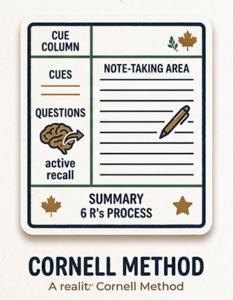 1. The Cornell Method: The “6-R” Professional Standard
This is the heavy hitter. It’s the most trusted Cornell Method notes printable system because it forces you to think while you write. You divide your page into three specific zones: a Cue column (left), a Note-taking area (right), and a Summary block (bottom).
Why it works: It uses the “6-R” process—Record, Reduce, Recapitulate (a fancy teacher-word for summarize), Recite, Reflect, and Review.
The Result: By the time you finish a page, you’ve already studied the material three times. It’s perfect for the dense legal definitions in provincial security or insurance exams.
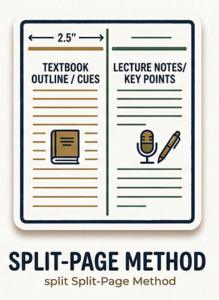 2. The Split-Page Method: The “Textbook-to-Lecture” Bridge
If you’ve ever struggled to connect what you read in the manual with what the instructor said in class, this is your tool. You draw a vertical line 2.5 to 3 inches from the left.
How to use it: Use the left side to outline the textbook chapter before class. Use the right side to add the instructor’s specific “inside info” during the lecture.
The Result: You end up with a side-by-side comparison. No more flipping back and forth between your book and your binder. It keeps everything in one place—just how we like it.
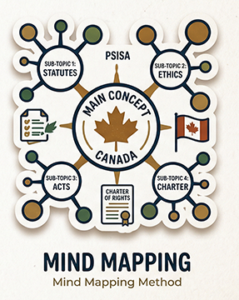 3. Mind Mapping: The “Visual Navigator”
Standard notes can feel like a “wall of text.” Mind Mapping breaks that wall down. You start with the central theme in a circle (like “The Charter of Rights”) and draw “spokes” out to sub-topics.
Why it works: It mimics how your brain actually stores memories—through connections, not just lists.
The Result: It’s an “out-of-the-box” way to see the big picture. If you’re a visual learner, this is how you spot the “Trap Questions” that catch others off guard.
Brian’s Behind-the-Scenes Tip: Don’t try to master all three at once. Pick the one that matches your subject. Use Cornell for law, Split-Page for trades, and Mapping for brainstorming your essays.
[Download the 5-Method Template Vault & Audio Lectures – $19 CAD]
Write it out!
 By writing my notes by hand, I am able to focus on the information that is provided and ensure that I understand the topic. For example, to prepare for a biology test, I will go through Powerpoints from my teachers to create my notes. Then I will read the textbook to fill in any details that could have been left out ensuring that I am covering all the content of the course. Writing by hand helps solidify the information by creating a connection between memory and movements as shown in cross-modality learning techniques. After I have done all the notes, I will try to make connections from the course material and personal interests as a way of making the process enjoyable. For example when studying muscles, I would think of what was happening in my muscles during sports practices. These techniques paired with reciting orally and translating my notes have provided me with great results.
Following the completion of the written notes, I then recite them out loud while simultaneously translating to English. As I was part of the French Immersion program, my family and I’s first language is English. Therefore, I translate my notes to develop a better understanding of the topics. In doing so, this allows multiple parts of the brain to work together in hopes of assimilating new knowledge. Usually, I will recite them to my mom who loves hearing all about what I learn. She will usually ask questions that challenge me and create an opportunity to become aware of any gaps in knowledge. This way, instead of simply memorizing the content, I am able to learn and completely master whatever it is I may be learning about.
How to Take Notes – A Quick Guide
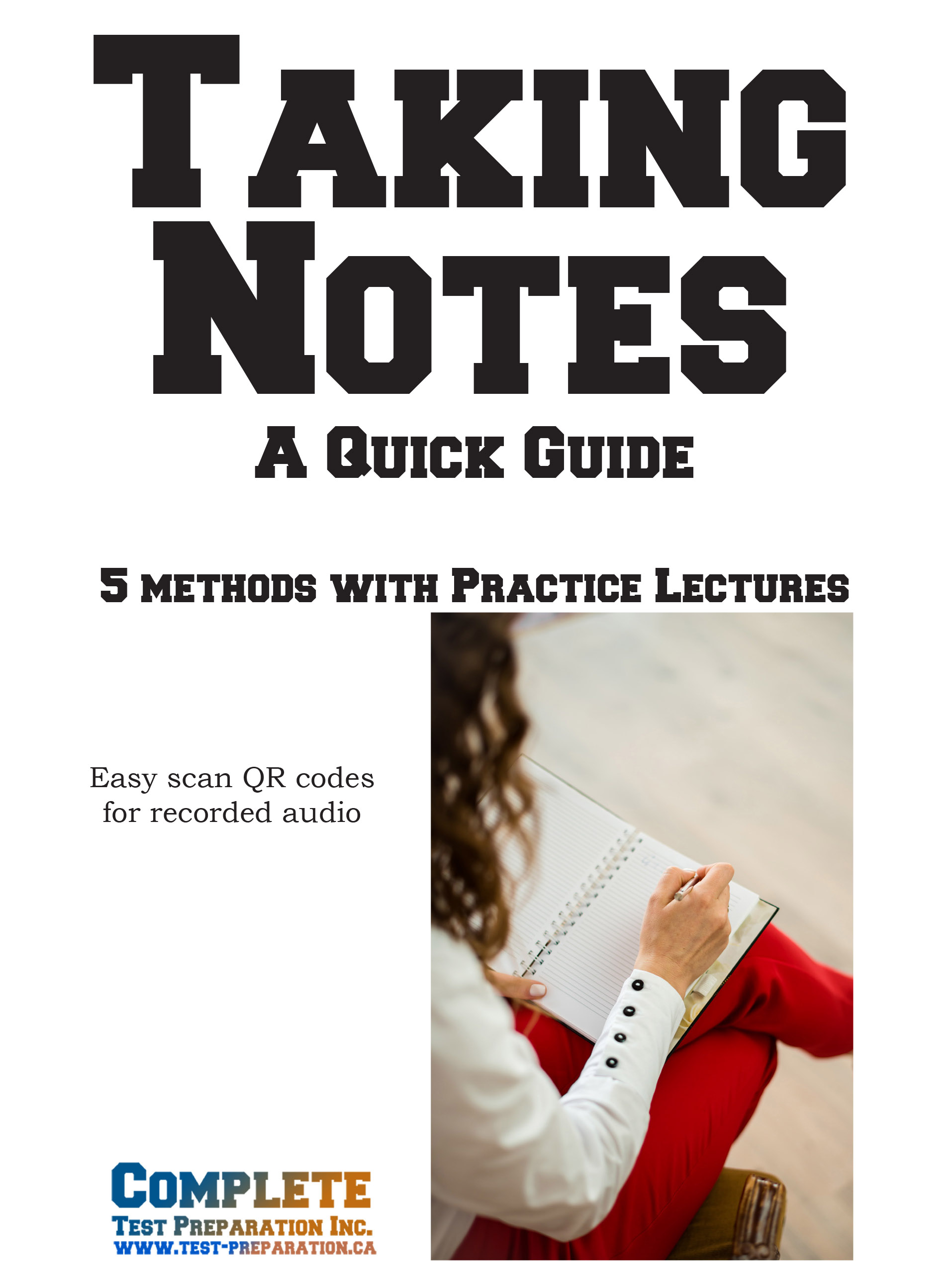 Learn 5 Note Taking Methods – With Full Explanation and Examples!
Taking notes is an essential academic skill and you will be doing a LOT!
You Receive:
- Downloadable audio lectures with easy scan QR codes
- Free Page Templates
- Full explanation with examples for 5 different methods
- Learn these Note Taking Methods:
- Outlining, Cornell, Split Page, Charting and Mapping
How to Take Notes – A Quick Guide
Learn 5 Note Taking Methods – With Full Explanation and Examples!
Taking notes is an essential academic skill and you will be doing a LOT!
You Receive:
- Downloadable audio lectures with easy scan QR codes
- Free Page Templates
- Full explanation with examples for 5 different methods
- Learn these Note Taking Methods:
- Outlining, Cornell, Split Page, Charting and Mapping

29 Comments
I prefer the slip page but I will also try out your other note taking styles in the other posts. Thanks!
this is really gay who looks at this lol <3
Actually about 1,000 people everyday LOL!
When you have to submit your notes either in a Cornell or Outline format- knowing what your doing really does help. I only wish there was a more detailed example.
well bit-ch alot of people look at this (SMART people who study) and if you are saying “who looks at this” why are you looking at it huh if you didnt need it you wouldnt have gone on this website stupid
After reading Excellent ideas on your Blog. I like. thank you for posting such lovely content
Well Vanessa if you curse then you ARE stupid because you obviously don’t know how to express your feelings. Its not good to curse. And you won’t be stupid if you don’t curse thank you. But yes, you’re right that this is useful.
Great Article! are you recommending that you mind map from the beginning? or take ‘regular’ notes then mindmap?
i sometimes find it difficult to mindmap from the onset. If i take regular notes then i can organise them later into a mindmap with colours.
Its up to you – You can mind map directly during a lecture, or use it as a way to re-organize/organize your notes later
Hey there, I’m a long-time lurker and also was too shy to create a comment.
Great resources. Wish i could find more info like this from other people! Thanks!
Interesting thought! You have covered almost all part of the the Outline method. However one thing I would like to is that “Outlining records content as well as relationships. Outlining also reduces editing. Your notes are easy to review by turning main points into questions.” 5 tips to take great usable notes- 1. Make clear and accurate notes, 2. Minimize distractions, 3. Come to class prepared, 4. Organize your notes, 5. Use abbreviations and symbols.
I have learned the above 5 important points of note taking from a book Secrets SMART Study System offered by 4 hour study week. It helps to learn the power-napping techniques and sleeping habits that will instantly boost your focus, creativity and ability to learn and memorize better. More importantly it helps a student to secure better grades in the class.
nice read, thanks!
Great post – I wondered if you have more on the subject? Thanks!
Martha – Taking notes is a very important and very popular topic for students at any level. See the links at the bottom of the post for more in depth information. I think the key thing about Taking Notes is that many students just start taking notes, which often is something like the Outline Method. Students don’t always realize that there are a number of different styles of taking notes, and if you try them out, you will probably find a note taking style that works better for you than the default Outline Method.
And for teachers, this is a really important skill to teach that will stay with students all of their academic career.
Taking notes split page method.. Not so bad 🙂
cool little site, glad I discovered it. I’ll definitely let my my friends about this blog & come back again.
What a great blog, glad happy I found it.
ashley u need to shut up because ur gay for saying it then
It’s a good post.
I believe this website is very helpful. When I note take, I write in the outline format. I find it to be more useful when it comes to taking many notes. I start off by writing my main idea. Then, I place bullets under the main idea to write down important information on the main topic. If there is still more to be emphasized, I then place numbers.
Thanks for your comment. The thing about taking notes is that it isn’t taught and most people end up taking notes one way by default without realizing there are a number of different ways to do it. Everyone is different and there is no right or wrong way. Whatever works for you is the best way!
Thanks for all the actual advice.I appreciate it,Coral
Am glad I could find such information. Keep up with the great work! Very precise and helpful.
Great lesson thank you very much 🙂
Very good article. I absolutely love this website.
Keep it up!
Thank you for giving such a great tips to maintain a better notes. It will be very helpful for my students.
I like this website it is really helpful. I not only learnt about note taking from it but also the meaning of some words. Thank you C for the great comment you posted. I really appreciate it.
I am going to try!