
Corrections Canada Situational Judgement Test
- Posted by Brian Stocker
- Date May 30, 2023
- Comments 4 comments
Practice!
Practice Questions with Explanation — How Hard is the test? — How the test is scored —
Understanding the Competencies — How this helps on Test day — Tips and Straategy
CSC Situational Judgement Practice Workbook
Corrections Situation Judgement Online Course — Practice Workbook (PDF Version)
Corrections SJT Practice Paperback (Amazon)

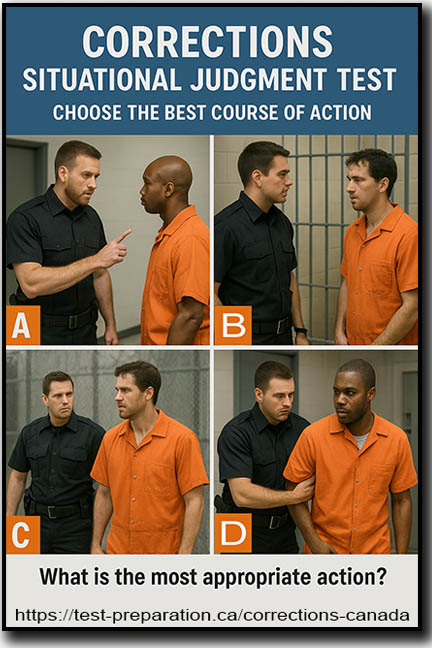
Correctional Officer Sample Scenario — Inmate Agitation during Transport
Situation: While transporting inmates, you encounter an agitated inmate who starts banging on the vehicle’s doors and threatening the staff.
Question 1: How should you handle this situation?
A) Ignore the inmate’s behavior and continue driving.
B) Immediately stop the vehicle and address the inmate’s concerns.
C) Call for backup and request assistance from nearby law enforcement.
D) Engage in a physical confrontation with the inmate.
The most effective response to this situation would be:
A B C D
The least effective response to this situation would be:
A B C D
What scenarios are on the CSC SJT?
1. Emergency Response
Fire alarms, medical emergencies, environmental hazards, and situations requiring quick, policy-based action.
2. Security of the Institution
Detecting threats, responding to contraband, managing fights, preventing escapes, and maintaining order.
3. Offender Accountability
Handling inappropriate behaviour, enforcing rules, managing conflict, and encouraging offenders to take responsibility for their actions.
4. Inmate Safety & Well-Being
Responding to signs of distress, mental health concerns, bullying, self-harm risks, or threats from other inmates.
5. Escort & Transport Situations
Ensuring safe movement of inmates within or outside the institution, monitoring behaviour, and following strict protocols.
6. Communication & Professional Conduct
How you interact with offenders, coworkers, and supervisors; how you deliver instructions; and how you de-escalate difficult situations.
Dealing with an Emergency – Audio Version
Corrections Situational Practice Questions with Detailed Explanations
Security of Inmates, Including During Transport
These scenarios focus on preventing harm to inmates and maintaining safety while they are under your care—especially during escorts or transport outside secure areas.
Situations may involve: medical transports, courthouse transfers, conflicts between inmates, attempted flight, or safety risks during movement.
You are being evaluated on:
- Safe escort procedures: Proper restraints, positioning, communication, and awareness of escape risks.
- Protecting vulnerable inmates: Recognizing intimidation, threats, or attempts to harm one another during movement.
- Maintaining situational awareness: Monitoring surroundings, anticipating risks, and adjusting escort techniques accordingly.
- Balancing security with care: Treating inmates respectfully while ensuring compliance and control.
- Incident prevention: Acting before a situation escalates—calling for backup, modifying routes, or separating individuals when needed.
Corrections Situation Judgement – Transporting Prisoners
Security of Inmates, Including During Transport – Practice Questions
Correctional Officer Sample Scenario — Inmate Agitation during Transport
Sample Scenario – Medical Emergency during Transport
Situation: While transporting an inmate, you notice the individual experiencing a medical emergency, such as difficulty breathing and chest pain.
Question : What should be your immediate response in this situation?
A) Continue transporting the inmate and inform medical staff upon arrival.
B) Administer first aid to the inmate using available supplies.
C) Immediately call for emergency medical services (EMS).
D) Delay seeking medical assistance until reaching the destination.
The most effective response to this situation would be:
A B C D
The least effective response to this situation would be:
A B C D
Security of Inmates, Including During Transport – Answer Key
1. C
2. D
Explanation: The effective response is option C, which involves calling for backup and requesting assistance from nearby law enforcement. This ensures the safety of staff and inmates by involving additional support to handle the agitated inmate appropriately. Ignoring the inmate’s behavior (option A) can lead to further escalation and potential harm. Stopping the vehicle (option B) might compromise the safety of other inmates and staff. Engaging in a physical confrontation (option D) is unsafe and against proper protocol.
Ranking in order of effectiveness
A) Ignore the inmate’s behavior and continue driving. Ineffective
B) Immediately stop the vehicle and address the inmate’s concerns. Very ineffective
C) Call for backup and request assistance from nearby law enforcement. Very effective
D) Engage in a physical confrontation with the inmate. Least Effective
Choose How You Want to Study
Option 1: The Full Experience (Best Value)
Online Course + Interactive Quiz + Full Audio
✅ Tutorials & Videos
✅ Audio Lessons
✅ Auto-timed Quizzes
✅ Includes Free Assessment
✅ Includes Bonus 120 Questions
Start Course Now
Most popular choice
Option 2: Instant Access – PDF Download
Practice Workbook (PDF)
✅ Download immediately
✅ Print at home
✅ Searchable text
Download PDF
$24.99 – Instant Delivery
Option 3: Physical Book
Paperback Version
✅ Traditional study style
✅ Take notes in margins
✅ Shipped via Amazon
Buy on Amazon
Order via Amazon
Security of the Institution and the Public
These scenarios involve threats to institutional security—such as suspicious behaviour, potential contraband, facility breaches, or inmates attempting to manipulate staff. The primary objective is to assess your ability to safeguard the institution and prevent risks from reaching the public.
You are being evaluated on:
- Vigilance: Recognizing signs of contraband movement, unusual patterns, or potential escape attempts.
- Sound judgment: Taking proportionate action, avoiding overreaction, and escalating only when warranted.
- Adherence to security procedures: Conducting searches correctly, enforcing movement rules, and reporting concerns.
- Integrity and professionalism: Remaining neutral, avoiding manipulation, and following ethical guidelines.
- Team coordination: Working with control, supervisors, and other staff to maintain a secure operation.
These scenarios measure your commitment to preventing incidents that could compromise safety beyond the facility walls.
Security of the Institution and the Public – Practice Questions
Scenario: Fire Hazard
Situation: While conducting regular rounds in the facility, you discover a small fire in one of the inmate’s cells. The fire is growing rapidly, and the smoke alarms have been triggered.
Question: What should be your immediate response in this situation?
A) Attempt to extinguish the fire using available fire extinguishers.
B) Evacuate nearby inmates and staff to a safe location.
C) Inform the inmate responsible for the fire to put it out immediately.
D) Ignore the fire and continue with regular rounds.
The most effective response to this situation would be:
A B C D
The least effective response to this situation would be:
A B C D
Scenario: Environmental Hazard
Situation: During a routine inspection, you discover a leak in a water pipe located in a high-security unit. The water is rapidly flooding the area and poses a safety risk to both staff and inmates.
Question: What should be your immediate response in this situation?
A) Attempt to stop the water leak by using temporary measures.
B) Evacuate staff and inmates from the affected area.
C) Document the leak and report it to maintenance after completing the inspection.
D) Continue the inspection and ignore the water leak.
The most effective response to this situation would be:
A B C D
The least effective response to this situation would be:
A B C D
Security of the Institution and the Public – Answer Key
B
D
Option B the correct response in this situation., It prioritizes the safety of staff and inmates by removing them from immediate danger. It allows the appropriate emergency response personnel to handle the fire. It minimizes the risk of the fire spreading and causing further harm. It demonstrates adherence to established emergency protocols.
Ranking in order of effectiveness
A) Attempt to extinguish the fire using available fire extinguishers. Effective
B) Evacuate nearby inmates and staff to a safe location. Very effective
C) Inform the inmate responsible for the fire to put it out immediately. Ineffective
D) Ignore the fire and continue with regular rounds. Very ineffective
B
D
Option B is the correct response in this situation. This ensures the safety of staff and inmates first.
Ranking in order of effectiveness
A) Attempt to stop the water leak by using temporary measures. Effective
B) Evacuate staff and inmates from the affected area. Most effective
C) Document the leak and report it to maintenance after completing the inspection. Ineffective
D) Continue the inspection and ignore the water leak. Least effective
How hard is the corrections situational judgement test
This is the most frequently asked question.
The Corrections Canada Situational Judgement Test (SJT) is considered one of the more challenging parts of the CSC entrance process, mainly because it measures judgement, not memorization. Many candidates find it difficult because the questions place you in realistic Correctional Officer scenarios where more than one answer may seem reasonable.
The challenge is choosing the option that reflects CSC policies, safety priorities, professionalism, and appropriate use of authority — even under pressure.
What makes the test feel hard is that it requires you to think like an officer before you have experience in the role. You’re expected to understand inmate behaviour, security risks, emergency responses, and communication protocols.
With the right preparation, it becomes far more manageable. Once you learn how CSC evaluates decisions — safety first, follow procedures, maintain professionalism, communicate clearly — the patterns start to make sense and your score improves quickly. Most candidates who practice realistic scenarios find the test significantly easier and far less intimidating.
How the CSC Situational Judgement Test Is Scored
1. Each Scenario Has a “Best” Response
For every scenario, one option demonstrates the best judgement based on CSC values, safety protocols, professionalism, and appropriate use of authority.
2. One or Two Options Are “Acceptable”
These actions may be reasonable or safe, but not the best. They show some judgement, but may lack proactive steps, proper communication, or full alignment with procedure.
3. One Option Is Clearly Ineffective or Unsafe
This response typically:
- Ignores safety
- Escalates the situation
- Breaks policy
- Shows poor professionalism
Choosing this option signals weak judgement and lowers your overall score. If you see options that are clearly incorrect, you can eliminate immediately and increase your chances. More Multiple Choice strategies
4. Scoring Is “Single-Choice”
Only one options is the best and only one is scored. You do not rank responses, and you don’t get partial credit for “almost correct” answers.
5. Your Score Reflects Consistency
The SJT looks for patterns. Consistently choosing safe, professional, policy-aligned actions demonstrates reliability — something CSC values highly.
Interview results
Suitability and security screening
What Competencies Does the CSC Situational Judgement Test Measure?
The SJT evaluates the most important competencies required for Correctional Officers in Canada.
1. Safety & Security First
Every decision must protect:
- Staff
- Inmates
- The public
- The integrity of the institution
Actions that ignore or downplay risk are scored poorly.
2. Following Procedures & Policy
Correctional Officers rely on structure and protocol. The test rewards decisions that:
- Follow established procedures
- Use appropriate authority
- Maintain compliance
- “Going with your gut” instead of policy is never the best answer.
3. Professionalism & Integrity
- Your responses must reflect:
- Respectful behaviour
- Ethical decision-making
- Integrity, even under stress
Unprofessional or emotional reactions are scored low.
4. Communication & De-escalation
CSC expects officers to use clear, respectful communication to prevent conflict. Good responses show:
- Firm but calm direction
- Active listening
- De-escalation techniques
- Professional language
- Avoiding communication or escalating tension signals poor judgement.
5. Problem-Solving & Decision-Making
Strong candidates:
- Assess the situation quickly
- Recognize risk factors
- Choose the safest, most effective option
- Follow through appropriately
Ineffective problem-solving leads to safety issues — and a lower score.
6. Accountability & Reliability
CSC values officers who take responsibility for:
- Reporting incidents accurately
- Documenting events
- Following up correctly
- Maintaining professional standards
Looking the other way or avoiding responsibility is scored very negatively.
Choose How You Want to Study
Option 1: The Full Experience (Best Value)
Online Course + Interactive Quiz + Full Audio
✅ Exclusive A.I. Study Hall Tutor
✅ Tutorials & Videos
✅ Audio Lessons
✅ Auto-timed Quizzes
✅ Includes Free Assessment
✅ Includes Bonus 120 Questions
Start Course Now
Most popular choice
Option 2: Instant Access – PDF Download
Practice Workbook (PDF)
✅ Download immediately
✅ Print at home
✅ Searchable text
Download PDF
$24.99 – Instant Delivery
Option 3: Physical Book
Paperback Version
✅ Traditional study style
✅ Take notes in margins
✅ Shipped via Amazon
Buy on Amazon
Order via Amazon
Why Understanding These Competencies Helps You Score Higher
The SJT isn’t about guessing. Once you understand what CSC wants to see — safety, professionalism, structure, communication, and sound judgement — the “best response” becomes much clearer.
Most candidates struggle because they:
- Overthink the scenarios
- Choose the answer they personally would do
- Select options that try to “be nice” instead of following procedure
- Misjudge what is considered safe or professional in a correctional environment
- Training your thinking to match CSC priorities dramatically improves results.
When unsure, choose the response that:
- Prioritizes safety and security
- Follows policy and proper procedures
- Uses calm, clear communication
- Maintains professionalism
- Addresses the problem directly and appropriately
- Reflects CSC values and expectations
If a response feels impulsive, emotional, risky, or outside procedure — it’s almost always wrong on this test.
Common Mistakes on a Situational Judgement Test
- Not reading the question carefully: Situational judgement questions are often complicated with multiple scenarios. As with any multiple choice question – read the question and all the choices carefully before selecting your answer.
- Not considering the context: The context of the situation often determines the best answer. In a different context, the correct answer will be different. Take into account all details of the scenario, the people involved, the setting, and the goals of the organization.
- Not considering the ethical implications: Many situational judgement questions have ethical considerations. In choosing your answer, consider not only the legal and professional implications, but also the moral and ethical implications of your actions.
- Choosing the most drastic option: Some questions may present extreme options as choices, but in a real-life situation, the drastic option is almost never the best. Extreme actions presented as solutions are designed to distract and are rarely the best course of action. Usually, but not always they can be eliminated right away.
- Not considering the long-term consequences: Some decisions have short-term benefits but long-term consequences. Consider the potential consequences of your actions before making a decision.
- Not thinking critically: Consider multiple perspectives and options when answering. This is a critical skill that situational judgement questions are designed to test.
Corrections Situational Judgement Test
Corrections Situation Judgment - Tips and Strategy
Date Published: Tuesday, May 30th, 2023
Date Modified: Sunday, July 5th, 2026

Created by Brian Stocker and the team in Victoria, BC.
Helping students succeed since 2005
Got a Question? Email me anytime - Brian@test-preparation.ca
You may also like
Free Canadian History Practice: CAEC & Citizenship Prep
Stop Drowning in Dates. Start Passing Your Canadian History Exam Let’s be honest: the Canadian story is massive. Between the Constitutional Act of 1867 summary and the deep complexities of Indigenous History and Treaties in Canada, it’s easy to feel …
Police Vocabulary Practice
Most people think police work is all sirens and chases. But ask any veteran officer, and they’ll tell you the real work happens behind a desk. You might spend 20 minutes making an arrest and 3 hours writing the report. …
Police Problem Solving for SSPO and OACP Test
Police Problem Solving: Rule Application (Deductive Logic) This section of the SSPO (Sigma Survey for Police Officers) and OACP certificate process measures your ability to apply a general rule or a policy to a specific real-world situation or scenario. This …
4 Comments
Difficult – can u post tutorial on how to answer??
Pls i need tutorial question and answer for the Correctional Service of Canada exam.
Pls I need situational judgement Test and Psychological Assessment question and answer for the Correctional Service of Canada
Complete Corrections Situation Judgement Course here