
Don’t Let One Test Delay Your Career by 12 Months.
If you are applying for the Canadian Border Services Agency, you already know the stakes. Failing the Officer Trainee Entrance Exam (OTEE) isn’t just a setback—it is a mandatory one-year waiting period before you can re-apply. That is 365 days of lost seniority and a $70,000+ starting salary gone.
Our CBSA OTEE practice test and study materials are designed for one purpose: to ensure you pass the CBSA entrance exam on your first attempt. We don’t just give you questions; we provide the OTEE sample questions Canada needs to see from its future officers.

Don’t gamble with a 12-month delay. Get the “Zero-Wait” Prep Bundle.
Full-featured prep with AI coaching for half the price of the big guys.
PDF Download
Online Course
Amazon Paperback
— L., CBSA Test-Taker
Navigating the CBSA Hiring Process 2026
The road to becoming a Border Services Officer (BSO) is a marathon, not a sprint. In 2026, the CBSA has streamlined its recruitment, but the standards remain incredibly high. If you fail the written exam, you are sidelined for a full year.
Here is your Rigaud Readiness Roadmap—the exact path from applicant to frontline officer.
The Rigaud Readiness Roadmap: From OTEE to FB-02
Stage 1: The Gatekeeper (OTEE)
The Goal: Pass the 117-question Officer Trainee Entrance Exam.
The Stakes: This is the most significant hurdle. It tests your Reasoning, Analytical Thinking, Client Service, and Writing Skills.
Pro-Tip: Results are usually returned within 2–10 business days. Successful results are valid indefinitely, but a fail triggers the mandatory one-year wait.
Stage 2: The Assessment Phase (Interviews & Skills)
Structured Behavioral Interview: You will be assessed on competencies like integrity and decisiveness. You must provide specific STAR (Situation, Task, Action, Result) examples.
Role-Play Scenario: A live evaluation where you handle a simulated “difficult traveler.” They are looking for professional judgment under pressure.
Firearms Safety: You must complete the CFSC and CRFSC (Non-restricted and Restricted) courses before moving to the next block.
Heading to the border? CBSA trainees often face language evaluations during the clearance process. Get ahead of the pack with our English SLE practice tools
Stage 3: The Clearances (Medical & Security)
Medical & Psych Evaluation: Includes vision/hearing tests and a psychological inventory to ensure you can handle the “Use of Force” training.
Security Clearance: A deep-dive “Secret” level clearance. This is often the longest stage of the CBSA hiring process 2026, sometimes taking months depending on your travel and financial history.
Stage 4: The Officer Induction Training Program (OITP)
Part A: Distance Learning (4 Weeks): Online facilitated training you can do from home (approx. 5 hours/day).
Part B: In-Residence at Rigaud (14 Weeks): Intensive, paid training at the CBSA College in Rigaud, Quebec. You will live on-site, learn defensive tactics, and master the 90+ Acts of Parliament you’ll enforce.
Stage 5: Officer Induction Development Program (OIDP)
The Finish Line: You are posted to a Port of Entry (POE) as an FB-02 Trainee. This is a 12 to 18-month on-the-job development phase. Once completed, you are a fully qualified Border Services Officer.
Don’t just read about the process—train for it.
The OTEE is a digital, timed exam. If you haven’t practiced in a simulated environment, the 135-minute clock will be your biggest enemy. Our Online OTEE Course includes auto-timed quizzes that mimic the real 2026 CBSA interface.
Anatomy of the OTEE: Reasoning and Analytical Thinking
The Reasoning and Analytical Thinking section is widely considered the most challenging part of the Officer Trainee Entrance Exam. It doesn’t test what you know; it tests how you process information under extreme time pressure.
To pass, you must demonstrate the ability to identify patterns, spot discrepancies in massive data sets, and apply complex rules to specific scenarios—exactly what a Border Services Officer does every day at a Port of Entry.
The 3 Pillars of OTEE Reasoning
1. Discrepancy Identification (The “Eagle Eye” Test)
In this sub-section, you are presented with two sets of data—often a traveler’s declaration and a manifest or passport scan.
** The Challenge:** You must identify if the names, dates, serial numbers, or quantities match perfectly. The “traps” are subtle: a transposed digit in a passport number (e.g., 1234 vs. 1243) or a slight misspelling of a city.
The Goal: 100% accuracy. In the real world, missing a discrepancy could mean a security breach.
2. Logic and Sequence (The “Pattern” Test)
These questions involve series of symbols, numbers, or shapes. You must determine the underlying rule to predict the next item in the sequence.
The Challenge: The rules are often multi-layered. One element might rotate 90 degrees while another changes color or disappears.
The Goal: To assess your cognitive flexibility—how quickly you can pivot your thinking when a “rule” changes.
3. Rule Application (The “Protocol” Test)
You are given a set of CBSA-style regulations (e.g., “Duty-free limits for a traveler out of Canada for 48 hours vs. 7 days”) and a specific traveler profile.
The Challenge: You must ignore your personal opinions and apply only the provided rules to determine the correct outcome.
The Goal: This tests your ability to follow Legislative Authority without bias.
Wait! Don’t Go Into the Exam Room Half-Prepared
I often get asked, “Brian, I’m taking the OTEE so why do I need the GCT materials?” It’s a great question. Here’s the “inside scoop” from my years of triple-checking these requirements:
The GCT is the “DNA” of your exam. The Public Service Commission uses the General Competency Test (GCT) as the blueprint for almost all their entrance exams. Whether you are applying for the Border Services (OTEE), the RCMP, or Correctional Services, the “Reasoning” and “Analytical” sections are actually GCT sub-tests in disguise.
Do you really need it?
If you can look at a complex logic pattern or a massive data set and spot a tiny discrepancy in 30 seconds, you might be fine. But most of us haven’t done that kind of “brain gymnastics” since high school.
You need the GCT Bundle if:
- You’re worried about the clock: The GCT logic questions are designed to make you run out of time. We teach you how to beat the timer.
- You want to “Speak the Language”: The government has a very specific way of grading “Correct” vs. “Most Correct.” The GCT materials show you the exact logic they’re looking for.
- You want total peace of mind: Why study 50% of the test when the logic portion is where most people fail?
The “Success Bundle” – Your Complete Toolbox
Instead of just getting the basic guide, this bundle gives you the core test material plus the deep-dive GCT logic training. It’s like studying the playbook before the big game instead of just looking at the scoreboard.
[Upgrade to the Success Bundle & Master the GCT Logic]
Save 20% compared to buying them separately—because we’d rather see you pass the first time.
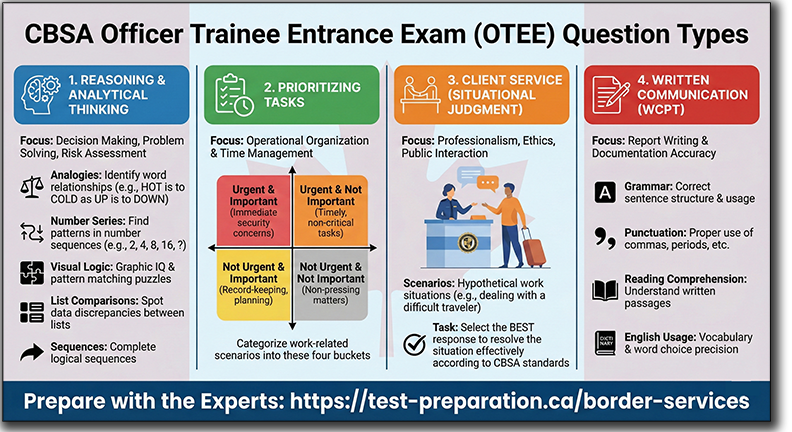
| OTEE Question Type | The Common Pitfall | The "Stocker" Pro-Tip |
|---|---|---|
| Data Comparison & Discrepancy | Reading too fast and "auto-correcting" errors in your head (e.g., seeing Smith when it's Smyth). | Accuracy > Speed. Use your finger or a cursor to track data points. Your brain is trained to skip typos; force it to stop. |
| Task Prioritization | Choosing the "polite" or "helpful" option over the protocol-driven one. | Agency Logic first. Security and Law Enforcement always trump administrative convenience or traveler comfort. |
| Logical Reasoning Sequences | Getting "stuck" on one hard pattern and watching the 135-minute clock bleed out. | The 30-Second Rule. If the pattern doesn't click in 30 seconds, mark it, guess, and move on. The OTEE is a volume game. |
| Situational Judgement (SJT) | Answering based on your personal ethics rather than CBSA core competencies. | Integrity & Decisiveness. We teach you the "Mindset" in our course so you can spot the Agency-approved response every time. |
The Logic Mastery Module
Don’t let a transposed digit cost you a year.
Most candidates fail the Reasoning section because they lack a systematic way to scan data. Our OTEE Study Guide PDF includes our proprietary “Scan & Verify” method, designed specifically to catch the types of discrepancies the CBSA hides in the OTEE.
Mastering the Situational Judgement Section: The “CBSA Mindset”
The Situational Judgement (SJT) portion of the OTEE is not a personality test—it is a competency test. The CBSA isn’t looking for “nice” people; they are looking for candidates who demonstrate the specific professional traits required to manage Canada’s borders.
If you answer these questions based on how you would act at a regular office job, you will likely fail. You must answer as a Border Services Officer.
The 4 Core CBSA Competencies
To pass the SJT, every answer you choose must be filtered through these four pillars:
- Integrity and Ethics: There is no “gray area.” Rules and legislation must be followed strictly. If a scenario involves a conflict of interest or a minor breach of protocol, the correct answer is always the one that upholds the highest ethical standard.
- Decisiveness: You are often the final authority at a secondary inspection. The Agency looks for candidates who can make a firm decision based on the facts available without constantly deferring to a supervisor for simple matters.
- Client Service Orientation: This is the “Firm but Fair” balance. You must remain professional and calm, even when dealing with difficult, non-compliant, or abusive travelers.
- Effective Interactive Communication: You must demonstrate that you can listen, decode verbal and non-verbal cues, and communicate clearly to resolve conflict.
The “Mindset Shift”: Customer Service vs. Law Enforcement
In a retail job, “the customer is always right.” In the CBSA, the legislation is always right. * The Scenario: A traveler is $20 over their personal exemption limit and is becoming emotional because they are in a rush.
- The “Normal” Response: Let them go with a warning to keep the line moving and the “customer” happy.
- The CBSA Response: Follow the protocol for the overage. Security and revenue collection are the priority; the traveler’s schedule is secondary.
The “Stocker” SJT Strategy: The “Elimination” Method
In our Online OTEE Course, we teach you to categorize SJT options into three buckets:
- The Passive Answer (FAIL): Doing nothing, “waiting to see what happens,” or immediately passing the buck to a supervisor.
- The Aggressive Answer (FAIL): Escalating a situation unnecessarily or being rude to a traveler.
- The Professional Answer (PASS): Taking direct action that follows policy while maintaining a calm, professional demeanor.
Here is What’s on the Test
Stop Guessing. Start Thinking Like an Officer.
The Situational Judgement section is where most “high-IQ” candidates fail because they overthink the logic. Our Online Course includes video walkthroughs of 20+ real-world CBSA scenarios, showing you exactly how to spot the “Integrity Trap” and choose the high-scoring response every time.
The “Cognitive Trap” Diagnostic: Why Smart People Fail the OTEE
After years of analyzing results from thousands of applicants, I’ve discovered a frustrating truth: Being “smart” isn’t enough to pass the OTEE. In fact, many high-achieving university grads fail this test because they fall into “Cognitive Traps”—mental shortcuts our brains use every day that are actually penalized by the CBSA scoring algorithm.
Are you falling into these three common traps?
Trap #1: The “Auto-Correct” Mirage
Where it happens: Reasoning and Analytical Thinking (Data Comparison).
The Trap: Your brain is a highly evolved pattern-matching machine. When you see a word like “Vancouver,” your brain skips the individual letters because it already knows the word. On the OTEE, the test will list “Vancover” (missing the ‘u’).
- The Diagnostic: If you find yourself finishing practice sets quickly but getting 15% of the “easy” comparison questions wrong, you are falling for the Mirage.
- The Cure: We teach you the “Reverse-Scan” technique in our workbook—forcing your brain to look at data in a way that breaks the auto-correct habit.
Trap #2: The “Supervisor” Crutch
Where it happens: Situational Judgement (SJT).
The Trap: In most entry-level jobs, the “safe” answer is to ask your manager what to do. On the OTEE, choosing “Ask a Supervisor” is often a low-scoring response.
The Diagnostic: Are you picking the answer that “escalates” the problem upward? The CBSA wants to hire people who can handle FB-02 level responsibilities independently.
The Cure: Use our “Decisiveness Matrix” to determine when a supervisor is actually required versus when you are expected to take the lead.
Trap #3: The “Context” Clutter
Where it happens: Prioritizing Tasks and Logic.
The Trap: You bring outside knowledge into the test. You think, “Well, in a real airport, this would happen first…” * The Diagnostic: If you are arguing with the practice questions because “that’s not how it works in real life,” you’re cluttering the logic. The OTEE is a closed loop. You must only use the rules provided on the screen, even if they contradict your previous experience.
The Cure: Our “Blank Slate” method helps you strip away outside assumptions so you can solve the logic puzzles based strictly on the provided prompts.
Which trap is your biggest hurdle?
Take our 10-minute diagnostic quiz to see your “Error Profile.” Most students find that once they identify their specific Cognitive Trap, their scores jump by 20% overnight.
Train your brain to see what others miss.
Our Online OTEE Course doesn’t just give you more questions; it includes our “Trap Detection” video series. I walk you through 50 of the most common OTEE traps and show you exactly how to rewire your thinking to avoid them.
CBSA OTEE Practice Questions & Resources – The Resource Hub
Free CBSA OTEE Practice Test
Section Drill: Logic and Reasoning Questions
Section Drill: Situational Judgement & Case Studies
Section Drill: List Comparison Practice
Section Drill: Prioritizing Practice
Section Drill: Writing and Grammar Assessment
Beyond the OTEE: The Full CBSA Qualification Picture
While the Officer Trainee Entrance Exam is the academic gateway, the CBSA requires a “whole-person” qualification. To wear the badge, you must prove you are physically capable, psychologically resilient, and legally authorized to carry defensive equipment.
The PARE: Physical Ability Requirement Evaluation
Before you are invited to Rigaud, you must pass the PARE. This is a grueling obstacle course that simulates a foot pursuit and a physical struggle.
- The Test: You must complete an obstacle course, a push-pull station (70 lbs), and a weight carry (100 lbs) in 4 minutes and 45 seconds or less.
- The Goal: To ensure you have the cardiovascular and muscular strength to handle a physical confrontation at a Port of Entry.
- Pro-Tip: Your PARE results are valid for 18 months. If you are serious about the CBSA hiring process 2026, start training for the “Push-Pull” station now—it’s where most candidates fail.
Firearms Training: CFSC and CRFSC
As a Border Services Officer, you are a peace officer authorized to carry a sidearm. You cannot be hired without proof that you have passed the national safety standards.
CFSC: The Canadian Firearms Safety Course (Non-Restricted).
CRFSC: The Canadian Restricted Firearms Safety Course.
The Goal: You must successfully pass the written and practical exams for both. The CBSA will provide more intensive tactical training at the Academy, but these certifications are your “entry ticket.”
The Medical and Psychological Assessment
The Agency needs to know you can handle the high-stress environment of a border crossing.
- Medical Evaluation: A physician will test your vision (minimum uncorrected standards apply) and hearing. You must also pass a “Use of Force” medical clearance.
- Psychological Assessment: This involves a lengthy written personality inventory followed by an interview with a psychologist.
The Goal: They are looking for emotional stability, resilience to stress, and a lack of “authoritarian” or “passive” extremes in your personality.
Security Clearance: The “Secret” Level
This is more than a simple criminal record check. The CBSA will investigate your financial history, your past travel, and your associations.
The Goal: To ensure you are not vulnerable to coercion or bribery. Integrity is the Agency’s most valuable currency.
The “Uniform Fit” Calculator
Are you actually ready to apply?
Before you spend a dime on study materials, use our quick checklist to see if you meet the “hard” requirements:
[ ] Are you a Canadian Citizen or Permanent Resident?
[ ] Do you have a valid Driver’s License?
[ ] Are you willing to relocate to any Port of Entry in Canada?
[ ] Can you pass a “Secret” security clearance?
If you checked every box, the only thing standing between you and a $70,000+ career is the OTEE.
The average wait time for a CBSA application is 12–18 months. Don’t add another year to that by failing the OTEE.
You’ve done the research. You know the requirements. Now, give yourself the competitive edge that thousands of successful officers have used.
Wait! Don’t Go Into the Exam Room Half-Prepared
I often get asked, “Brian, I’m taking the OTEE so why do I need the GCT materials?” It’s a great question. Here’s the “inside scoop” from my years of triple-checking these requirements:
The GCT is the “DNA” of your exam. The Public Service Commission uses the General Competency Test (GCT) as the blueprint for almost all their entrance exams. Whether you are applying for the Border Services (OTEE), the RCMP, or Correctional Services, the “Reasoning” and “Analytical” sections are actually GCT sub-tests in disguise.
Do you really need it?
If you can look at a complex logic pattern or a massive data set and spot a tiny discrepancy in 30 seconds, you might be fine. But most of us haven’t done that kind of “brain gymnastics” since high school.
You need the GCT Bundle if:
- You’re worried about the clock: The GCT logic questions are designed to make you run out of time. We teach you how to beat the timer.
- You want to “Speak the Language”: The government has a very specific way of grading “Correct” vs. “Most Correct.” The GCT materials show you the exact logic they’re looking for.
- You want total peace of mind: Why study 50% of the test when the logic portion is where most people fail?
The “Success Bundle” – Your Complete Toolbox
Instead of just getting the basic guide, this bundle gives you the core test material plus the deep-dive GCT logic training. It’s like studying the playbook before the big game instead of just looking at the scoreboard.
[Upgrade to the Success Bundle & Master the GCT Logic]
Save 20% compared to buying them separately—because we’d rather see you pass the first time.
Full-featured prep with AI coaching for half the price of the big guys.
The Quick-Start: PDF
- Instant access: No waiting for the mail. Start right now.
- Searchable: Use Ctrl+F to find exact formulas fast.
- Print what you need: Save ink by only printing the tricky sections.
- Budget-friendly: We pass the printing savings straight to you.
The Gold Standard: Course
- ★ EXCLUSIVE: A.I. Study Hall Tutor. A helping hand that nudges you in the right direction without giving the answer away.
- ★ EXCLUSIVE: 3-Minute Power Drills. Build speed without the burnout.
- ★ EXCLUSIVE: A.I. Interview Coach
- Dynamic Tracking: Know exactly where you're ready and where you need work.
- Realistic Simulation: Mimics the pressure of the real exam.
The Classic: Paperback
- Zero distractions: No notifications. Just you and the material.
- Tactile learning: Pencil to paper is proven to help memory retention.
- No blue light: Save your eyes from screen fatigue.
- The security blanket: A permanent resource for the kitchen table.
— L., CBSA Test-Taker
 Written by, Brian Stocker MA.,
Published by, Complete Test Preparation Inc.
Updated:Wednesday, October 7th, 2026
Published: Tuesday, March 17th, 2020
4 Comments
more vocab plse!!!
helpful but I feel like could be more detailed. For someone like me who’s new to this kind of test, id like a better explanation and more tutorials. It’s a good start, but there’s room for improvement.
The questions are decent, but I think they oversimplify some aspects of the CBSA test. which could lead to a false sense of preparedness. I’d recommend supplementing this with more detailed study materials.
how im gonna appplay for this think to become amigration officer can u help me