Master Spatial Relations: The Definitive Guide for Canadian Entrance Exams

- Posted by Brian Stocker
- Date May 31, 2021
- Comments 2 comments
Stop Visualizing Success and Start Engineering It.
Most candidates walking into a Canadian Forces Aptitude Test (CFAT) or an Ontario Skilled Trades Assessment share a secret fear: “Spatial Blindness.” You might be excellent at technical theory or mathematics, but when faced with complex spatial relations practice in Canada, your brain freezes. You see a flat pattern, but you can’t “see” the 3D shape.
This isn’t a lack of talent; it’s a lack of a system. On the Canadian firefighter aptitude folding section or the SIGMA, a single missed rotation can be the difference between a career offer and a “better luck next year” letter.
This guide is your Master Spatial Relations blueprint. We don’t just show you shapes; we give you a repeatable Folding Formula to deconstruct any 3D object in under 20 seconds. Stop guessing and start passing on your first try.
Spatial Relations – Folding
Folding questions are a type of visual-spatial reasoning question used in cognitive and intelligence tests, and pre-employment test such as the CFAT, Canada Post GAT and the CCAT tests.
For these questions, you have to mentally manipulate a two-dimensional object by folding it to create a three-dimensional object, and then to identify the resulting object or how it would appear if unfolded.
Folding spatial relations questions are designed to test your ability to mentally manipulate and rotate objects, and understand spatial relationships and transformations.
To prepare for folding spatial relations questions, practice visualizing and manipulating two-dimensional and three-dimensional objects in your mind. You can also practice folding paper along different lines and visualizing how the resulting three-dimensional object would appear if unfolded.
Practice will help the most. Below are step-by-step solutions that will help you know what to look for.
With any multiple choice question, the most powerful technique is Elimination. See more – How to Answer Multiple Choice
Look at the choices and eliminate any obviously wrong answers.
Choose your Test
The “15-second Drill”
When the two longest sides touch what will the shape be?
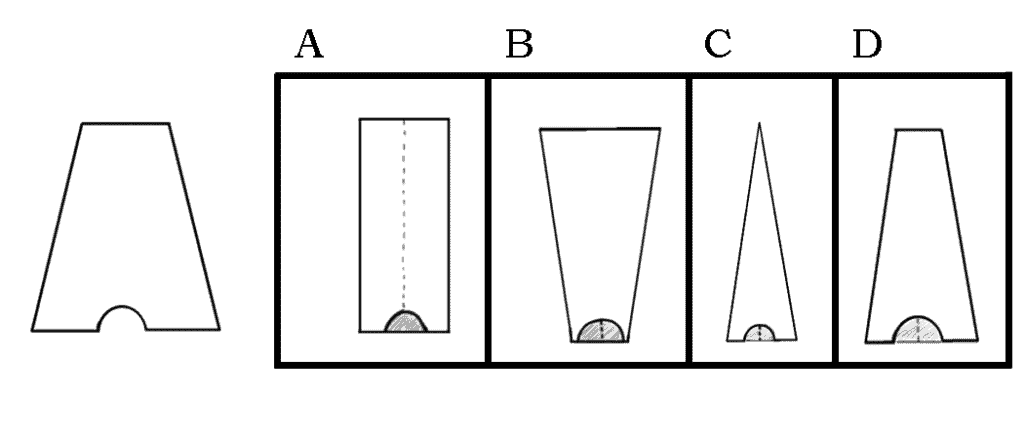
Clock’s Ticking: In a real Alberta Trades Entrance Exam, you have roughly 45 seconds per question. The Challenge: Look at the “Tapered Notch” shape below.
1. Identify the “Anchor Face” (the widest part).
2. Spot the “Anomaly” (the notch).
3. Eliminate any choice where the notch isn’t on the anchor face.
Did you do it in under 15 seconds? If not, you’re losing time you’ll need for the Math section.
First really look. The given shape has two elements that are distinctive: it is tapered (1) and has a notch at the bottom, which is the widest (2). If this shape is folded, the resulting shape will also be tapered. So, Choice A can be eliminated right away.
Looking at the notch, which is in the widest part, we can see that choice B, which has the notch at the narrowest part, is incorrect
That leaves choices C and D. Looking at choice C, the shape comes to a sharp point. This is impossible with the given shape so choice C can be eliminated.
Choice D is left. Checking quickly, it is tapered, to flat top and the notch is at the bottom, widest part. Choice D is correct.
Another spatial relations example:
When folded, what pattern is possible?
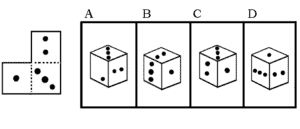
The key here is which sides will be next to each other and which corners will touch. The given figure has one, two and three dots in separate squares that folded, will make a cube with open ends.
Notice that the three dots go from corner to corner, the one dot is in the center, and the two does are up and down in the middle.
Choices B and D can be eliminated, since the three dots are not corner to corner.
That leaves choices A and C. Looking at choice A, the one dot is in the corner, not in the center so choice a can be eliminated.
Anatomy of a Wrong Answer
Here is a folding quesiton:
When put together, what 3-dimensional shape will you get?
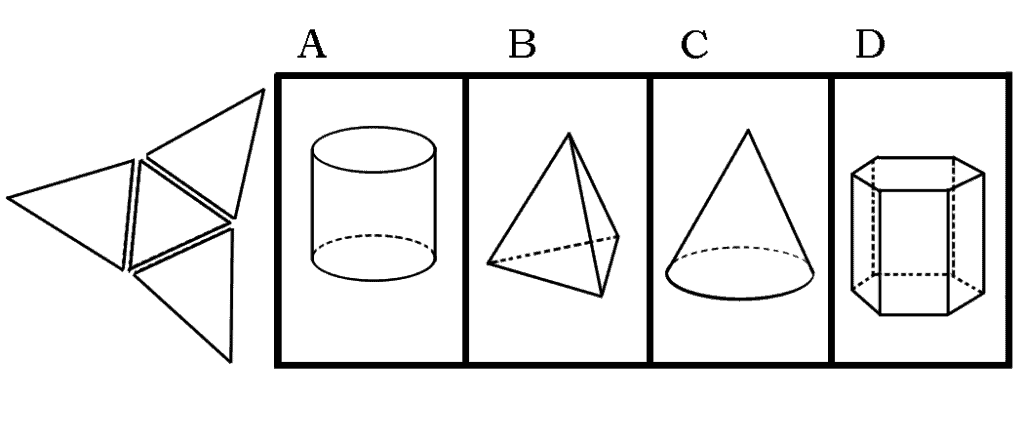
The Correct Answer: B (Triangular Pyramid)
The net consists of four equilateral triangles. When the outer triangles are folded upward toward a central point, they meet to form a triangular pyramid (also known as a tetrahedron).
Why You Might Get This Wrong (The Deconstruction)
The Trap of Option C (The Cone)
- The Error: Many students see the “pointy” nature of the triangles and immediately associate them with a cone.
- The Reality: A cone requires a circular base and a curved surface. Since the net provided is composed entirely of straight-edged flat triangles, it is physically impossible for it to form a curved surface or a circular base. If you chose C, you were likely prioritizing the feel of the shape over the geometry of the edges.
The Trap of Option A & D (The “Complex Shape” Bias)
- The Error: Choosing the Cylinder (A) or the Hexagonal Prism (D).
- The Reality: These options are “distractors” designed to catch students who are rushing.
- A (Cylinder): Requires two circles and a rectangle.
- D (Hexagonal Prism): Requires two hexagons and six rectangles.
- The Lesson: If the net has only 4 pieces, the resulting 3D shape cannot have more than 4 faces. Counting the “faces” on the net is the fastest way to eliminate complex distractors like D.
Another example
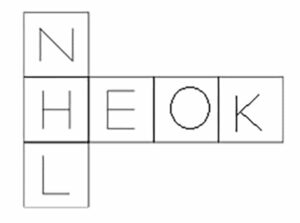
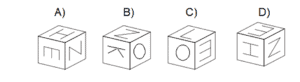
Look at the given shape and number the squares in your heard. Note the orientation relative to what will be an adjacent square when folded into a cube.
Choice A can be eliminated as the N and H are oriented incorrectly. Choice B can be eliminated as the O and K are oriented incorrectly. Choice C looks correct.
Check choice D. Choice D can be eliminated as the N and E are oriented incorrectly.
Pattern Folding Tricks for SIGMA and CFAT
Mastering 3D visualization practice isn’t about having a “natural gift”—it’s about knowing which edges to watch. Whether you are facing the CFAT spatial ability help sections or the pattern folding tricks for SIGMA, these two specific techniques will help you deconstruct complex shapes without losing time.
1. The “Anchor Face” Strategy (Crucial for CFAT)
The Canadian Forces Aptitude Test spatial section often uses irregular shapes with more than six sides. To solve these:
- Identify the most unique face: Look for the shape with the most “landmarks” (notches, protrusions, or unusual angles).
- Keep it stationary: Mentally “glue” that face to the table.
- Fold the wings: Only rotate the simpler squares around that one complex anchor. If a choice shows the anchor face in a different orientation relative to the “wings,” eliminate it immediately.
2. The “Clockwise Dot” Rule (The SIGMA Secret)
The OACP SIGMA test loves to use dots, lines, and shading on the faces of a cube. This is where most students suffer from “Spatial Blindness.”
- Pick three adjacent faces: Choose a corner where three faces meet.
- Trace the path: Look at the original 2D pattern. If you move clockwise from the “Dot” to the “Line” to the “Shaded” square, that same clockwise relationship must exist on the 3D cube.
- The Flip Trap: If the 3D choice shows the Dot to the Line moving counter-clockwise, the AI is trying to trick you with a mirror image.
3. Mechanical Aptitude Spatial Logic: The Parallel Rule
In any cube folding question, faces that are separated by exactly one square in a straight line on the 2D plan can never touch in 3D. They will always be parallel (opposite) to each other.
Example: If you see a “Star” and a “Circle” separated by one square in the flat layout, any multiple-choice option that shows the Star and Circle on adjacent faces is a guaranteed wrong answer.
Most Common Errors on Spatial Relations Questions
- Not understanding the question: Read the question carefully or you can easily misinterpret the information. With any type of question proceed at a measured speed. Don’t go fast, but don’t hang around either.
- Misinterpretation of the diagram: Examine the diagram or map carefully.
- Pay attention to details in the diagram. Everything is important.
Video Tutorial
The Spatial Diagnostic Lab: Advanced Training
Before you sit for your official provincial assessment, ensure you have mastered every variation of spatial logic. Complete these specialized modules to identify any remaining “blind spots” in your visualization skills.
[Module 1: Advanced Folding & Pattern Logic]
Focus: Complex irregular shapes and internal pattern matching.
[Module 2: 3D Structural Analysis]
Focus: Hidden block counting and rotational perspective—essential for mechanical aptitude.
The Canadian Spatial Success Checklist
Before you head to the testing centre, ensure you can check off every box below. If you can’t, you aren’t exam-ready yet.
1. Strategy & Logic
[ ] The “Anchor” Habit: Can I instinctively identify the most complex face of a shape to use as my stable reference point?
[ ] The Parallel Rule: Do I automatically eliminate choices where opposite faces are shown touching?
[ ] The Clockwise Check: Can I trace a pattern around a corner (Dot → Line → Shade) to verify if a rotation is a “mirror-trap”?
2. Time Management
[ ] The 20-Second Rule: Can I deconstruct a standard cube folding question in under 20 seconds?
[ ] Elimination First: Am I spending time proving the right answer, or am I quickly “killing” the 3 wrong answers first? (Elimination is faster).
[ ] The “Skip” Trigger: Do I know when to skip a high-complexity shape to save time for easier questions later?
How to Manage your Time on a Test
3. Exam-Specific Readiness
[ ] Provincial Nuance: Do I understand the specific format used by my authority (e.g., OACP SIGMA vs. CFAT vs. AIT)?
[ ] Mental Rotation Endurance: Have I practiced at least 30 questions in a single sitting to build “spatial stamina”?
Still seeing “Spatial Blindness”?
If you are still struggling to “see” the 3D shape, don’t leave your career to chance. Our Spatial Relations Master Workbook provides the full, step-by-step Folding Formula that has helped thousands of Canadians pass their entrance exams on the first try.
Updated: Saturday, January 31st, 2026
Published: Monday, May 31st, 2021
Created by Brian Stocker and the team in Victoria, BC.
Helping students succeed since 2005
Got a Question? Email me anytime - Brian@test-preparation.ca
You may also like
Police Problem Solving for SSPO and OACP Test
Police Problem Solving: Rule Application (Deductive Logic) This section of the SSPO (Sigma Survey for Police Officers) and OACP certificate process measures your ability to apply a general rule or a policy to a specific real-world situation or scenario. This …
Toolbox Math – Basic Math for Trades
Basic Math Practice Questions for Canadian Trades Trades Entrance Canada Trades Alberta Trades Skilled Trades Readiness
CELPIP Writing Prompts
The CELPIP writing evaluates your ability to communicate effectively in written English different tasks. Here are some sample CELPIP Writing prompts for writing an exmail. You are given a prompt and a scenario. Your email may be formal or informal, …


2 Comments
thank you can u give more examples?
Practice questions here – https://test-preparation.ca/spatial-ability-practice-questions/