Spatial Relations Practice for Canadian Professional Exams
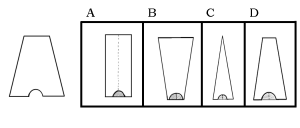
1. When the two longest sides touch what will the shape be?
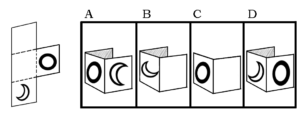
2. When folded, what pattern is possible?
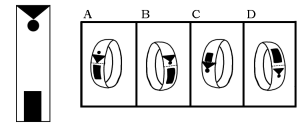
3. When folded into a loop, what will the strip of paper look like?
4. Which figure represents the assembly of the following pieces?
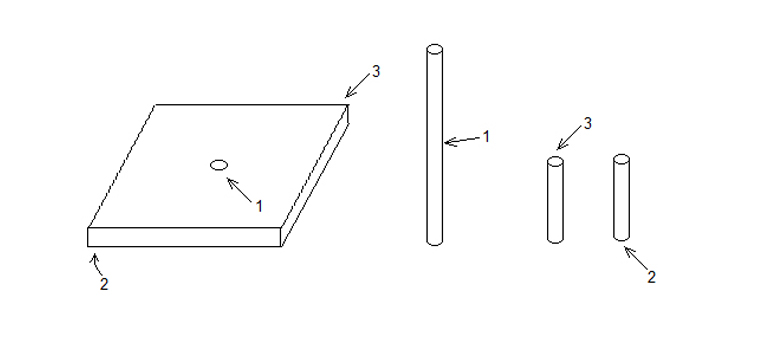
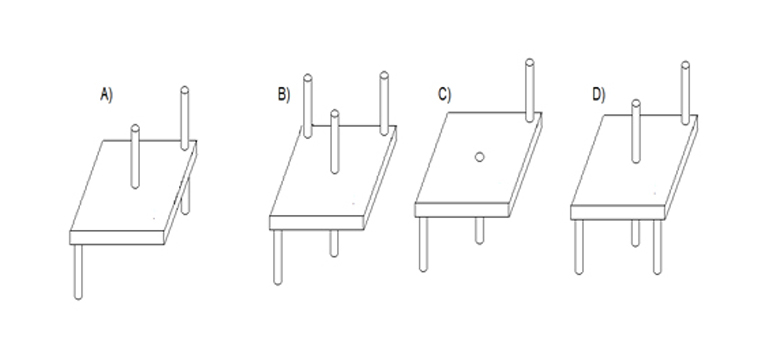






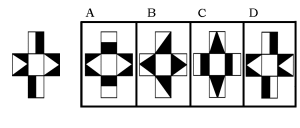
1. Which of the choices is the same pattern at a different angle?
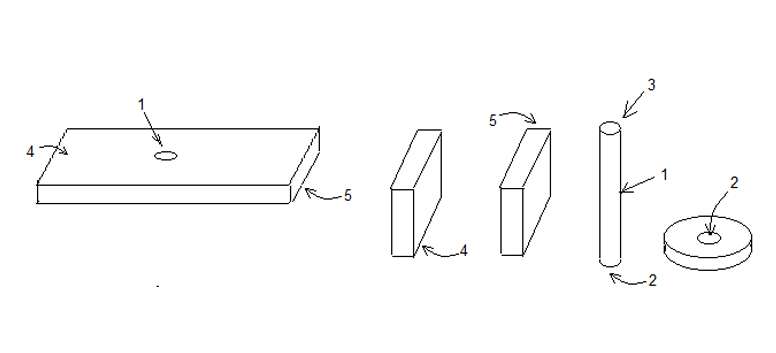
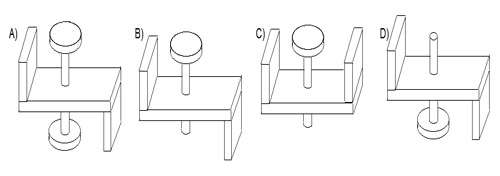
2. Which figure represents the assembly of the following pieces?
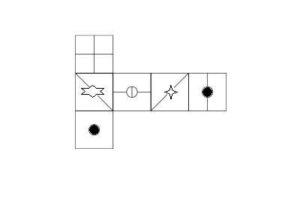
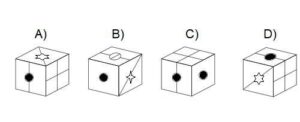
3. Which cube is obtained by folding the shape below?
Anatomy of a Wrong Answer
Here is a folding quesiton:
When put together, what 3-dimensional shape will you get?
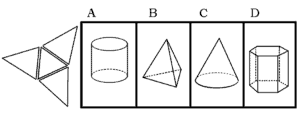
The Correct Answer: B (Triangular Pyramid)
The net consists of four equilateral triangles. When the outer triangles are folded upward toward a central point, they meet to form a triangular pyramid (also known as a tetrahedron).
Why You Might Get This Wrong (The Deconstruction)
The Trap of Option C (The Cone)
- The Error: Many students see the “pointy” nature of the triangles and immediately associate them with a cone.
- The Reality: A cone requires a circular base and a curved surface. Since the net provided is composed entirely of straight-edged flat triangles, it is physically impossible for it to form a curved surface or a circular base. If you chose C, you were likely prioritizing the feel of the shape over the geometry of the edges.
The Trap of Option A & D (The “Complex Shape” Bias)
- The Error: Choosing the Cylinder (A) or the Hexagonal Prism (D).
- The Reality: These options are “distractors” designed to catch students who are rushing.
- A (Cylinder): Requires two circles and a rectangle.
- D (Hexagonal Prism): Requires two hexagons and six rectangles.
- The Lesson: If the net has only 4 pieces, the resulting 3D shape cannot have more than 4 faces. Counting the “faces” on the net is the fastest way to eliminate complex distractors like D.

You may also like
Master Canadian Listening Comprehension for the CELPIP and CAEL
Master Canadian Scientific Reasoning (Without the Academic Headache)
6 Comments
Thanks! got it!
1) should be C? “Longest sides” only touch in the triangle?
No. When the longest sides touch it will form a cone, but with a flat top as in Choice D. Choice C has a pointed top.
I see what you mean about A being correct but it very misleading.
In order for A to be correct you would have to fold the net and then invert it to get the moon on the right side of the circle. However because your final folded shape in the question’s answer options has no top (like it would if inverted) it is very confusing and makes this a bit of a trick question.
Question 1 is messed up. I understand that rotating the shape, it is possible then for the two long sides to be touching, and still have a flat top.. but the question doesn’t say anything about rotating the shape, or that is even a 3d shape.. so when the two sides are touching it can ONLY be option C. In option D the two long sides aren’t even touching, the shape is the exact same as the original shape.. please explain this to me.
Looking at the shape given, when the sides touch – there is going to be a hole in the top, because the example has a flat top. If the top of the example came to a point, the answer would be choice C, a cone.