
Electronics Practice: CFAT & Trades Prep (PDF)

To master the basics for the Canadian Forces Aptitude Test (CFAT) or the Alberta Trades Entrance exam, or the Canada Trades, you have to move past “memorizing” and start “visualizing.” In the Canadian trades, we don’t just care about the math; we care about whether the circuit actually works without blowing a fuse.
Here is the “Kitchen Table” breakdown of the core logic you’ll need to pass.
- The Power Source: AC vs. DC
The first thing to understand is how the electricity is moving.
- DC (Direct Current): Think of a battery. The electrons flow in one direction, like water through a hose. This is what you’ll find in most CFAT mechanical questions.
- AC (Alternating Current): This is what powers your home in Canada. The flow reverses direction periodically (60 times a second, or 60 Hz).
- The “Golden Triangle”: Ohm’s Law
If you only learn one formula for the Canada Trades exam, make it this one. Ohm’s Law (V = I · R) defines the relationship between:
- Voltage (V): The “pressure” pushing the electrons (Measured in Volts).
- Current (I): The “flow” of the electrons (Measured in Amps).
- Resistance (R): The “friction” slowing them down (Measured in Ohms Ω).
Brian’s Shortcut: To solve for what’s missing, just cover that letter with your thumb. Want to find Voltage? Cover V and you see I · R.
Want to find Current? Cover I and you see V over R.
- Circuit Logic: Series vs. Parallel
This is the “make or break” section for most applicants. You need to know how components behave when they are linked up.
Series Circuits (The “One Path” Rule)
In a series circuit, there is only one path for the electricity.
- The Big Risk: If one bulb burns out, the whole path is broken, and every light goes dark.
- The Math: Resistance adds up (Rtotal = R1 + R2 + …). The more things you add, the harder it is for the current to flow.
Parallel Circuits (The “Independent” Rule)
In a parallel circuit, each component has its own “branch” or bridge back to the power source.
- The Benefit: This is how Canadian homes are wired. If the light in the kitchen burns out, your TV in the living room stays on because it has its own path.
- The Math: Adding more branches actually decreases total resistance because you’re giving the electricity more paths to take.
- Canadian Electrical Code (CEC) Basics
You don’t need to be a master electrician to pass an entrance exam, but you should know these “Safety Standards” that the AIT and Red Seal exams love to throw at you:
- Conductors vs. Insulators: You need to know that Copper and Aluminum are the workhorses (conductors), while Plastic and Rubber are the “labourers” that keep the electricity where it belongs (insulators).
- Grounding: In Canada, we use a “ground” wire to provide a safe path for electricity to return to the earth if there is a fault. This prevents you from becoming the path yourself!
- Fuses and Breakers: These are “weak links” designed to break the circuit if the current gets too high. It’s better for a $5 fuse to melt than for your house to catch fire.
The “Stocker” Strategy for Success
When you’re taking the test and see a complex diagram, don’t panic. Take a breath and follow the “Flow”:
- Start at the Battery: Trace the path with your finger.
- Look for Gaps: Is there a break (Open Circuit)? If so, nothing works.
- Count the Paths: Is there only one way home (Series) or are there choices (Parallel)?
We’ve spent years triple-checking our practice questions to make sure these diagrams look exactly like what you’ll see on exam day. Don’t let a simple gear or a parallel bulb hold you back from your apprenticeship.
To master the basics for the Canadian Forces Aptitude Test (CFAT) or the Alberta Trades Entrance exam, you have to move past “memorizing” and start “visualizing.” In the Canadian trades, we don’t just care about the math; we care about whether the circuit actually works without blowing a fuse.
Here is the “Kitchen Table” breakdown of the core logic you’ll need to pass.
- The Power Source: AC vs. DC
The first thing to understand is how the electricity is moving.
- DC (Direct Current): Think of a battery. The electrons flow in one direction, like water through a hose. This is what you’ll find in most CFAT mechanical questions.
- AC (Alternating Current): This is what powers your home in Canada. The flow reverses direction periodically (60 times a second, or 60 Hz).
- The “Golden Triangle”: Ohm’s Law
If you only learn one formula for the Canada Trades exam, make it this one. Ohm’s Law (V = I · R) defines the relationship between:
- Voltage (V): The “pressure” pushing the electrons (Measured in Volts).
- Current (I): The “flow” of the electrons (Measured in Amps).
- Resistance (R): The “friction” slowing them down (Measured in Ohms Ω).
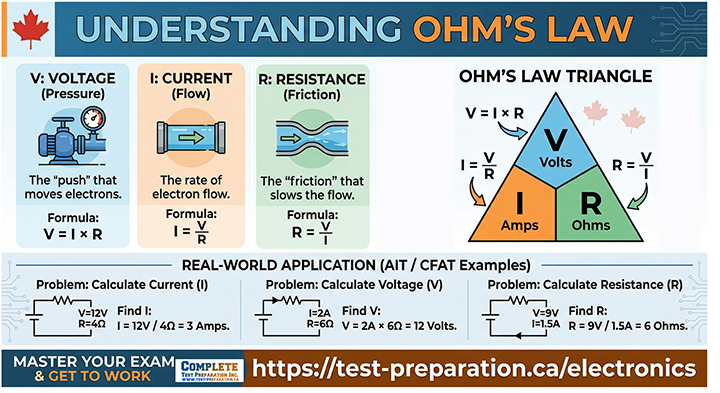
Brian’s Shortcut: To solve for what’s missing, just cover that letter with your thumb. Want to find Voltage? Cover V and you see I X R. Want to find Current? Cover I and you see V over R.
- Circuit Logic: Series vs. Parallel
This is the “make or break” section for most applicants. You need to know how components behave when they are linked up.
Series Circuits (The “One Path” Rule)
In a series circuit, there is only one path for the electricity.
- The Big Risk: If one bulb burns out, the whole path is broken, and every light goes dark.
- The Math: Resistance adds up (Rtotal = R1 + R2 + …). The more things you add, the harder it is for the current to flow.
Parallel Circuits (The “Independent” Rule)
In a parallel circuit, each component has its own “branch” or bridge back to the power source.
- The Benefit: This is how Canadian homes are wired. If the light in the kitchen burns out, your TV in the living room stays on because it has its own path.
- The Math: Adding more branches actually decreases total resistance because you’re giving the electricity more paths to take.
- Canadian Electrical Code (CEC) Basics
You don’t need to be a master electrician to pass an entrance exam, but you should know these “Safety Standards” that the AIT and Red Seal exams love to throw at you:
- Conductors vs. Insulators: You need to know that Copper and Aluminum are the workhorses (conductors), while Plastic and Rubber are the “labourers” that keep the electricity where it belongs (insulators).
- Grounding: In Canada, we use a “ground” wire to provide a safe path for electricity to return to the earth if there is a fault. This prevents you from becoming the path yourself!
- Fuses and Breakers: These are “weak links” designed to break the circuit if the current gets too high. It’s better for a $5 fuse to melt than for your house to catch fire.
The “Stocker” Strategy for Success
When you’re taking the test and see a complex diagram, don’t panic. Take a breath and follow the “Flow”:
- Start at the Battery: Trace the path with your finger.
- Look for Gaps: Is there a break (Open Circuit)? If so, nothing works.
- Count the Paths: Is there only one way home (Series) or are there choices (Parallel)?
We’ve spent years checking our practice questions to make sure these diagrams look exactly like what you’ll see on exam day. Don’t let a simple gear or a parallel bulb hold you back from your apprenticeship.

You may also like
Master Canadian Listening Comprehension for the CELPIP and CAEL
Master Canadian Scientific Reasoning (Without the Academic Headache)
3 Comments
Very true
Also the thicker a wire the more current it can carry so the answer should be C and the thinner the wire the lesser the current it can carry so if you had said about the thinner one then A would have been correct but since you said about the thicker one C is the answer
The answer is correct from ohm’s law
Question four is a poor representation of the concept of conductor resistance in a circuit. If the current present is low, then either conductor will require the same voltage. It is only when the capacity of the conductor to carry the current is significantly utilized that the difference in voltage could be measured. Otherwise the difference is only theoretical.