
General Aptitude Test Battery GATB Practice Test Questions
- Posted by Brian Stocker
- Date April 2, 2020
- Comments 1 comment
GATB Practice Test Canada: Master the General Aptitude Test Battery (2026)
One test stands between you and your career in the Canadian Public Service or Law Enforcement. Whether you are applying for the Toronto Transit Commission (TTC), Nuclear Security, or a specialized role through Applicant Testing Services (ATS), the GATB isn’t just a “formality.” It is a high-stakes gatekeeper.
Most candidates walk into the testing centre relying on “natural talent.” In a competitive Canadian labour market, that’s a mistake. You don’t need more talent; you need Strategic Familiarity. Our GATB Online Course Canada and Canadian GATB Study Guide are designed to deconstruct the “black box” of aptitude testing, turning anxiety into a predictable, repeatable strategy for success.
Why the Public Service Commission Aptitude Test is the Ultimate Gatekeeper
In the Canadian federal and provincial hiring landscape, the GATB is more than just a questionnaire—it is the “Invisible Filter.” Because the Public Service Commission (PSC) and agencies like Ontario’s Applicant Testing Services (ATS) receive thousands of applications for every opening, they rely on these scores to identify top-tier talent before a human ever reads your resume.
If you are eyeing a stable, pensioned career in the public sector, here is why this test is the ultimate high-stakes hurdle:
1. The “One and Done” Risk
Unlike a university exam, you cannot simply “re-sit” the GATB next week if you have a bad day. In many Canadian jurisdictions, failing to meet the target score triggers a mandatory waiting period of three to six months (and sometimes longer for federal roles) before you are eligible to attempt it again. In a fast-moving hiring cycle, a three-month delay means the job you wanted is gone.
2. The “Alternative Diploma” Weight
For many operational and administrative support roles in Canada, a satisfactory score on a PSC-approved aptitude test (like the GATB or GCT) is used as an official alternative to a secondary school diploma. This makes the test a literal legal requirement for qualification. If you don’t hit the mark, the system electronically disqualifies you from the “Merit-Based” pool immediately.
3. Competitive Percentile Ranking
Passing isn’t enough. Many departments don’t just look for a “pass”; they use normative sampling. This means your score is compared against thousands of other Canadians. While a “minimum” pass might be the 10th percentile, hiring managers often set their own cut-offs as high as the 50th or 70th percentile to narrow the field.
4. A Benchmark for Life
Once you secure a high GATB score, it often remains valid for three years or more. A top-tier result today doesn’t just get you this job—it acts as a “Fast Pass” for future internal promotions and lateral moves across different Canadian agencies.
The Reality Check: Most candidates fail not because they lack intelligence, but because they are unprepared for the format and the clock. The GATB is a race against time. Our training environment is designed to ensure that when you walk into that testing centre, you aren’t just “taking a test”—you are executing a proven strategy.
The GATB Career-Path Aptitude Map
Where does your ambition lead? In Canada, “passing” the GATB is relative. Different provincial and federal agencies set their own “cut-off” benchmarks based on the complexity of the role. Use the map below to see the aptitude standards required for your target career and why high-tier preparation is non-negotiable.
Map Your Success: Requirements & Outlook
| Target Career Path (Canada) | GATB Focus Area | Target Percentile | Est. Starting Salary |
|---|---|---|---|
| Federal Public Service (PSC) | Vocabulary & Problem Solving | Top 15% (85th) | $58,000 – $74,000 |
| Nuclear Security (AECL/OPG) | Spatial Relations & Math | Top 10% (90th) | $82,000 – $95,000 |
| Transit Special Constable (TTC) | Problem Solving & Vocabulary | Top 20% (80th) | $72,000 – $88,000 |
| Provincial Corrections (ON/BC) | Vocabulary & Math | Top 30% (70th) | $65,000 – $78,000 |
| Trades & Apprenticeships | Spatial Relations & Math | Top 40% (60th) | $55,000 – $85,000 |
Why These Targets Matter
In the Canadian Public Service, many roles use “Category-Based Selection.” * The “Safety” Zone (60th Percentile): You qualify for entry-level vocational and trades roles.
The “Professional” Zone (80th Percentile): You are eligible for law enforcement, transit security, and specialized technician roles.
The “Elite” Zone (90th+ Percentile): You are fast-tracked for high-security clearance positions and senior administrative paths.
Expert Tip: Don’t aim for the “minimum.” If two candidates have similar interviews, the hiring manager will almost always look at the GATB raw scores as the tie-breaker. Aiming for the 90th percentile isn’t just about passing; it’s about becoming the “obvious choice.”
Is your target score within reach?
Most Canadians who fail the GATB on their first attempt do so because they hit a “wall” in the Spatial Relations (Folding) or Problem Solving sections—the two areas where “winging it” simply doesn’t work.
[Unlock the GATB Online Course – Target the 90th Percentile]
Spatial Aptitude Practice: The 2-Minute Folding Challenge
Most Canadian applicants fail the GATB not because they can’t solve the problems, but because they can’t solve them fast enough. In the official exam, you have less than 45 seconds to visualize a 3D object from a 2D flat pattern.
Can you handle the pressure of the testing centre? Press play below and attempt our 2-minute Spatial Drill. Grab a pen and paper—you won’t have time to second-guess yourself.
Take the 2-Minute Challenge
1. When the two longest sides touch what will the shape be?
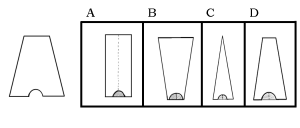
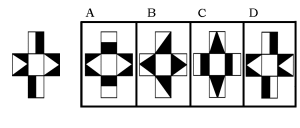
4. Which of the choices is the same pattern at a different angle?
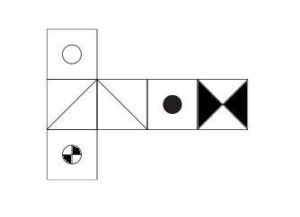
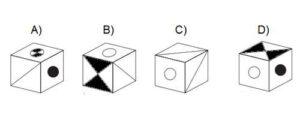
3. Which cube is obtained by folding the shape below?
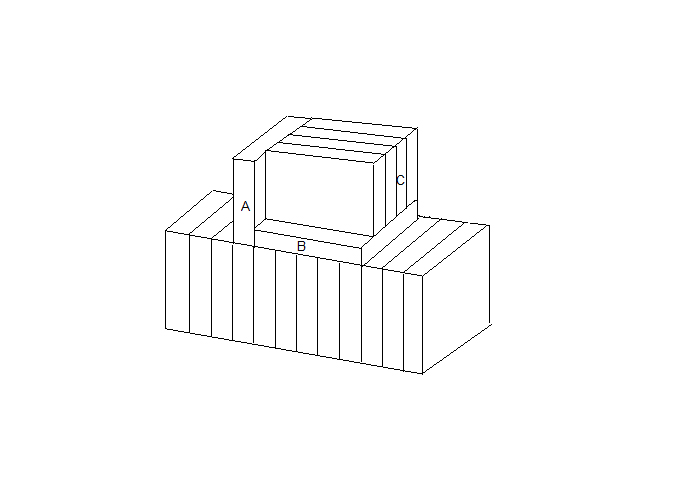
4. How many blocks is block A touching?
a. 4
b. 5
c. 6
d. 7
Answer Key
1. D
2. D
3. D
The upper and lower shapes cannot be adjacent as they constitute opposite faces in the cube. Here, for the middle-left and the third shape in the central (long) row and for the second and the fourth shape of the central row.
4. C
Block A touches 6 blocks (1 is below, 4 are lateral in vertical position and 1 is lateral in the horizontal position.
How did you do?
-
4/4 Correct: You have strong natural spatial logic, but can you maintain this accuracy for 40+ questions straight?
-
2/4 or 3/4 Correct: You are falling into “visual traps.” One wrong fold can disqualify you from high-tier careers like Nuclear Security.
-
0/4 or 1/4 Correct: Don’t panic. Spatial reasoning is a skill, not a fixed trait. Our study guide teaches you the “Point-to-Edge” method to solve these without “imagining” the fold at all.
What’s on the General Aptitude Test Battery?
Basic Math & Problem Solving:
Basic math and problem solving skills are essential for performing a wide range of tasks that require analytical thinking and problem-solving abilities, such as:
Analyzing crime scenes. Police officers and security personnel need to analyze crime scenes to collect and evaluate evidence. Basic math skills such as geometry are used to determine the size, shape, and location of objects.
Traffic management. Police officers need to manage traffic flow and ensure public safety on roads and highways. Basic math skills help officers calculate distances, speeds, and travel times.
Risk assessment. Security personnel use basic math and problem solving skills to identify and assess potential risks, threats and vulnerabilities and make informed decisions about security measures in various settings such as airports, government buildings, and public events.
Emergency response. Police officers and security personnel need to respond quickly and effectively in emergency situations. Basic math and problem-solving skills enable officers to analyze situations, evaluate risks, and determine the best course of action.
Basic Math, Word Problem Tutorial, Basic Math Video Tutorials.
Vocabulary & Communication
Vocabulary is an essential aspect of communication in any profession, and this is especially true for security and police personnel.
Writing Reports. Police and security guards and related personnel need to write clear and concise reports that accurately describe incidents and document evidence. A strong vocabulary help officers use precise language and avoid ambiguity.
Interviewing. Police officers and security personnel interview witnesses and suspects to gather information about a variety of incidents. A large vocabulary help officers ask clear and precise questions and understand responses.
Occupations that use the GATB
- Toronto Transit Special Constable
- Airport Special Constable
- Barrie Police
- Parking Enforcement
- AECL Nuclear Security
- Toronto Traffic Control Constable
- Court Prisoner Security Officer
- Go Transit Safety Officer
- Ontario Provincial Police
- London Police Service Court Prisoner Security Officer
- York Court Security Officer
Salaries and Occupational Outlook
Toronto Police
Average Salary: $76,144
PEEL Regional Police Officer
Average Salary: $73,203
Occupational Outlook
Demand for police officers is expected to grow at about the average for all occupations, around 5% 2018 to 2028. Public safety is ongoing and will not diminish. Demand for police officers and security officers varies by location.
Common Misconceptions about the GATB Test
The GATB test is an IQ test: They are similar but not the same. The GATB test measures an individual’s aptitude in various areas, but it is not an IQ test. IQ tests are designed to measure intelligence, while the GATB test is designed to measure a person’s potential for success in different types of jobs.
The GATB test is pass/fail: There is no passing or failing score. The test is designed to measure an individual’s aptitude in various areas, and the scores are used to help determine the types of jobs that the individual is best suited.
The GATB test is only for entry-level jobs: While the GATB test is often used for entry-level jobs, it can also be used for mid-level and even some senior-level positions. The test is designed to determine an individual’s potential for success in a job, regardless of the level of the position.
The GATB test is biased: The GATB test is designed to be fair and unbiased. The test questions are reviewed by subject matter experts to ensure that they are free from cultural or gender biases.
The GATB test is easy to cheat on: Cheating on the GATB test is difficult because the test is typically administered in a proctored testing environment. Additionally, the questions on the test are randomized, so no two tests are exactly the same.
The GATB test scores are the only factor in getting a job: While test scores are an important factor, they are not the only one. Employers may also consider an individual’s experience, education, and other qualifications when making hiring decisions.
GATB Study HELP
General Aptitude Test Battery Study Practice Course
Timed Tests, quizzes, self assessments, tutorials how to take a test and more
Online Course with FREE Quiz
Paperback (Amazon)
Published: Thursday, April 2nd, 2020

Created by Brian Stocker and the team in Victoria, BC.
Helping students succeed since 2005
Got a Question? Email me anytime - Brian@test-preparation.ca
You may also like
Free Canadian History Practice: CAEC & Citizenship Prep
Stop Drowning in Dates. Start Passing Your Canadian History Exam Let’s be honest: the Canadian story is massive. Between the Constitutional Act of 1867 summary and the deep complexities of Indigenous History and Treaties in Canada, it’s easy to feel …
Police Vocabulary Practice
Most people think police work is all sirens and chases. But ask any veteran officer, and they’ll tell you the real work happens behind a desk. You might spend 20 minutes making an arrest and 3 hours writing the report. …
Police Problem Solving for SSPO and OACP Test
Police Problem Solving: Rule Application (Deductive Logic) This section of the SSPO (Sigma Survey for Police Officers) and OACP certificate process measures your ability to apply a general rule or a policy to a specific real-world situation or scenario. This …
1 Comment
This seems a bit extreme for someone who has applied to Canada Post for a part time on call temporary position ♀️, but ok then.