Back

Taking the Ontario Police Constable Entrance Test? Sigma Survey for Police Officers (SSPO) Practice Questions

Imagine it’s 8:32 AM. You’re not staring at a glowing screen or a stack of flashcards. You’re lacing up your boots, grabbing a coffee, and heading out for your first shift with the OPP, Toronto, or York Regional Police. The only thing standing between you and that morning is a 35-minute exam designed by folks in suits who probably haven’t sat in a cruiser in decades.

We know what’s keeping you up at night. Failing the OACP isn’t just about a bruised ego; it means missing the hiring cycle. It means watching your buddies head off to the Ontario Police College in Aylmer while your career is suspended for months, stuck at a job you were ready to leave yesterday.

Our job isn’t just to sell you an Ontario OACP practice test PDF. It’s to get you out of the classroom and onto the job site, first time out. We’ve sat at the kitchen table triple-checking these questions so you walk into the testing centre knowing the exact style, timing, and logic of the real thing. You put in a fair shake of studying with our Ontario police exam prep courses, and you’ll walk out with your OACP certificate. It’s that straightforward.

The “Day in the Life” Career Roadmaps

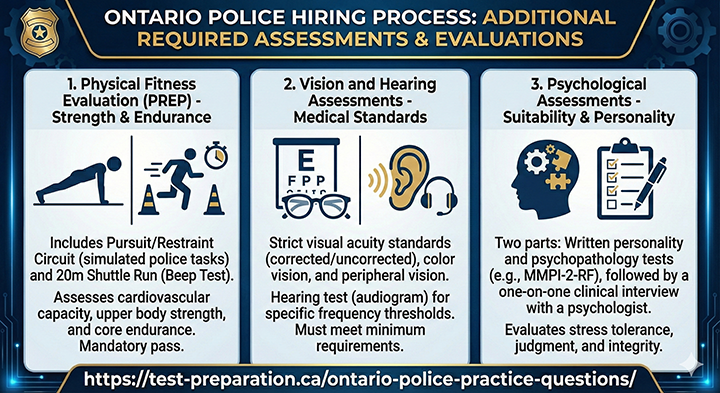
Getting hired as a police officer in Ontario isn’t a straight line. It’s an obstacle course. You don’t just “take a test”—you have to secure your Ontario Association of Chiefs of Police (OACP) Certificate, clear the vision and hearing medicals, log a Level 7 on your fitness assessment, and navigate a rigorous background and psychological evaluation. The SSPO (Sigma Survey for Police Officers) is the gatekeeper to all of it. We aren’t just teaching you how to fill in bubbles; we’re teaching you how to navigate the Ontario intake process without getting tripped up by administrative red tape.

Ontario Police Hiring - Click for Larger - https://test-preparation.ca/wp-content/uploads/2025/11/Ontario-Police-Hiring.png

The 28-Second Logic Trap (And How to Beat It)

If you spend any time on Ontario policing forums, you’ll hear the same local legend repeated over and over: “You can’t study for the OACP problem-solving section. You either have a police brain or you don’t.”

Having spent years at the kitchen table breaking down these exact exams, I can tell you that is complete nonsense.

The true hurdle isn’t the logic itself. It’s the clock. You are given 35 minutes to answer 74 questions on the SSPO. That leaves you with roughly 28 seconds per question. Most candidates don’t fail because they aren’t smart enough; they fail because they hit a wordy scenario, realize the clock is ticking, and start to panic. We call this the 28-Second Logic Trap.

You don’t need to be born with a special “police brain” to pass this. You just need a system to beat the clock.

When you’re staring at a messy map question—where Officer A is three blocks North of the bank and Officer B is two blocks East—you can’t afford to read the paragraph three times. Our practice tests train your internal clock. We teach you to read the last sentence first so you know exactly what the question is asking, sketch a quick layout on your scratch paper, and eliminate the trap answers without second-guessing yourself.

It’s not about being a genius. It’s about having a straightforward, reliable method to filter out the noise and make the right call before the timer runs out.

Police 2-Minute Challenge

Grab a coffee and pull up a chair. We call this the 2-Minute Challenge because it takes less than two minutes of your day to find out if you are actually ready for the pressure of the Ontario SSPO.Here is the reality of the OACP Certificate process: the test gives you 74 questions and exactly 35 minutes to finish them. That leaves you with roughly 28 seconds per question. We call this the “28-Second Logic Trap.” Most folks don’t fail because the questions are impossible; they fail because the clock runs down, panic sets in, and they start making sloppy mistakes on basic spelling and map reading. To prove it, we’ve built a quick diagnostic drill right here at the kitchen table.

How to Take the 2-Minute Challenge

This interactive drill strips away the corporate fluff and throws you right into the deep end. You will face three real-world style SSPO questions: one spelling, one grammar, and one logic problem.
Because you get 28 seconds per question on the real exam, we’ve set the timer on this drill to 2 minutes.

Your Instructions:

  • Clear the distractions: Put your phone on silent. The real online proctored exam is notoriously strict, so treat this like the real thing.
  • Watch the clock, but don’t panic: The timer is there to build your internal pacing. If you spend 45 seconds on the first question, you’ll have to make up that time on the next two.
    Remember the scoring rule: On the actual SSPO, wrong answers receive a penalty, but unanswered questions do not. For this drill, try to answer all three to see how your gut reacts under pressure.
  • No cheating: No dictionaries, no calculators. Just you and the screen.
  • Start the video timer when you’re ready to see how you handle the 28-second trap.

The 2-Minute OACP SSPO Challenge

1: Grammar & Canadian Spelling (The Report Writing Trap)
You are writing a use-of-force report for an incident on Highway 401. Which sentence is legally and grammatically correct for an Ontario police report?

A) The suspect’s vehicle was seen traveling East on the highway with it’s headlights off.
B) The suspects vehicle was seen travelling East on the highway with its headlights off.
C) The suspect’s vehicle was seen travelling east on the highway with its headlights off.
D) The suspect’s vehicle was seen traveling east on the highway with its headlights off.

2: Police Vocabulary (The “Big Prep” Trap)
You have arrested a suspect for armed robbery in Toronto. In your incident report, which term correctly classifies the severity of this crime under Canadian law?

A) A First-Degree Felony
B) An Indictable Offence
C) A Major Misdemeanor
D) A Capital Offense

3: Problem-Solving Logic (The 28-Second Trap)
Read the rule and the facts, then judge the conclusion.

Rule: All OPP officers assigned to highway traffic enforcement must wear a high-visibility vest when stepping outside their cruiser.
Fact: Constable Miller is standing outside his cruiser wearing a high-visibility vest.
Conclusion: Constable Miller is assigned to highway traffic enforcement.

A) True
B) False
C) Cannot be determined

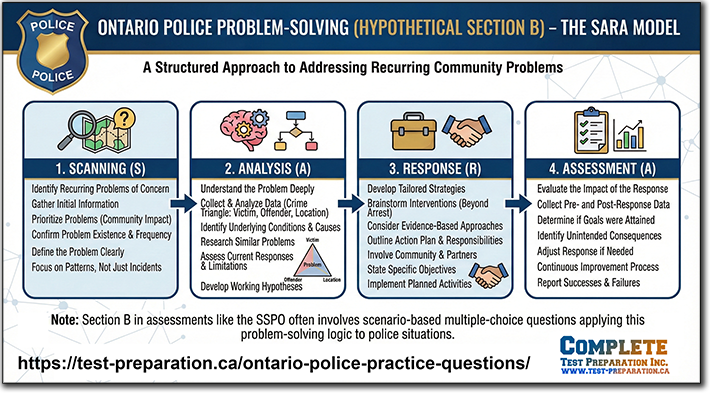
Problem Solving - Click for Larger - https://test-preparation.ca/wp-content/uploads/2025/11/Problem-Solving.png

SSPO Incident Report Writing: The Hidden Trap

A lot of applicants breathe a massive sigh of relief when they get to the Incident Report Writing section. They look at it and think, “Great, I speak English, I know how to write. This will be the easy part.”

Don’t let your guard down. This section is quietly one of the biggest score killers on the entire OACP exam because it is loaded with spelling and grammar traps.

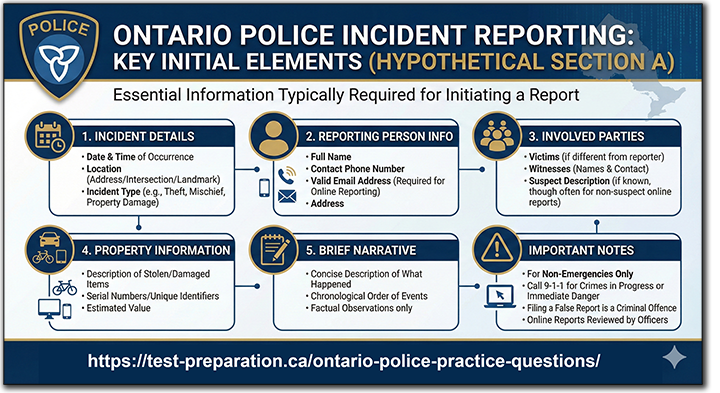
Here is the unvarnished truth: the SSPO isn’t testing whether you can write a university-level essay. It’s testing whether you can write a clear, factual incident report that will hold up under cross-examination in an Ontario courtroom.

The biggest trap folks fall into is trying to sound too “professional.” They start throwing around twenty-dollar words when a five-dollar word will do just fine. A judge doesn’t care if you write “apprehended the perpetrator” instead of “arrested the suspect.” But if you misspell “apprehended,” or if you string your sentences together with comma splices, the exam software is going to dock your score.

Worse yet, on the job, a defence lawyer will use that sloppy grammar to poke holes in your credibility on the stand.

Court reports require perfect, plain English. Nothing more, nothing less. Our practice materials drill you on exactly what the SSPO is looking for: perfect capitalization, strict Canadian spelling (like offence instead of the American offense), and rock-solid subject-verb agreement. We train you to keep your writing simple, factual, and legally bulletproof so you never lose points on a test you already know how to pass.

Police Incident Reporting - Click for Larger - https://test-preparation.ca/wp-content/uploads/2025/11/Incident-Reporting.png

Test Prep + Job Prep

Here’s the thing the big-box, generic test prep companies will never admit: passing the exam is the easy part. Being ready for the job is the point. They give you generic high school questions because it’s cheaper to print. We build our practice around the head-scratching, real-world scenarios you’ll face on day one in Ontario.

“Big Prep” (The Generic Way)

The Bake Sale Math: “If a train leaves the station at 60 mph…” (Irrelevant, wastes your time, uses American measurements).
The Academic Reading: A three-paragraph essay on the history of the cotton gin, asking you to identify the main idea.

Complete Test Prep (The Ontario Way)

The Patrol Logic: “You are patrolling Hwy 401. A vehicle is traveling 130 km/h in a 100 km/h zone. Based on the OACP distance-time formula provided…”

The Incident Report: A witness statement from a break-and-enter in Mississauga riddled with comma splices. You must correct the punctuation exactly as required for court.

The SSPO Test is your Gateway to an in-demand and exciting career!

Format Description Action
Paperback Edition

Shipped to You

Official Ontario Police SSPO Study Guide & Practice Questions in high-quality print. Perfect for hands-on study, highlighting, and physical test preparation. Shipped directly via Amazon.
Buy on Amazon
Digital PDF Edition

Instant Download

Get immediate access to the Ontario Police Constable Study Guide. Download instantly to your phone, tablet, or computer and start preparing for your SSPO exam right away.
Download PDF

The Ontario Police Psychological Evaluation

The Police use the Ontario Police Psychological Test to evaluate the psychological health of potential candidates. Officers face many challenges, including horrifying crime scenes, violence, abusive language, and more.

This test does not test your mental stability; it is an evaluation of your mental fitness to encounter all the possible scenarios you may face while working in law enforcement.

Vital characteristics for officers are control impulse, judgment, good courage, honesty, integrity, dependability, ability to deal with supervision, appropriate attitudes, and ability to handle stress.

The police psychological test has three sections, depending on the agency. Below are the components:

1.    Self-Evaluation

This section is a pre-test that involves your personal history such as education, strengths and weaknesses, as well as background information like drug abuse, and employment records.

2.    Series of Questions

Questions determine your psychological strength. Questions are multiple choice, where you express your feeling by marking one answer from the multiple choices to show if you agree, strongly agree, neutral, disagree, or strongly disagree.

The series of questions will often repeat to enable the psychologist to evaluate your honesty, consistency, and integrity, so don’t lie.

3.    Eye-to-Eye Conversation with a Psychologist

The psychologist will ask the same questions you have answered in the pre-test for clarification and explanation. They will want to know more about your background, education, your current lifestyle, and previous work experience.

Free SSPO Practice Questions

SSPO Section A – Incident Report Writing

This section tests if you have the literacy skills to write reports, which often are used in court. It may look easy, but tricky spelling and grammar traps can ruin your score.
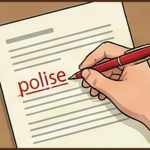
Spelling
You are given a word (e.g., “Occurance”) and must decide YES or NO if it is spelled correctly. Tip: Watch for double letters!
Spelling Practice Questions

Spelling Rules


Vocabulary
Choose the best synonym for a word used in a police context (e.g., “The suspect was apprehended”).
Police Vocabulary

Synonym Practice Questions

General Vocabulary Practice Questions


Grammar & Punctuation You see 4 versions of a sentence. You must pick the one with correct capitalization and punctuation.

Grammar Practice Questions

Punctuation Practice Questions

Why Practice Matters You cannot rely on ‘gut feeling’ for grammar. You need to know the rules of comma splices, capitalization, and subject-verb agreement.

SSPO Section B – Police Problem Solving (The “Score Killer”)

This section measures your logical reasoning and judgment. It uses realistic police scenarios and map-based questions.

You are given a rule (e.g., “Officers may only enter a park after dusk if…”) and a scenario. You must decide if the officer’s action was correct.
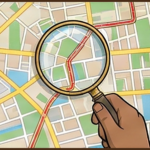
Map ReadingMap Reading & Logic Officer A is 3 blocks north of the bank. Officer B is 2 blocks east…” Questions require spatial orientation and quick mental mapping.
Map Reading Practice
Sentence Logic Practice
Logic Practice II 
Logic Tutorial
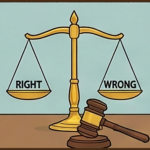
 

Ethical Judgment and Applying Rules –  Determining the “best” course of action in a difficult situation.

Police Problem Solving
Police Judgement Practice
Police Situation judgement – In-depth Analysis
Police Situation Judgement Workbook


Test Strategy
These questions are wordy. We teach you how to scan for keywords so you don’t waste precious minutes reading unnecessary details.
This is a multiple choice test – help with multiple choice

Get some experience!  A great opportunity and common career path is to build your law enforcement resume by gaining experience in high-level security roles. Preparing for the GardaWorld entrance evaluations is a great way to sharpen your situational judgment skills before the police exam

Written by,

Updated: Sunday, August 2nd, 2026
Published: Wednesday, June 22nd, 2016