
Back

Basic Geometry – How to find the Area of Complex Shapes

How to Find the Area of Complex Shapes

Complex figures can be divided into several smaller shapes where the perimeter or area formula is known, then added.

Standardized School Assessments

These are the big ones that most students across the provinces will run into. They almost always include problems where you have to break a shape down into rectangles and triangles to find the total area.

  • Ontario EQAO (Grade 9 Math): This is a staple. The “Geometry and Measurement” strand specifically tests the ability to solve problems involving the perimeter and area of composite two-dimensional shapes.
  • BC Graduation Numeracy Assessment (Grade 10): Instead of just straight math, this one is “contextualized.” A student might be asked to calculate the amount of flooring needed for a weirdly shaped room or the area of a garden path.
  • Alberta Provincial Achievement Tests (PATs – Grades 6 & 9): Geometry is a significant chunk here. By Grade 9, students are expected to handle composite 2-D shapes and even surface areas of composite 3-D objects.

Trade and Technical Entrance Exams

If you’re working with someone heading into the trades, they can’t escape geometry. Calculating material for complex footprints is a “real-world” skill these tests love.

  • Pre-Admission Technical Math (Colleges like Mohawk, BCIT, etc.): Many technical programs require a math placement test. These almost always feature “composite area” problems because they’re essential for construction and engineering tech.
  • Canada Trades, Ontario Skilled Trades, Alberta Trades
  • Ironworker or Carpenter Pre-Apprenticeship Exams: These are very practical. Expect questions like: “What is the total area of this L-shaped concrete slab?”

Law Enforcement & Military

“Big Prep” often forgets that spatial reasoning and basic geometry are part of the “Numerical” or “Spatial” sections of these exams.

Example – Composite 2-D shapes 


To determine the area of any composite figure, simply ADD the areas of each component basic figure.  Be sure to write your final answer with square units.

Determine the area of the given shape. 
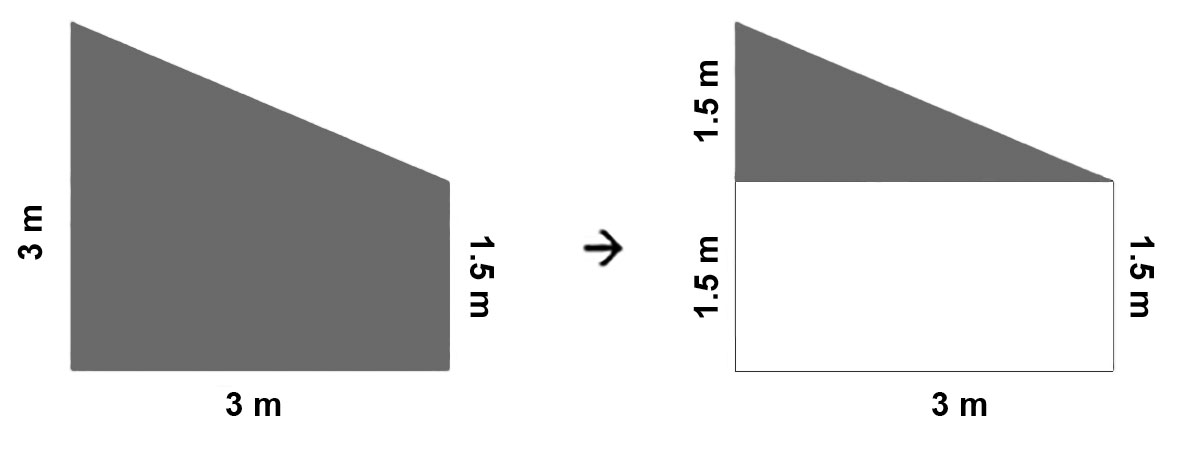
area of complex shape

The original shape can be redrawn as a rectangle and a triangle.  Rectangles have opposite sides that are congruent (exactly the same).

Area Composite = Area Triangle + Area Rectangle

Area Triangle = (1/2)(Base)(Height) = (1/2)(3m)(1.5m) = 2.25 m2

Area Rectangle = (Base)(Height) = (3m)(1.5m) = 4.5 m2

Area Composite = (2.25m2) + (4.5m2) = 6.75 m2

How to find the area of a complex figure

To determine the surface area of any composite solid, simply add the surface areas of each component basic solid.  You must also subtract the area of any internal face.  Be sure to write your final answer with square units.

Ex. Determine the surface area of the given shape.  Leave the final answer in terms of pi.
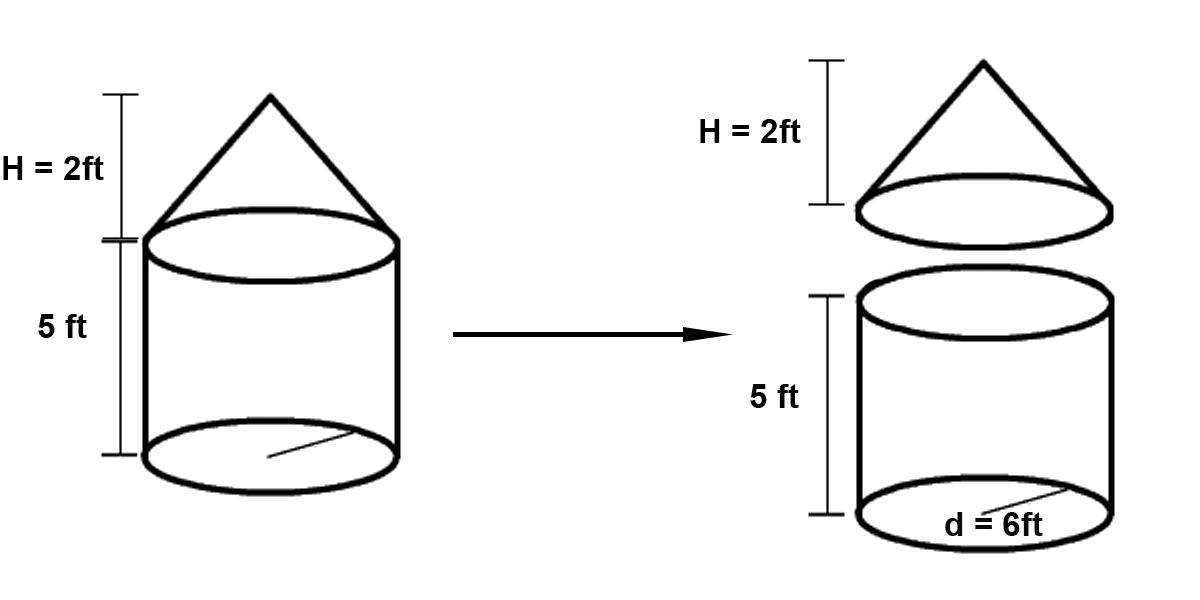
The original shape can be redrawn as a cylinder and a cone.  We will have to subtract the area of the circle where the figures meet from each surface area equation because they are “inside” the solid.

SurfaceArea Composite = S.Area Cone + S.Area Cylinder

S.Area Cone = (Base Area)+(1/2)(Perimeter)(Height) = (1/2)(dπ)(h) = (1/2)(6π)(2) = 6π ft2

S.Area Cylinder = 2(Base Area)+(Perimeter)(Height) = (πr2)+(dπ)(h) = (π32)+(6π)(5) = 39π ft2

S.Area Composite = (6π ft2) + (39π ft2) = 45π ft2


Most Popular Geometry Questions

Common geometry questions on on standardized tests :

Most Common Geometry Mistakes on a Test

  1. Not clearly labeling or identifying the given and unknown information in a problem
  2. Not understanding the properties and definitions of basic geometric figures (e.g. line, angle, triangle, etc.)
  3. Incorrectly using basic formulas (e.g. area of a triangle, Pythagorean theorem)
  4. Incorrectly interpreting geometric diagrams
  5. Not understanding the relationship between parallel lines and transversals
  6. Not understanding the relationship between angles and their degree measures
  7. Not understanding the relationship between perimeter and area
Updated: Thursday, April 2nd, 2026
Published: Monday, October 9th, 2017

Created by Brian Stocker and the team in Victoria, BC.
Helping students succeed since 2005
Got a Question? Email me anytime - Brian@test-preparation.ca

    2 Comments

  1. Anonymous
    October 19, 2023 3:10 pm
    Reply

    How is not interpreting diagrams a mistake? examples?

  2. November 23, 2023 4:32 pm
    Reply

    I think it refers to not interpreting the diagram correctly.

Leave A Reply

Your email address will not be published. Required fields are marked *