
CCAT Practice Test Questions and test information
- Posted by Brian Stocker
- Date November 4, 2020
- Comments 4 comments
Is Your Child Ready for their “One-Shot” at the Gifted Program?
In school boards across Canada—from the TDSB in Ontario to the CBE in Alberta—the Canadian Cognitive Abilities Test (CCAT) is often a “one-shot” opportunity. Most students are screened only once, typically during the Grade 4 Universal Screening in Ontario, and a single bad day can mean missing out on enriched learning for the rest of their elementary years.
It’s not just about how “smart” your child is; it’s about Format Friction. Even the brightest students underperform when faced with the strict timing and abstract puzzles of the CCAT Practice Test Canada. At Complete Test Preparation Inc., we help you eliminate that friction. Our Canadian Cognitive Abilities Test prep transforms “test anxiety” into “test familiarity,” ensuring your child’s true potential shines through to reach that coveted Stanine 9 score.
The “One-Shot” Reality: Why the Timing in Canada is Everything
In the Canadian education system, the window for gifted identification is notoriously narrow. Most parents don’t realize that for many major boards, there is a singular “Universal Screening” event—and if your child isn’t prepared when that date arrives, the opportunity may not return for several years, if ever.
The “Grade 4 Gateway”
In provinces like Ontario, the CCAT is typically administered to every student in Grade 4. This is the primary filter used by boards like the TDSB or Peel District to determine who qualifies for enhanced programming.
- The Problem: If a student is unfamiliar with the logic of a Figure Matrix or the pacing of the Quantitative Battery, they may freeze.
- The Consequence: A “bad day” results in a score that doesn’t reflect their true cognitive potential. Because Canadian schools rely heavily on these standardized results for placement, your child could be “locked out” of the gifted stream for the remainder of their elementary career based on a single two-hour session.
Provincial Pressure Points
Unlike general classroom tests, the CCAT 7 measures innate ability under strict time constraints. In Alberta or British Columbia, where school choice and specialized “Challenge” programs are highly competitive, the CCAT score is often the “make-or-break” metric for admission.
Why “Wait and See” Doesn’t Work
Waiting until the school sends home the permission form is often too late. By then, the screening is usually only days away.
- The “Format Friction” Factor: Bright students often overthink simple questions or spend too much time on a single “Number Puzzle” because they’ve never seen the format before.
- The Advantage: Preparation isn’t about “teaching intelligence”—it’s about removing the mystery of the test format so your child can demonstrate their actual reasoning skills without the interference of anxiety.
Don’t let a “one-off” test define your child’s academic trajectory. Familiarity is the key to confidence on screening day.
Navigating the Nelson Education CCAT 7: A Roadmap to Success
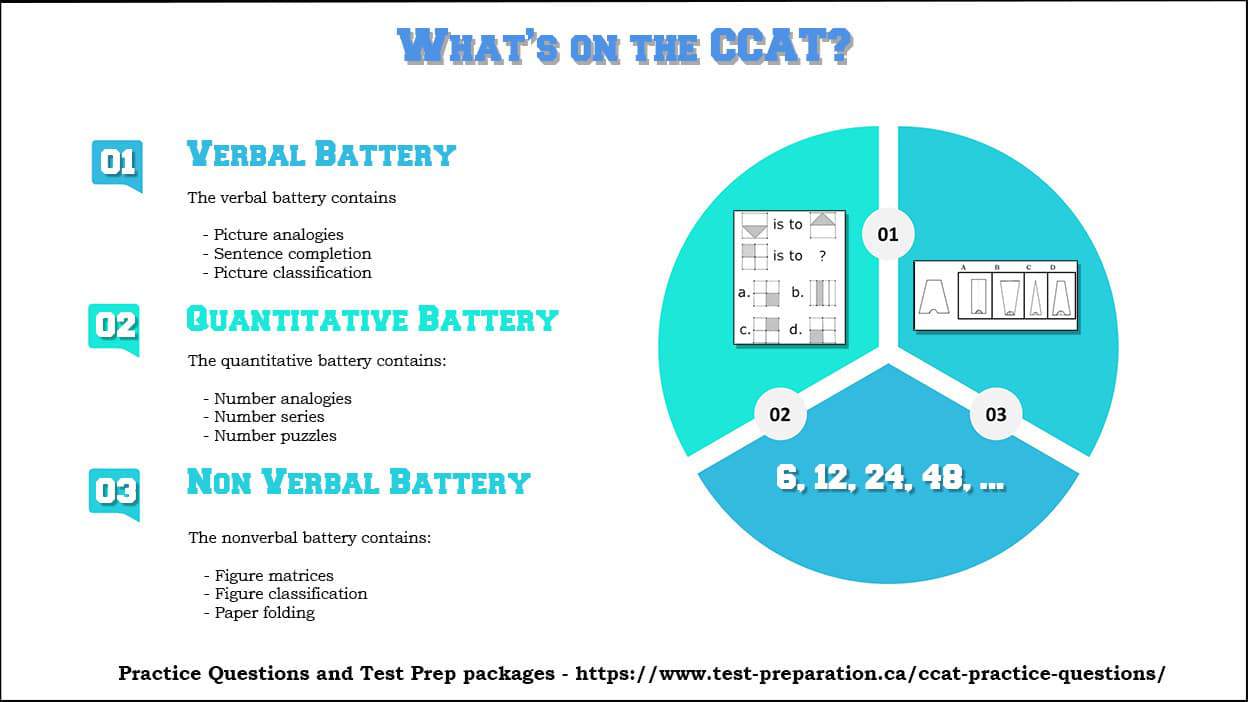
The Nelson Education CCAT 7 is designed to measure how a student processes information, rather than what they have memorized in class. Because it is a “norm-referenced” test, your child is being compared against thousands of other Canadian students. To reach the top percentiles, they must master three distinct sections, known as Batteries.
Understanding the nuances of these batteries is the first step in eliminating “test day surprises.”
The Verbal Battery: Reasoning Beyond Words
In the Canadian CCAT 7, the Verbal Battery identifies how well a student can use language to solve problems and find relationships. While it sounds like a reading test, it is actually a logic test disguised as language.
- Verbal Analogies: Determining the relationship between two words and applying that same logic to a third.
- Verbal Classification: Identifying the “odd one out” or the common link in a group of words.
- Sentence Completion: Predicting the logical conclusion of a thought based on context clues.
Parent Tip: For younger students (Levels 5/6 through 8), this battery uses Picture Analogies to ensure that reading level doesn’t interfere with their ability to show high-level reasoning.
The Quantitative Battery: The Logic of Numbers
This is often where bright students get “stuck” by trying to do complex mental math. The CCAT 7 isn’t testing multiplication speed; it’s testing numerical pattern recognition.
- Number Analogies: Finding the “rule” that changes one number into another (e.g., x + 2 or 2x).
- Number Puzzles: Solving for a missing piece of an equation, similar to a mathematical “balance scale.”
- Number Series: Identifying the sequence in a string of numbers to predict what comes next.
The Solution: We teach students to look for the “rule” first, rather than jumping straight into the arithmetic. This saves precious seconds and prevents fatigue.
The Nonverbal Battery: Visualizing Solutions
This is the most “pure” measure of cognitive ability because it removes language and numbers entirely. It is also the section where Format Friction is highest because students rarely encounter these types of puzzles in a standard Canadian classroom.
- Figure Matrices: Solving a 2 x 2 or 3 x 3 grid where shapes change, rotate, or flip according to a specific logic.
- Figure Classification: Grouping shapes based on abstract characteristics like “number of vertices” or “shaded area.”
- Paper Folding: Mentally “unfolding” a piece of paper that has been folded and punched with a hole to determine where the holes will appear.
Why it matters: The Nonverbal Battery is often weighted heavily by school boards because it provides a “fair” assessment for students who are English Language Learners (ELL) or who have high spatial intelligence but struggle with traditional verbal tasks.
Timed Micro-Challenge
Try this: You have 30 seconds to find the relationship.
Train is to Track as Whale is to…?
A) Water
B) Ocean
C) Pod
D) Plankton
The Reality Check: If your child chose “Ocean,” they are close—but in the CCAT, the relationship is Functional. A train travels on a track; a whale travels through water (The medium). Many students choose the “habitat” instead of the “medium.” This distinction is the difference between an 85th and a 97th percentile rank.
Anatomy of a Wrong Answer
Here is a folding quesiton:
When put together, what 3-dimensional shape will you get?
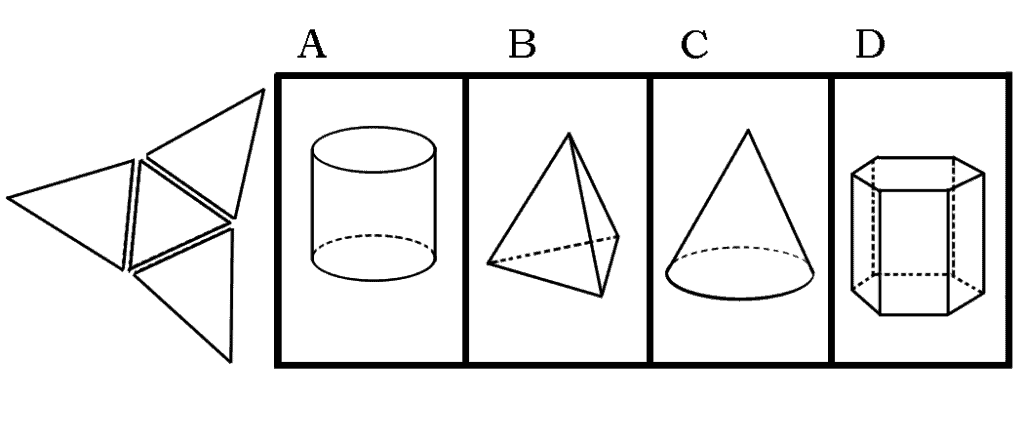
The Correct Answer: B (Triangular Pyramid)
The net consists of four equilateral triangles. When the outer triangles are folded upward toward a central point, they meet to form a triangular pyramid (also known as a tetrahedron).
Why You Might Get This Wrong (The Deconstruction)
The Trap of Option C (The Cone)
- The Error: Many students see the “pointy” nature of the triangles and immediately associate them with a cone.
- The Reality: A cone requires a circular base and a curved surface. Since the net provided is composed entirely of straight-edged flat triangles, it is physically impossible for it to form a curved surface or a circular base. If you chose C, you were likely prioritizing the feel of the shape over the geometry of the edges.
The Trap of Option A & D (The “Complex Shape” Bias)
- The Error: Choosing the Cylinder (A) or the Hexagonal Prism (D).
- The Reality: These options are “distractors” designed to catch students who are rushing.
- A (Cylinder): Requires two circles and a rectangle.
- D (Hexagonal Prism): Requires two hexagons and six rectangles.
- The Lesson: If the net has only 4 pieces, the resulting 3D shape cannot have more than 4 faces. Counting the “faces” on the net is the fastest way to eliminate complex distractors like D.
Understanding Stanine and Percentile Rank Scoring: What the Results Mean for Canadian Parents
When you receive your child’s CCAT 7 score report, you won’t just see a “pass” or “fail.” Instead, you’ll see a complex set of numbers that compare your child’s reasoning skills to thousands of other students across Canada. Understanding these metrics—APR, GPR, and Stanine—is essential for knowing if your child qualifies for gifted programming.
APR vs. GPR: The Peer Comparison
The CCAT provides two different Percentile Ranks. A percentile rank tells you what percentage of the “norm group” your child scored higher than.
APR (Age Percentile Rank): This compares your child to other Canadian students born in the same month and year. It is often the most accurate measure for children who are very young or very old for their grade level.
GPR (Grade Percentile Rank): This compares your child to other students in the same grade, regardless of age.
Key Takeaway: If your child has a GPR of 95, they scored higher than 95% of students in their grade across Canada. Most competitive gifted programs, such as those in the TDSB or Peel District, look for scores in the 98th or 99th percentile.
| Stanine Score | Percentile Range | Performance Level | Gifted Placement Context |
|---|---|---|---|
| 9 | 96 – 99 | Very High | Primary target for Canadian Gifted programs. |
| 8 | 89 – 95 | Above Average | Highly competitive; often triggers secondary screening. |
| 7 | 77 – 88 | Above Average | Strong student; generally exceeds grade expectations. |
| 4 – 6 | 23 – 76 | Average | Meeting standard Canadian curriculum requirements. |
| 1 – 3 | Below 23 | Below Average | May indicate a need for specialized classroom support. |
What Score Does My Child Need?
Requirements vary by school board, but for most Gifted and Talented programs in Canada, the bar is set very high:
- The “98th Percentile” Rule: Many boards require a score at or above the 98th percentile in at least two of the three batteries (Verbal, Quantitative, or Non-Verbal).
- The “Composite” Alternative: Some boards will accept a Composite Score (the average of all three batteries) at the 98th percentile even if one individual battery was slightly lower.
- The Individual Assessment Gateway: If your child scores in the 92nd–97th percentile, the school’s In-School Team may recommend them for a Stage 2 individual psychological assessment to see if their full potential was captured by the group-administered CCAT.
Verbal Battery
The verbal battery contains
- Picture analogies
- Sentence completion
- Picture classification
The verbal reasoning section tests reasoning and comprehension, and the use language for reasoning tasks.
Why Verbal Reasoning is important
- Conceptual Thinking: Verbal tasks, especially those involving classification, require your child to identify relationships between different words or concepts
- Language Proficiency: tests a child’s ability to understand, use and assimilate language. This is a critical skill and predictor of academic success, as well as daily communication and various types of interactions.
- Predictor of Academic Success: Proficiency in the verbal section is an excellent predictor of a child’s future achievements in social studies, language arts, , and related disciplines.
- Identifying Needs: The verbal section can guide teachers in instruction and intervention strategies to improve children’s language and reasoning ability.
Verbal Battery Practice
Sentence Completion (meaning in context)
Picture Analogies (IQ type)
Quantitative Battery
The Quantitative Battery assess a student’s ability to understand and analyze numerical concepts and relationships, use logical reasoning, apply mathematical concepts and solve mathematical problems, and reason using numbers. All of these cognitive skills are essential for problem-solving in many different contexts.
The quantitative battery contains:
- Number analogies
- Number series
- Number puzzles
Why the Quantitative Battery is Important
Evaluates Numerical Proficiency: The quantitate battery assesses the ability to understand, work with, and infer information based on numerical data. This is a critical skill in many mathematical applications in academic and daily life.
Predicting Academic Success: This section identifies students who might need additional tutoring support in mathematical areas and predicts future success.
Quantitative Battery Practice
Nonverbal Battery
The Nonverbal Battery presents the test taker with geometric shapes and figures, and asks them to identify relationships between pictures in a matrix, determine how a shape will look when folded or unfolded, and recognizing patterns in a set of shapes and choosing the next figure in the sequence.
The nonverbal battery contains:
- Figure matrices
- Figure classification
- Paper folding
Non Verbal Battery Practice
Common Mistakes on the CCAT
Misreading the Question This is a timed test. Students might read questions too quickly and miss key details or instructions.
Consider all the Answer Choices Making a fast decision and not considering all answer choices, leads to incorrect selections.
Elimination This is the most powerful multiple choice strategy! Use the process of elimination to narrow down choices – More on Multiple Choice Strategy
Time Management Don’t speed through but don’t hang around either! How to manage your time on a test
Review Never leave the test room without reviewing your test.
Learn the Test Format Students who are unfamiliar with the test format may struggle with the question types or the way they are presented.
Careless Errors See above – Always review!
Test Anxiety One of the main causes of poor grades! How to handle test anxiety
Practice Not practicing with sample questions or practice tests can leave students unprepared for the types of questions they will encounter.
CCAT Practice Test Questions and Study Packs
Published: Wednesday, November 4th, 2020

Created by Brian Stocker and the team in Victoria, BC.
Helping students succeed since 2005
Got a Question? Email me anytime - Brian@test-preparation.ca
You may also like
Police Problem Solving for SSPO and OACP Test
Police Problem Solving: Rule Application (Deductive Logic) This section of the SSPO (Sigma Survey for Police Officers) and OACP certificate process measures your ability to apply a general rule or a policy to a specific real-world situation or scenario. This …
Toolbox Math – Basic Math for Trades
Basic Math Practice Questions for Canadian Trades Trades Entrance Canada Trades Alberta Trades Skilled Trades Readiness
CELPIP Writing Prompts
The CELPIP writing evaluates your ability to communicate effectively in written English different tasks. Here are some sample CELPIP Writing prompts for writing an exmail. You are given a prompt and a scenario. Your email may be formal or informal, …
4 Comments
I really like to learn and thank you for making this site
oh i also like to learn milana
Very helpful thanks!
very comprehensive thanks!!