Spatial Relations Practice for Canadian Professional Exams
- Posted by Brian Stocker MA
- Date June 12, 2014
- Comments 6 comments
Stop Guessing. Start Seeing the Patterns.
Master the OACP, CFAT, and Trades Spatial Tests Without the “Big Prep” Headache.
Most students walk into the testing centre in cities like London, Calgary, or Victoria with one major fear: “I’m just not a ‘visual’ person.” That’s exactly what the generic corporate test-prep companies want you to believe. They want you to think spatial reasoning is an inherited trait you’re born with. It’s not. It’s a mechanical skill, just like swinging a hammer or checking a manifold. Whether you are facing the Sigma SSPO for the Ontario Police or the CFAT Spatial Ability section for the Forces, the “secret” isn’t a higher IQ—it’s knowing how to deconstruct 2D nets before your 90-second timer runs out.
We’ve spent years at the kitchen table triple-checking these patterns to ensure they match the specific Canadian provincial standards. Don’t let a “Spatial Relations” section stand between you and your career in the Trades or Public Safety. Use our OACP Practice Test PDF and hands-on drills below to prove to yourself that you’ve got this.
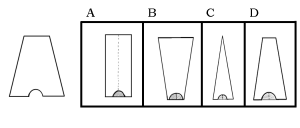
1. When the two longest sides touch what will the shape be?
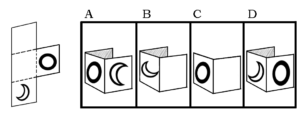
2. When folded, what pattern is possible?
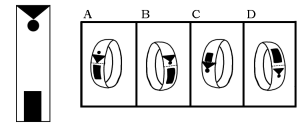
3. When folded into a loop, what will the strip of paper look like?
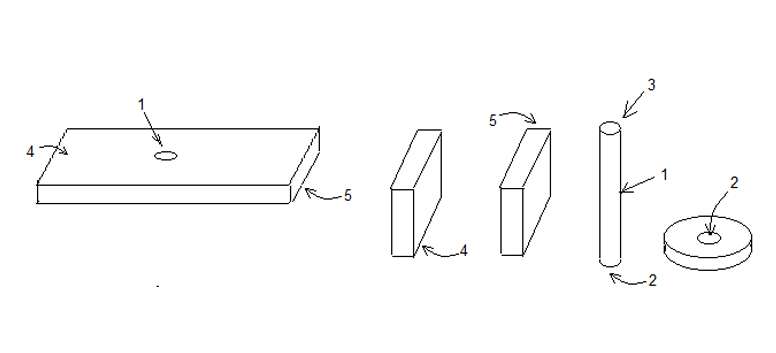
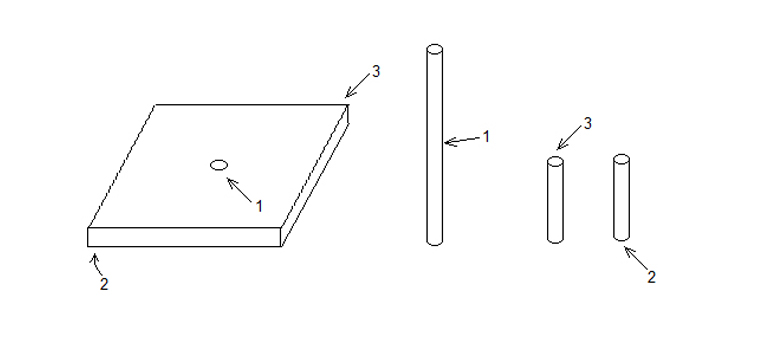
4. Which figure represents the assembly of the following pieces?
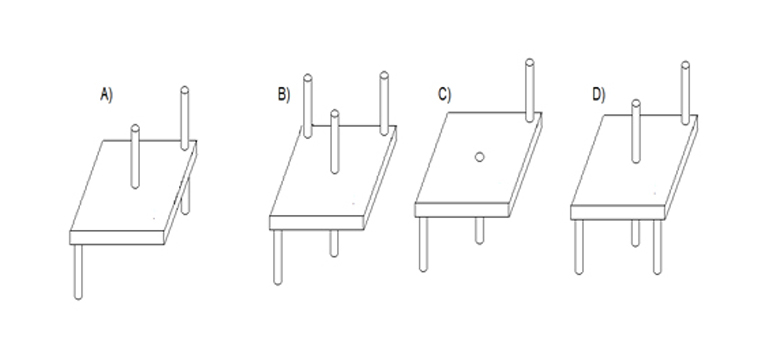
1. D
There is some confusion about this question. Viewed from the side it will still have a flat top (Choice D). If the longest side came to a point, then when the 2 sides touch, it would be a cone (Choice C).
2. A
3. C
4. D
If two pieces have the same number at the position shown, it means that point is a junction point. Here, the long rod is half above and half below the rectangular platform; the disc is at bottom of the rod, and the small rectangular shapes are in a vertical position at the extremities of the big rectangular platform, where the first is below the platform (the one on the right) and the other is above it (the one on the left).
Choose your Test
The Provincial Gatekeepers: Who Really Runs the Show?
When you’re sitting at your kitchen table trying to fold a 3D cube in your mind, it helps to know who’s actually grading the paper. In Canada, testing isn’t federal; it’s local.
1. Ontario: The OACP & TNT Justice Consultants
In Ontario, if you want to wear the badge, you go through the Ontario Association of Chiefs of Police (OACP). They don’t just use any test; they use the Sigma SSPO.
- The Anchor: This isn’t just a “police test.” It is a legally validated screening tool. If you fail the spatial section here, you aren’t just “bad at puzzles”—according to the Police Services Act, you haven’t met the “Specialized Mental Ability” standard required for the Constable Selection System.
2. British Columbia: The JIBC (Justice Institute of British Columbia)
Out here in the West, the JIBC is the gold standard. Their entrance exams for firefighters and law enforcement often lean on the Gledhill-Shaw or custom psychometric batteries.
The Anchor: The JIBC focuses heavily on “Spatial Awareness” because of the physical nature of the job—navigating a burning building or a high-speed pursuit in Vancouver traffic requires a different kind of mental rotation than a desk job.
3. Alberta: Alberta AIT (Apprenticeship and Industry Training)
If you’re aiming for the trades in Alberta, you answer to Apprenticeship and Industry Training (AIT). Their entrance exams are notorious for a reason.
- The Anchor: The spatial questions here are grounded in the Apprenticeship and Industry Training Act. They want to see if you can read a blueprint before they let you near a multi-million dollar piece of equipment on a job site in Fort McMurray.
Why This Matters for Your Study Plan
The “Big Prep” companies sell you a “Global Spatial Guide.” We don’t do that. We know that an Alberta Trades student needs to focus on Pattern Folding (essential for sheet metal and carpentry), while an Ontario OACP student needs to master Mental Rotation (essential for situational awareness).
The “Stocker” Rule of Thumb:
Don’t just study “shapes.” Study the exam that fits your provincial regulator.
Ontario: The Sigma-Style Logic (OACP)
For the Sigma SSPO, you need to move beyond simple folding; you’re looking for “Mental Manipulation.” This means being able to rotate a complex 3D object in your mind and identify it from a completely different bird’s-eye view while a 30-minute timer is breathing down your neck.
Alberta Trades: The AIT STAR Standards
The Alberta Apprenticeship and Industry Training (AIT) ” Alberta Trades exams are built for people who work with their hands, so the spatial questions are “Industrial.” You’ll face “Pattern Development” (folding flat sheets into 3D shapes) and “Hidden Figures,” which simulate the high-pressure task of reading a blueprint on a windy job site in Fort McMurray.
BC Fire/Police: The JIBC-Style Visual Acuity
The Justice Institute of British Columbia (JIBC) looks for “Situational Spatial Awareness,” which is less about abstract cubes and more about “Visual Search” and “Spatial Orientation.” They want to see if you can quickly spot the odd-one-out in a complex field of shapes—a skill that translates directly to identifying a hazard in a crowded room or navigating a West Coast emergency scene.
Spatial Relations Practice
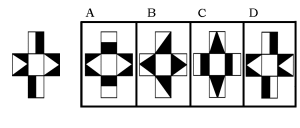
1. Which of the choices is the same pattern at a different angle?

2. Which figure represents the assembly of the following pieces?
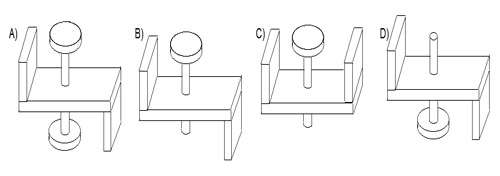
3. Which cube is obtained by folding the shape below?
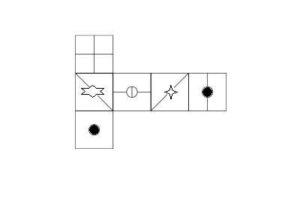
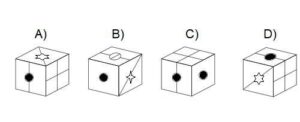
Answer Key
1. D
2. D
The upper and lower shapes cannot be adjacent as they constitute opposite faces in the cube. Here, for the middle-left and the third shape in the central (long) row and for the second and the fourth shape of the central row.
3. D
The upper and lower shapes cannot be adjacent as they constitute opposite faces in the cube. Here, for the middle-left and the third shape in the central (long) row and for the second and the fourth shape of the central row.
Speed Tip: Face Counting
On the your test, every second counts. Don’t try to animate the folding in your head first. Count the shapes.
- Count the pieces in the net: 4 triangles.
- Count the faces on the options: * A: 3 faces (2 circles, 1 curved).
- B: 4 faces (all triangles). MATCH.
- C: 2 faces (1 circle, 1 curved).
- D: 8 faces (2 hexagons, 6 rectangles).
By simply counting, you arrive at B in under 3 seconds without even “folding” the object.
Anatomy of a Wrong Answer
Here is a folding quesiton:
When put together, what 3-dimensional shape will you get?
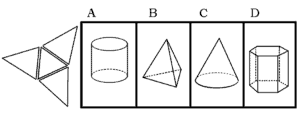
The Correct Answer: B (Triangular Pyramid)
The net consists of four equilateral triangles. When the outer triangles are folded upward toward a central point, they meet to form a triangular pyramid (also known as a tetrahedron).
Why You Might Get This Wrong (The Deconstruction)
The Trap of Option C (The Cone)
- The Error: Many students see the “pointy” nature of the triangles and immediately associate them with a cone.
- The Reality: A cone requires a circular base and a curved surface. Since the net provided is composed entirely of straight-edged flat triangles, it is physically impossible for it to form a curved surface or a circular base. If you chose C, you were likely prioritizing the feel of the shape over the geometry of the edges.
The Trap of Option A & D (The “Complex Shape” Bias)
- The Error: Choosing the Cylinder (A) or the Hexagonal Prism (D).
- The Reality: These options are “distractors” designed to catch students who are rushing.
- A (Cylinder): Requires two circles and a rectangle.
- D (Hexagonal Prism): Requires two hexagons and six rectangles.
- The Lesson: If the net has only 4 pieces, the resulting 3D shape cannot have more than 4 faces. Counting the “faces” on the net is the fastest way to eliminate complex distractors like D.
Common Errors on Spatial Relations Questions
- Not understanding the question. Read the question carefully or you can easily misinterpret the information. With any type of question proceed at a measured speed. Don’t go fast, but don’t hang around either.
- Misinterpretation of the diagram. Examine the diagram or map carefully.
- Pay attention to details in the diagram. Everything is important.
Video Tutorial
Updated: Sunday, March 29th, 2026
Published: Thursday, June 12th, 2014
You may also like
Master Canadian Listening Comprehension for the CELPIP and CAEL
The “Accent Trap” & Real-World Canadian Audio In Victoria, Vancouver, or Toronto, people don’t speak like robots. We run our words together. We have background noise. If you only practice with “perfect” studio audio, the Prometric Testing Centres will feel …
Master Canadian Scientific Reasoning (Without the Academic Headache)
Science Reasoning” Stall Your Canadian Career Most people hear the word “Science” and think of lab coats and complex formulas they haven’t seen since Grade 10. But on exams like the Alberta Trades or Canada Trades Entrance or the CAEC, …


6 Comments
Thanks! got it!
1) should be C? “Longest sides” only touch in the triangle?
No. When the longest sides touch it will form a cone, but with a flat top as in Choice D. Choice C has a pointed top.
I see what you mean about A being correct but it very misleading.
In order for A to be correct you would have to fold the net and then invert it to get the moon on the right side of the circle. However because your final folded shape in the question’s answer options has no top (like it would if inverted) it is very confusing and makes this a bit of a trick question.
Question 1 is messed up. I understand that rotating the shape, it is possible then for the two long sides to be touching, and still have a flat top.. but the question doesn’t say anything about rotating the shape, or that is even a 3d shape.. so when the two sides are touching it can ONLY be option C. In option D the two long sides aren’t even touching, the shape is the exact same as the original shape.. please explain this to me.
Looking at the shape given, when the sides touch – there is going to be a hole in the top, because the example has a flat top. If the top of the example came to a point, the answer would be choice C, a cone.